1996issue C021-8
Treat one options idea as a regime-aware portfolio decision
A historical options workflow used Implied volatility analysis to judge whether an option looked cheap or expensive versus its stock, then treated expiration week and an Option spread as structure and personality choices. Editorial reading: decide that volatility regime first, match a Put-call ratio or Option spread to it, and keep only a trade a trader can hold.
- Implied volatility is the model-implied volatility that makes a pricing model reproduce the observed option price after underlying price, strike, time to expiration, and the short-term interest rate are fixed.
- Comparing implied volatility with historical volatility of the same stock is presented as a way to judge whether an option looks cheap or expensive relative to the stock.
- Index-option expiration can produce a distinct late-week regime, and a long OEX call versus short S&P futures hedge is presented as a way to sit inside that regime rather than as a directional stock bet.
- An Option spread is framed as a personality-fit procedure: use only the entry, exit, and abstention rules a trader can actually follow, including the fact that one leg is always losing.
Cheap or expensive versus the stock
Implied volatility analysis in this historical workflow is a comparison, not a next-tick price call. Implied volatility is the model-implied volatility that makes a pricing model reproduce the observed option price after the known inputs of underlying price, strike, time to expiration, and the short-term interest rate are fixed.
Comparing implied volatility with historical volatility of the same stock is presented as a way to judge whether an option looks cheap or expensive relative to the stock.
A historical snapshot compared stocks whose implied volatilities sat above their short-term and longer historical volatilities, and treated those options as expensive versus the stocks.
Implied versus historical volatility at end of November 1995
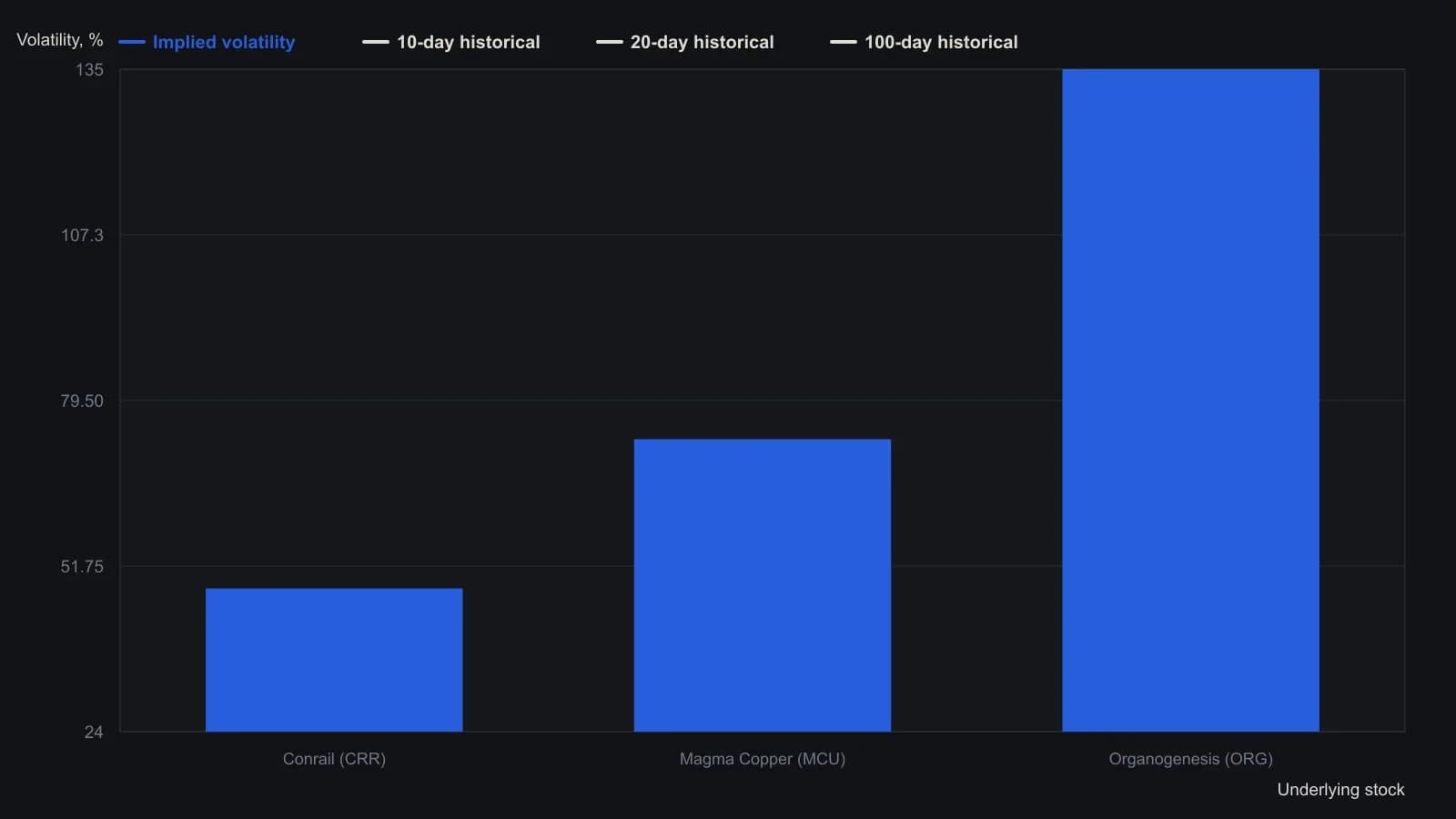
Implied volatility is dated 29 November for Conrail and 28 November for Magma Copper and Organogenesis, as printed in the source table.
Lottery tickets and stock-like options
Buying short-dated, far out-of-the-money options is described as a common beginner error because the chance the stock travels far enough before expiration is treated as extremely small.
In-the-money options that carry little time-value premium are preferred when the goal is an option that behaves more like the stock rather than a low-priced lottery ticket.
Expiration week as a market regime
Index-option expiration can produce a distinct late-week market regime, including faster OEX moves versus S&P futures near the Friday close and large Thursday swings that leave Friday quiet after arbitrage flow is spent.
An expiration-day hedge of long OEX calls against short S&P futures is presented as a way to sit inside that index-arbitrage regime rather than as a directional stock bet.
Keep only Option spread rules a trader can follow
Option spreads are framed as a personality-fit procedure. Some traders reject them because one leg is always losing, so the teaching point is to use only the entry, exit, and abstention rules a trader can actually follow.
All readings on this track · 31 readings
- 1989Constructing an open-interest-scaled put-call ratio
- 1990Open-interest put/call ratio as an intermediate sentiment overlay
- 1990Activity-weighted call-put ratio for options regime context
- 1990Stacking moving averages, put-call regimes, and double bottoms
- 1991Constructing put-call open-interest regime filters
- 1991Constructing an activity-weighted call-put sentiment reading
- 1991Fund-index regime, put-call confirmation, then the tracking fund
- 1992A seven-vote sentiment score for fund-sleeve regimes
- 1992Construct an activity-weighted call-put ratio before reading crowd conviction
- 1992Pair action with opinion in a composite sentiment index
- 1992Crowd extremes as a three-gate contrary procedure
- 1993Constructing a put-volume average regime filter
- 1993Neural-net inputs and rule trees for mechanical systems
- 1994Failed Treasury put-call signal and a dollar regime shift
- 1994Separate survey, put-call, and premium ledgers before a regime call
- 1994Repeated option-premium prints and a four-zone regime map
- 1995Consecutive-day regimes in the put-call premium ratio
- 1995Construct a put-call ratio for regime-aware contrarian signals
- 1996Treat one options idea as a regime-aware portfolio decision
- 1997Options open interest, put-call sentiment, and contrarian context
- 2000A two-layer put-call construction for intermediate market conditions
- 2002Sentiment confirmation for trend-following options
- 2003Construct a regime overlay from implied volatility and the put-call ratio
- 2004Dollar-weighted Put-call ratio construction
- 2006Debit put spreads inside put-call regimes
- 2011Put-call ratio cycle phases for index context
- 2011Constructing a put-call ratio cycle indicator
- 2011Building a put-call ratio indicator stack
- 2011Put-call ratio regime context with oscillator and band confirmation
- 2018Reading seasonal regimes with put-call divergence and bands
- 2020Treat close-only volume as a hypothesis, then choose regime or phase