1992issue C011-4
A seven-vote sentiment score for fund-sleeve regimes
A seven-component stack scores each buy-state reading as two points and each sell-state reading as zero. Totals of 10 and 4 are treated as buy and sell regimes, after which fund sleeves can be ranked by how they responded.
- Each of the seven components casts only a buy state worth two points or a sell state worth zero points.
- A total of 10 points is treated as a buy regime and a reading of 4 is treated as a sell regime.
- Adviser share, bullish advertisements, Friday put-call volume, and three futures-consensus series use fixed bands, while large-cap price versus its 20-day average supplies the trend-regime vote.
- After a buy-regime reading, a large-cap fund, a smaller-stock fund, and several sector funds can be ranked by how they responded to that signal.
A seven-vote buy or sell score
The historical workflow combines seven sentiment and tape readings into one score. Each component casts only a buy-state or a sell-state. A buy-state reading is scored as 2 points and a sell-state reading is scored as 0 points.
A total of 10 points is treated as a buy regime and a reading of 4 is treated as a sell regime.
S&P 500 returns after seven-vote buy signals
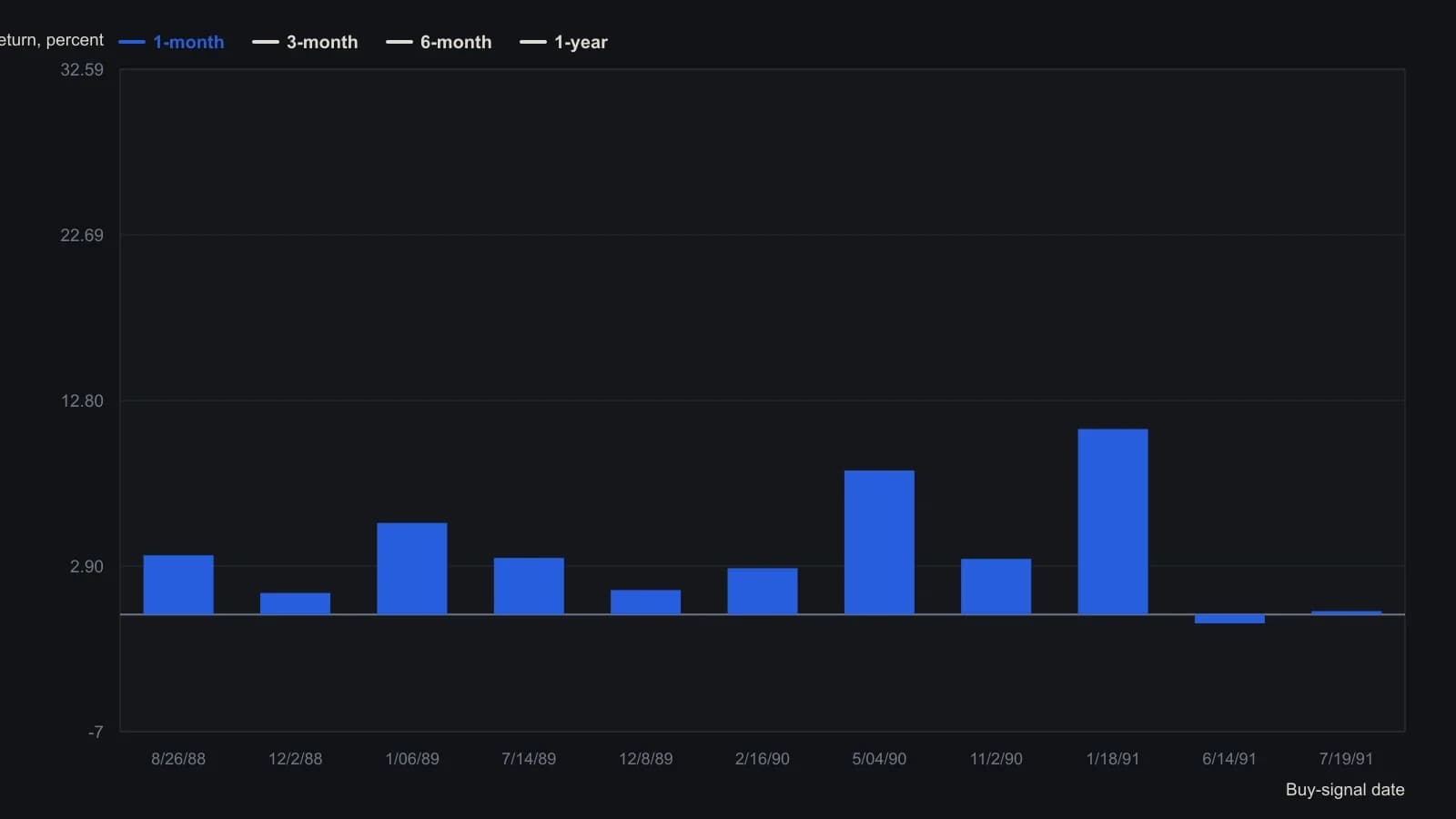
The July 14, 1989 three-month return includes the October 1989 correction. Six-month and one-year cells after the 1991 signals were still open at publication and are omitted. From August 1988 through the September 22, 1991 cutoff the oscillator had issued eleven buy signals and no sell signals.
How each vote is cast
The 13-week moving average of the bullish-adviser share, defined as bulls divided by bulls plus bears, is a buy-state vote at or below 40 percent and a sell-state vote at or above 70 percent.
The four-week moving average of the bullish-advertisement count is a buy-state vote at or below 7 and a sell-state vote at or above 15. That count is a consistently scored tally of return-touting print ads, omitting short, put, neutral, and negative ads.
Friday put volume divided by call volume is a buy-state vote at or above 0.50 and a sell-state vote at or below 0.40.
Bullish-consensus readings for stock-index, Eurodollar, and Treasury-bond futures each count as a buy-state vote at or below 40 percent and a sell-state vote at or above 70 percent.
Whether the S&P 500 is above or below its 20-day moving average supplies the trend-regime vote in the seven-component score.
Money-flow context and sleeve ranking
A weekly money-flow line is the S&P 500 close minus the Value Line Geometric close and is used to see whether capital is concentrating in large-cap names versus the broader market.
After a buy-regime reading, a large-cap fund, a smaller-stock fund, and several sector funds can be ranked by how they responded to that signal.
Editorial reading: those sleeves are not interchangeable forecasts. Ranking them by response after the regime reading is a relative overlay on the buy-regime band.
Where the lookbacks and the put-call vote sit
The put-call vote is Friday put volume divided by call volume, with a contrarian buy-state at or above 0.50 and a sell-state at or below 0.40. The moving-average lookbacks used as state filters are the 13-week average of the bullish-adviser share, the four-week average of bullish advertisements, and the 20-day average of the large-cap index.
The seven-component score maps those adviser, advertisement, futures-consensus, and put-call states plus large-cap price location onto a buy regime at 10 points and a sell regime at 4 points.
All readings on this track · 31 readings
- 1989Constructing an open-interest-scaled put-call ratio
- 1990Open-interest put/call ratio as an intermediate sentiment overlay
- 1990Activity-weighted call-put ratio for options regime context
- 1990Stacking moving averages, put-call regimes, and double bottoms
- 1991Constructing put-call open-interest regime filters
- 1991Constructing an activity-weighted call-put sentiment reading
- 1991Fund-index regime, put-call confirmation, then the tracking fund
- 1992A seven-vote sentiment score for fund-sleeve regimes
- 1992Construct an activity-weighted call-put ratio before reading crowd conviction
- 1992Pair action with opinion in a composite sentiment index
- 1992Crowd extremes as a three-gate contrary procedure
- 1993Constructing a put-volume average regime filter
- 1993Neural-net inputs and rule trees for mechanical systems
- 1994Failed Treasury put-call signal and a dollar regime shift
- 1994Separate survey, put-call, and premium ledgers before a regime call
- 1994Repeated option-premium prints and a four-zone regime map
- 1995Consecutive-day regimes in the put-call premium ratio
- 1995Construct a put-call ratio for regime-aware contrarian signals
- 1996Treat one options idea as a regime-aware portfolio decision
- 1997Options open interest, put-call sentiment, and contrarian context
- 2000A two-layer put-call construction for intermediate market conditions
- 2002Sentiment confirmation for trend-following options
- 2003Construct a regime overlay from implied volatility and the put-call ratio
- 2004Dollar-weighted Put-call ratio construction
- 2006Debit put spreads inside put-call regimes
- 2011Put-call ratio cycle phases for index context
- 2011Constructing a put-call ratio cycle indicator
- 2011Building a put-call ratio indicator stack
- 2011Put-call ratio regime context with oscillator and band confirmation
- 2018Reading seasonal regimes with put-call divergence and bands
- 2020Treat close-only volume as a hypothesis, then choose regime or phase