2003issue C121
Construct a regime overlay from implied volatility and the put-call ratio
Before judging a single options structure, lock which volatility-index construction you are reading, then place that implied-volatility level beside session put-call volume so level and positioning form one weeks-to-months market-regime layer.
- Lock whether you are reading the rebuilt volatility-index, which aggregates at-the-money and out-of-the-money S&P 500 options, or the earlier at-the-money S&P 100 series.
- Across calendar-year highs and lows from 1990 through August 2003, the earlier volatility index generally printed higher levels than the rebuilt series; after the formula change, matching highs and lows often differed by only a point or two.
- Construct the put-call ratio as that session's put volume divided by call volume, and treat an exchange-wide equity total as broad sentiment rather than a single-name reading.
- Editorial view: combine volatility-index level with put-call positioning into one weeks-to-months market-regime overlay before you judge a single options structure.
Build the backdrop first
Implied volatility is the options-market estimate of future movement embedded in listed prices, here aggregated into an index that can be read as a market-regime input. A put-call ratio is that session's put volume divided by call volume on an optionable stock, index, or futures contract, or across an exchange's listed equities.
Editorial reading: construct a weeks-to-months market-regime overlay before you judge any single options structure. First lock which volatility-index definition you are reading. Then place that print beside put-call volume balance so volatility level and positioning become one market-context layer rather than two disconnected gadgets.
Lock the volatility-index definition
A volatility-index is a published implied-volatility series built from a defined option set. The earlier construction averaged at-the-money options on a narrower equity index. The rebuilt series uses at-the-money and out-of-the-money options on a broader index.
The rebuilt volatility index aggregates implied volatility from at-the-money and out-of-the-money options on the S&P 500. The earlier index used only at-the-money options on the S&P 100.
Across calendar-year highs and lows from 1990 through August 2003, the earlier volatility index generally printed higher levels than the rebuilt series. After the formula change, matching highs and lows on the two volatility series often differed by only a point or two.
Editorial view: that small gap after the formula change does not turn one series into the other. It is a reminder to keep the option set attached to the print before you treat the level as a market-regime input.
Original VIX versus new VIX yearly highs and lows
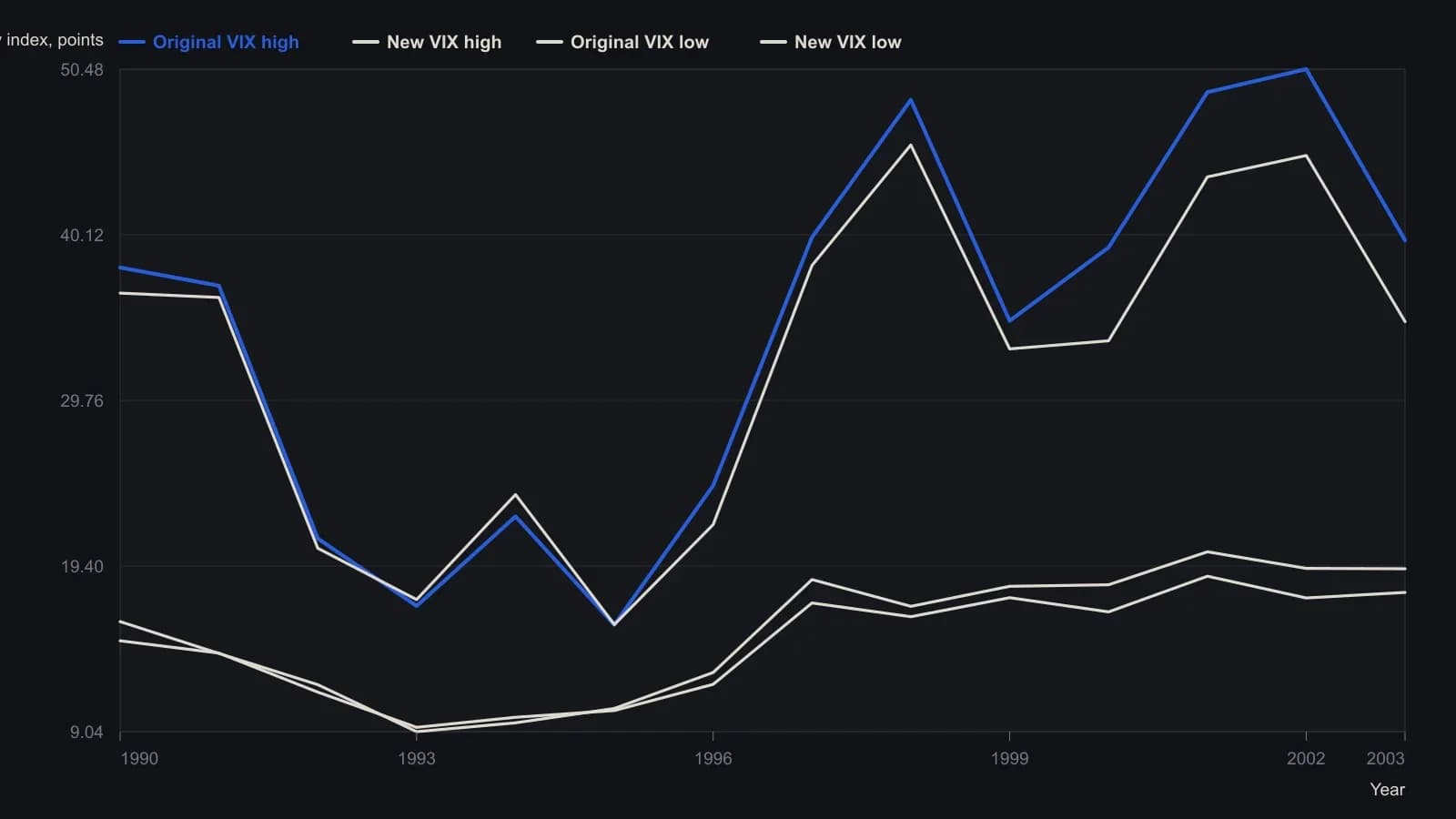
The 2003 row ends in August. The original series used only at-the-money S&P 100 options; the new series mixes at-the-money and out-of-the-money S&P 500 options.
Place put-call volume beside that reading
A put-call ratio is constructed as that session's put volume divided by call volume for an optionable stock, index, or futures contract. Combined-equity put-call ratios rarely exceed a one-to-one reading. A print above that line is classified here as an unusually heavy put mix relative to calls.
An exchange-wide total equity put-call ratio sums puts and calls across listed stocks and is built as a broad sentiment input rather than a single-name reading.
Editorial reading: keep the volatility-index level and this positioning measure in the same overlay. A single-name put-call ratio is not a substitute for the exchange-wide equity total, and neither reading replaces the index definition you locked first.
Keep structure labels off the overlay
A position is naked only when a short option remains open without a hedge that caps its loss. Buying back the short leg of a spread leaves long options and is not a naked short. A naked short is an open short option left without an offsetting long option, stock, or futures hedge that caps remaining loss.
If a long put remains below a short put, remaining loss is bounded by the strike gap rather than by a move all the way to zero. That structure is a defined-risk spread: a long option offsets a short option so remaining loss is limited to the strike gap after the short leg is still open.
Editorial view: remaining-loss labels belong to the structure, not to the market-regime layer. Finish the volatility-index and put-call overlay first, then read whether the open short is still naked or already bounded by a strike gap.
Form one market-regime layer
Market regime, as used here, is a weeks-to-months backdrop assembled from volatility-index level and put-call positioning. It is used to place one trade inside a diversified or regime-aware context.
Editorial workflow: lock the volatility-index construction, read the level against that definition, add the matching put-call mix, and only then inspect the options structure. Do not let a rebuilt print, an earlier print, a single-name ratio, or an exchange-wide total stand in for the full overlay.
All readings on this track · 31 readings
- 1989Constructing an open-interest-scaled put-call ratio
- 1990Open-interest put/call ratio as an intermediate sentiment overlay
- 1990Activity-weighted call-put ratio for options regime context
- 1990Stacking moving averages, put-call regimes, and double bottoms
- 1991Constructing put-call open-interest regime filters
- 1991Constructing an activity-weighted call-put sentiment reading
- 1991Fund-index regime, put-call confirmation, then the tracking fund
- 1992A seven-vote sentiment score for fund-sleeve regimes
- 1992Construct an activity-weighted call-put ratio before reading crowd conviction
- 1992Pair action with opinion in a composite sentiment index
- 1992Crowd extremes as a three-gate contrary procedure
- 1993Constructing a put-volume average regime filter
- 1993Neural-net inputs and rule trees for mechanical systems
- 1994Failed Treasury put-call signal and a dollar regime shift
- 1994Separate survey, put-call, and premium ledgers before a regime call
- 1994Repeated option-premium prints and a four-zone regime map
- 1995Consecutive-day regimes in the put-call premium ratio
- 1995Construct a put-call ratio for regime-aware contrarian signals
- 1996Treat one options idea as a regime-aware portfolio decision
- 1997Options open interest, put-call sentiment, and contrarian context
- 2000A two-layer put-call construction for intermediate market conditions
- 2002Sentiment confirmation for trend-following options
- 2003Construct a regime overlay from implied volatility and the put-call ratio
- 2004Dollar-weighted Put-call ratio construction
- 2006Debit put spreads inside put-call regimes
- 2011Put-call ratio cycle phases for index context
- 2011Constructing a put-call ratio cycle indicator
- 2011Building a put-call ratio indicator stack
- 2011Put-call ratio regime context with oscillator and band confirmation
- 2018Reading seasonal regimes with put-call divergence and bands
- 2020Treat close-only volume as a hypothesis, then choose regime or phase