1990issue C061-11
Constructing vertical debit spreads around implied volatility
A same-expiry vertical pairs one long option with one short option of the same type and expiration, differing only by strike. Editorially, TradersWeek treats the build as three knobs: strike order for direction, width and contract count for the net-delta budget, and the at-the-money strike for the implied-volatility stance.
- A vertical is a same-type, same-expiry long and short pair that differs only by strike. Buying the lower strike and selling the higher strike is bullish; the reverse is bearish.
- Net delta is the sum of the two leg deltas. Strike spacing and the number of spreads set total directional exposure, as in thirty spreads at +0.13 for +3.90 total delta.
- A debit vertical’s maximum loss is the premium paid and its maximum gain is the strike gap minus that debit. A credit vertical reverses those bounds.
- Rank candidates by expected value versus market price. Buy the at-the-money strike if implied volatility is expected to rise, and sell it if implied volatility is expected to fall.
What the two-leg pair specifies
A vertical option spread is one long option paired with one short option of the same type and the same expiration, differing only by strike. As an option spread, the two-leg construction replaces an open-ended single-contract stance so direction, bounded payoff, and net delta can be specified before entry.
A bull vertical buys the lower strike and sells the higher strike. A bear vertical buys the higher strike and sells the lower strike. In the 0.56/0.58 worked examples, both the bull-call pair and the bull-put pair have a net delta of +0.13. The matching bear constructions have a net delta of -0.13.
Debit and credit payoff bounds
A vertical debit spread is a same-type, same-expiry long and short option pair entered at a net premium paid. The debit is the position’s maximum loss, and the strike gap minus that debit is the maximum gain. In the 0.56/0.58 example, the bull call pays 0.0080 and can make at most 0.0120.
A credit vertical uses the same two-strike construction entered at a net premium received. Maximum gain equals the credit, and maximum loss equals the strike gap minus that credit. In the 0.56/0.58 example, the bull put receives 0.0114 and can lose at most 0.0086.
Expiration P/L of the 0.56/0.58 gasoline bull call debit spread
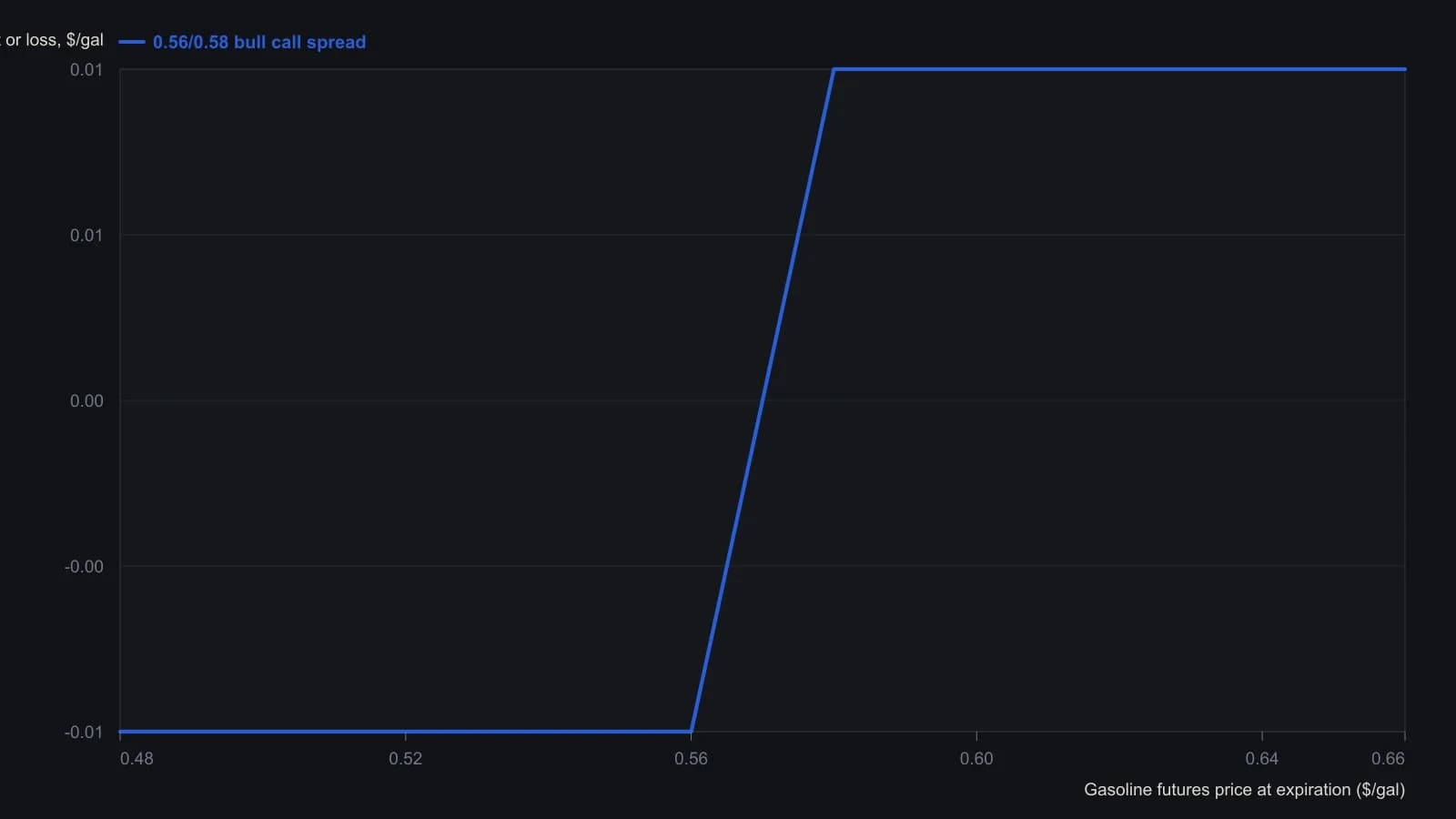
Uses the printed 0.56-call premium of $0.0254 and 0.58-call premium of $0.0174. Between the strikes the segment is the theoretical linear expiry payoff.
Strike spacing and the net-delta budget
Net delta is the sum of the long-leg and short-leg deltas. Its sign is the directional bias, and its size scales with strike distance and the number of spreads.
Strike spacing is the gap between the two strikes. With other construction choices held fixed, a wider strike gap raises the vertical’s net delta and therefore its sensitivity to the underlying. A wider gap also changes the maximum profit and loss bounds.
Total directional exposure equals net delta times the number of spreads. Thirty spreads at +0.13 produce +3.90 total delta. Two hundred produce +26.00.
Implied volatility and the at-the-money strike
Implied volatility is the volatility already priced into option premiums. It is used to revalue each candidate vertical under a higher or lower volatility assumption and to decide which strike should be the purchased or sold at-the-money leg.
Option premiums rise when implied volatility is expected to increase and fall when it is expected to decrease. A vertical should be ranked by expected value versus market price rather than by the lowest initial debit or largest credit.
If implied volatility is expected to rise, the construction that buys the at-the-money strike is favored. If implied volatility is expected to fall, the construction that sells the at-the-money strike is favored. The at-the-money option is more sensitive to volatility changes than in-the-money or out-of-the-money options.
With volatility assumed at 30 percent, a rise to 35 percent makes the 0.56/0.60 call vertical the preferred call construction in the comparison, with expected value 0.0147 versus a market price of 0.0139. A fall to 25 percent makes the 0.52/0.56 call vertical the preferred call construction, with expected value 0.0248 versus a market price of 0.0238.
All readings on this track · 29 readings
- 1986Rank listed calls against a vertical debit inside one forecast band
- 1990Constructing vertical debit spreads around implied volatility
- 1994Even-money call spread after a stop-limit gap
- 1995Payoff anchors for bull and bear vertical spreads
- 1995Matching vertical spreads to forecast confidence
- 1997A defined-risk short vertical as a single testable procedure
- 1998Vertical debit spreads when implied volatility is elevated
- 2001Constructing vertical debit spreads with a preset risk-reward filter
- 2002Regime-first construction of vertical debit spreads
- 2003Sizing a vertical by the constraint you can enforce
- 2006Event premiums, straddle bias, and volatility-hedged spreads
- 2006From a winning long call to a bull vertical debit spread
- 2007Vertical debit spread construction from codes and premiums
- 2010Vertical construction as a bounded-risk procedure
- 2010Zero-cash repair of an underwater long
- 2011Cheap long calls and in-the-money debit vertical marks
- 2011Vertical debit value path, volatility, liquidity, and box exits
- 2013Constructing defined-risk vertical call spreads
- 2014Protective put versus seasonal debit spread
- 2014One bearish energy thesis, three strike geometries
- 2014Coffee versus equity as a two-sided debit-spread drill
- 2015Natural-gas thesis: ETF drag versus a call debit spread
- 2017Funding a call spread with an offsetting put spread
- 2018An expected-value test for vertical option spreads
- 2019Option ladder construction for financed vertical debits
- 2020One-week call versus bull-put premium tradeoffs
- 2020Constructing in-the-money versus out-of-the-money bull call debit spreads
- 2020Combining vertical debit spreads on a volatility product
- 2025Time decay as a decision variable in an NVDA bull call spread