2003issue C121-4
Confirmation tests for bearish top patterns
Editorial reading: treat a sketched bearish silhouette as unfinished until a pattern-specific print appears. The same chart can then be checked in three independent pattern languages before a reversal hypothesis is allowed to stand.
- Editorial: treat a sketched bearish silhouette as unfinished until a pattern-specific confirmation print appears.
- A widening top is not finished by its outline. Count a partial rise only after each trendline has at least two touches, and leave the exit side of a broadening top open until a breakout.
- A twin-peak sketch becomes a completed double top only after a close under the lowest low between the peaks.
- A head-and-shoulders top is completed by a close under the neckline. Shoulder symmetry is the main identification check, and an atypical volume sequence does not invalidate the price structure.
A confirmation-first reading of topping tape
Editorial note from TradersWeek: treat a sketched bearish silhouette as unfinished until a pattern-specific print appears. Read the same chart in three independent pattern languages, a failed crossing of a widening range, a close under a twin-peak trough, or a close under a neckline, before a reversal hypothesis is allowed to stand.
Editorial note: the sections that follow restate the historical identification and completion rules for those three languages. They do not add a performance claim.
Failed crossings in a widening range
A right-angled ascending broadening pattern is drawn with a horizontal lower boundary and an upper boundary of rising highs, so the range widens only on the high side.
A partial rise is counted only after each trendline has at least two touches and price then advances from the lower line without reaching the upper line.
A broadening top is a pair of diverging trendlines enclosing higher highs and lower lows, entered from below, with the exit direction left open until a breakout.
A partial decline in a broadening top is a retreat from the upper trendline that fails to reach the lower trendline before reversing.
A smaller head-and-shoulders top can form inside a larger broadening top and is used as a second cue that the advance is ending.
Editorial note: these failed crossings of the opposite boundary are the widening-range prints. The outline alone is not the test, and a broadening top still leaves the exit direction open until a breakout.
The close that completes a double top
A twin-peak formation is treated as a completed double top only after a close below the lowest low between the peaks, which is also the breakout level.
Double tops are classified by four pairings of narrow pointed peaks and broader rounded peaks rather than by a single peak shape.
The neckline close that completes a head-and-shoulders top
A head-and-shoulders top is completed when price closes below the neckline that joins the two lows between a left shoulder, a higher head, and a right shoulder.
Shoulder symmetry in width, height, and distance from the head is treated as the primary identification check. An atypical volume sequence does not invalidate the price structure.
A complex head-and-shoulders top adds extra shoulders on both sides of one head, often with inner and outer shoulders that mirror one another in width and spacing.
Check the same chart in three languages
Editorial note from TradersWeek: check the same topping tape in each language on its own terms. Use the widening-range language for a partial rise, counted only after each trendline has at least two touches, or for a partial decline that leaves the far boundary untouched. Use the twin-peak language for a close under the lowest low between the highs. Use the three-swing language for a close under the neckline. Independence means the prints are not interchangeable labels for one silhouette.
AMD broadening top and nested head-and-shoulders, 2000-01
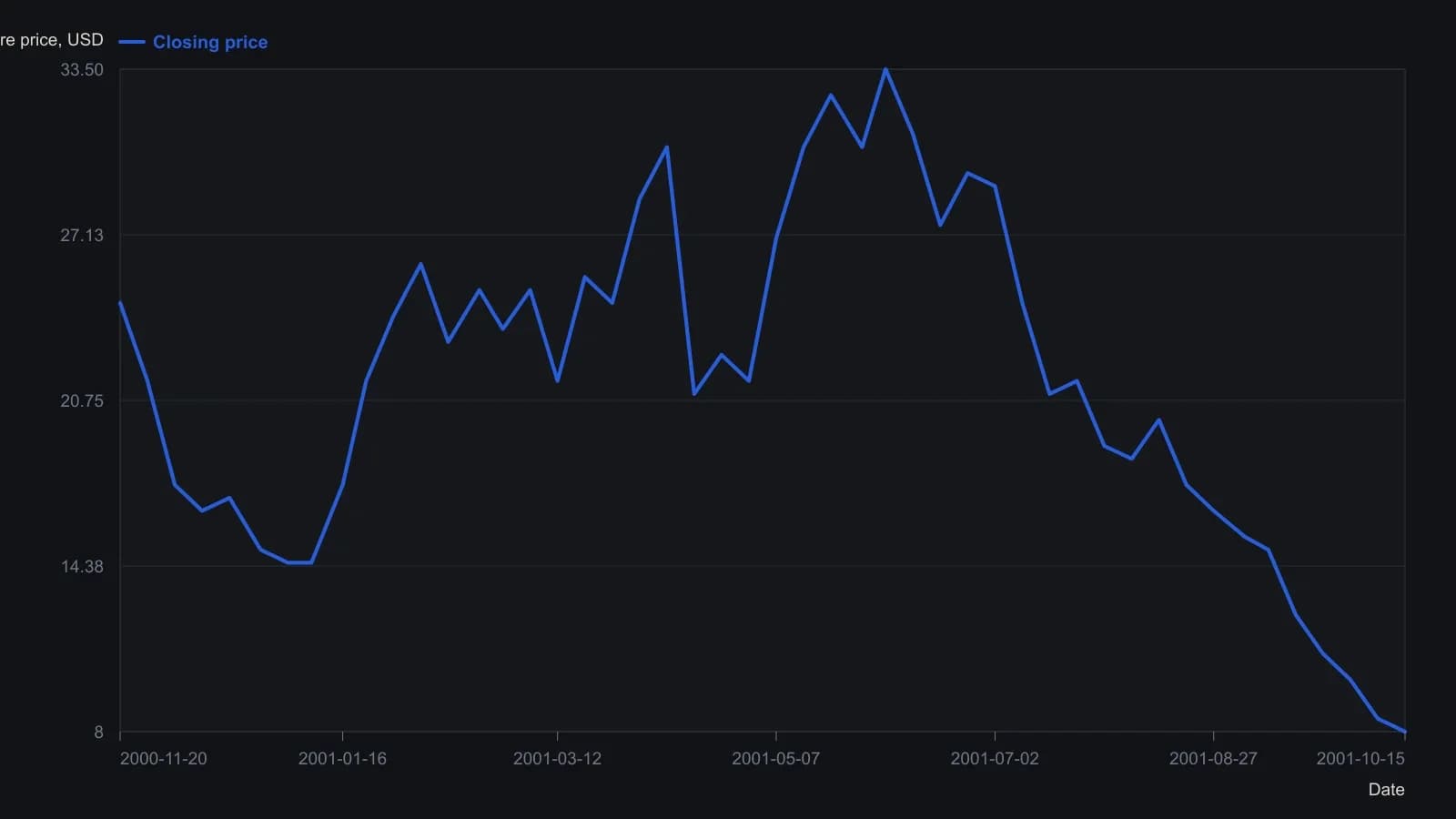
About one close per week was read from the daily high-low bars on a linear 6-34 dollar scale. Half-dollar steps are the finest resolution the raster supports. Month labels were mapped to calendar weeks; the exact session date of each bar is not printed. Volume bars have no numeric axis and were not digitized.
All readings on this track · 37 readings
- 1982Head and shoulders as a three-path completion test
- 1984Stock low clusters as a cycle baseline
- 1985Four-phase construction of the head-and-shoulders reversal
- 1989Volume-confirmed reversal patterns, stops, and measured objectives
- 1991The journal as one checklist for taken and skipped trades
- 1991Head and shoulders as a direction hypothesis
- 1991Candlestick body and shadow construction with three-Buddha peaks
- 1992A three-count drill that binds candlesticks, head and shoulders, and entry rules
- 1997Constructing bump and run reversal channels
- 1998Testing reversal formations in bond futures
- 1999Construction first: extra shoulders, the neckline, and the diamond test
- 1999Dead-cat bounce, rollover, and failed reversals
- 1999Evaluating time gaps in bond reversal patterns
- 2000Constructing head and shoulders and double reversal patterns
- 2001Constructing broadening and complex bottoms
- 2001Constructing a slanted head-and-shoulders when the chart is tilted
- 2002Head and shoulders with dominant-cycle timing
- 2002Trendline breaks, right shoulders, and trailing stops
- 2003Confirmation tests for bearish top patterns
- 2003Commodity top hypotheses on a dollar rebound
- 2003A head-and-shoulders test during a bear rally
- 2004Pattern breakouts need a primary-trend filter
- 2004Reading candlestick closes on trendline and neckline tests
- 2004Candle diagnosis needs Western targets and stops
- 2004Head-and-shoulders neckline construction
- 2005A familiar chart condition is a hypothesis, not a completed decision
- 2005A 50-day ceiling and a rising-floor stalemate
- 2006A complete trading plan from philosophy to checklist
- 2006Thin-market head and shoulders with two averages and MACD confirmation
- 2010Head and shoulders as a playback-tested setup
- 2011Turning a head-and-shoulders outline into a breakout hypothesis
- 2011Volume-confirmed head and shoulders on AIG and Citigroup in 2007
- 2013Constructing head-and-shoulders milestone points
- 2013Head-and-shoulders geometry versus the filter stack
- 2013Algorithmic head-and-shoulders construction
- 2018International relative strength as a double-top case study
- 2019Structure invalidation before comfort-stops