2019issue C1040-43
Failed flags, pennants, and triangles as a completed experiment
A failed flag, pennant, or triangle is useful mainly after the breakout is reclaimed. That reclaim locates the trapped side and a nearby invalidation, and the educational target is the stop cluster beyond the opposite extreme of the coil.
- A failed flag, pennant, or triangle is useful mainly after the breakout is reclaimed, because that reclaim locates the trapped side and the nearby invalidation.
- The educational target after a failed coil is the cluster of stops beyond the opposite extreme of the pattern, not a more precise entry inside the original breakout candle.
- Invalidation for a faded failed breakout sits just beyond the reclaim that trapped the first signal side, which can keep the opposing stop relatively close.
- A working classroom rule is not to assume every flag, pennant, or triangle will fail, but to treat an actual failure as a momentum shift that can be faded with a defined opposite thesis.
Failure starts when confirmation is withdrawn
A flag or pennant is a compact continuation coil after a sharp thrust. A failed flag or pennant is the thrust that cannot hold beyond the coil and then reverses through the opposite extreme.
A triangle is a contracting coil of higher lows and lower highs, including falling-wedge geometry treated here as a triangle-family squeeze. Failure is a breakout that is reclaimed and then driven through the far side of the coil.
A breakout is a close or thrust through a coil boundary that is supposed to confirm the pattern. Confirmation is withdrawn when price reclaims the boundary and the original signal side is left trapped.
The reclaim locates the trapped side
A failed flag, pennant, or triangle is useful mainly after the breakout is reclaimed, because that reclaim locates the trapped side and the nearby invalidation.
When silver's falling-wedge or bull-flag breakout failed and price recrossed the breakout area near 15.86, the subsequent decline was sharp and removed the prior lows as buyers were forced out.
The educational target is the far extreme
The educational target after a failed coil is the cluster of stops beyond the opposite extreme of the pattern, not a more precise entry inside the original breakout candle.
Invalidation for a faded failed breakout sits just beyond the reclaim that trapped the first signal side, which can keep the opposing stop relatively close.
The same logic appears outside the coil
The same failure logic used on flags and wedges also appears when a confirmed breakout of support, a neckline, or a trendline is later reclaimed and then driven the other way.
Pattern failures are presented as common across indexes, commodities, and currency pairs and across timeframes from lower charts up to daily and higher.
A working classroom rule is not to assume every flag, pennant, or triangle will fail, but to treat an actual failure as a momentum shift that can be faded with a defined opposite thesis.
Silver’s failed flag/wedge breakout around $15.86
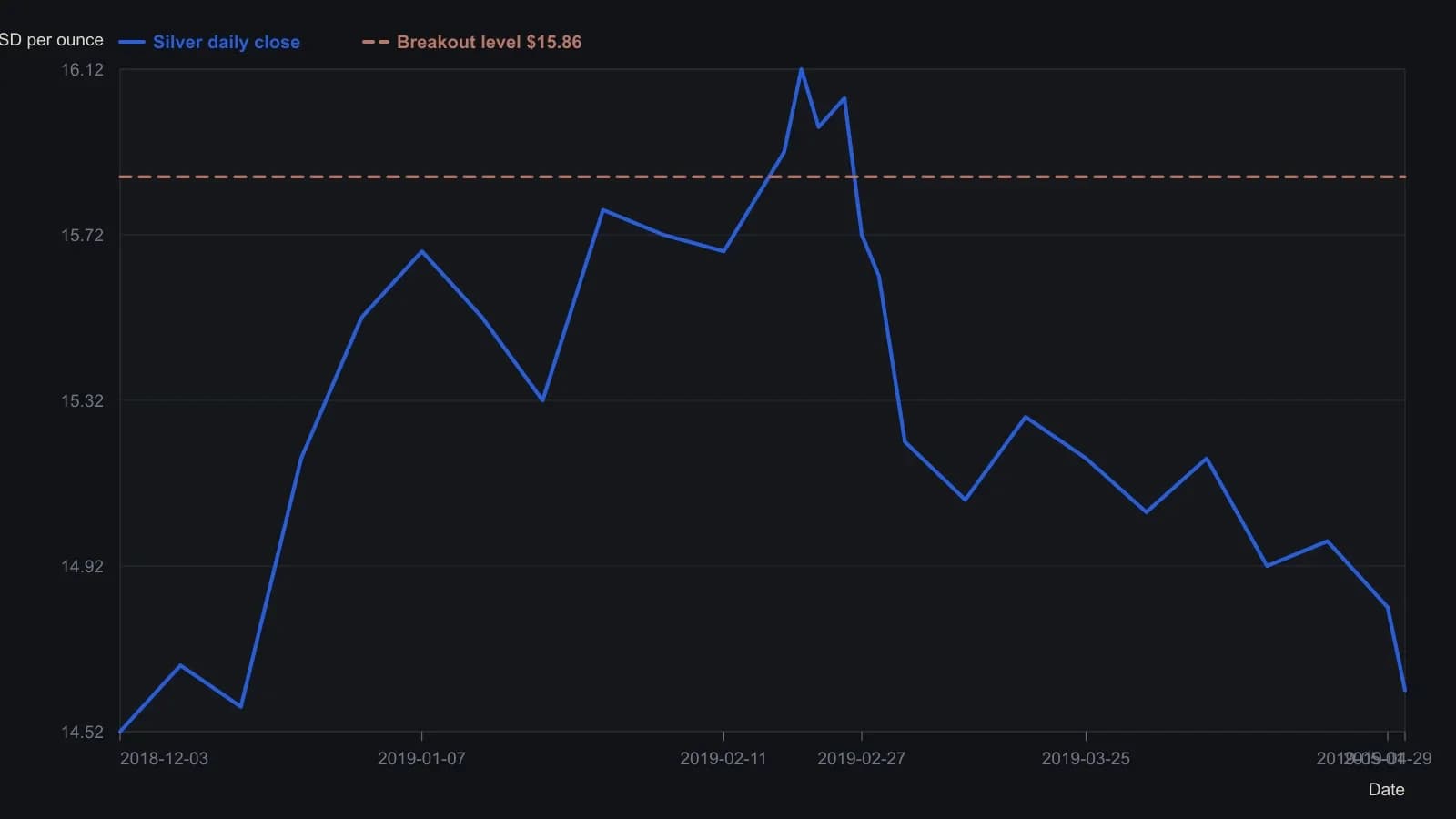
Daily closes and wicks were read off the published candlestick chart, so prices are approximate. The 21-day EMA is drawn on the source chart but is not required to show the failed-breakout reclaim.
All readings on this track · 26 readings
- 1986Constructing bounded relative-strength overlays from oscillator limits
- 1989Point-and-figure fulcrum, count, and flag as three jobs
- 1996The high, tight flag as a three-checkpoint continuation exam
- 2000Test chart patterns with confirmation, not names
- 2001Failed chart patterns as reverse breakout signals
- 2002Ascending triangle and flag: a three-checkpoint QQQ case study
- 2002Two-stage chart reading after breakouts
- 2002The second pattern after a breakout
- 2003Building flags, pennants, and triangles as continuation pauses
- 2003When trendline channels age into a wedge or a break
- 2004Bearish chart patterns need confirmation before the turn
- 2004Constructing flags, pennants, and triangles from swing pivots
- 2005Constructing flag and pennant rules from pole to exit
- 2005Fanline construction for testing trend health
- 2005When flag-and-pennant breakout scans fail a measurement audit
- 2006Testing a bear-flag target after the pause is confirmed
- 2007Homebuilder rebound as a bear-flag, trendline, and volume case study
- 2008Completed chart patterns as reward-to-risk arithmetic
- 2012Reading this file
- 2012Reading regime change: when to stop trading
- 2014Intraday flag construction with breakout and stop rules
- 2015Lock lookback and chart scale before you mark a flag or pennant
- 2017Constructing delayed buy-stops on bull flags and pennants
- 2018Copy an ABC swing as a ruler, then test flags and Fibonacci degree
- 2019Failed flags, pennants, and triangles as a completed experiment
- 2020Confirming candlestick and flag signals on a weekly chart