2014issue C1251-55
Intraday flag construction with breakout and stop rules
A flag can be specified as a steep pole, a shallow consolidation, and a timely breakout, then paired with a pre-set stop. Each condition can be checked on the chart before a trade is imagined.
- A flag can be specified as a steep pole of A times ATR in B bars, then a roughly horizontal consolidation that breaks out in C bars or less from the pole top.
- Flag depth can be capped at D times ATR, and an uptrend over the last E bars into the pole can be required before the pattern is treated as valid.
- Pole, flag, and flag-breakout can be coded as separate boolean functions so each step is independently true or false on the current bar.
- A stop at the flag bottom can exit too early; subtracting one ATR from that level is proposed as a more robust stop construction.
Four conditions to check on the chart
Editorial interpretation: a flag-and-pennant hypothesis is easier to falsify when the pole, the consolidation, the breakout, and the stop are checked as separate conditions on the chart, before a trade is imagined.
The historical workflow can code pole, flag, and flag-breakout as separate boolean functions so each construction step is independently true or false on the current bar.
How the flag is specified
In this construction, a flag-and-pennant is a compact, roughly horizontal consolidation after a steep pole, with limited depth versus recent range, used as the chart condition to test.
A pole is the steep prior run, measured as a multiple of average true range over a short bar count. A flag can be specified mechanically as a steep pole of A times ATR in B bars, followed by a roughly horizontal consolidation that breaks out in C bars or less from the pole top.
Flag depth can be constrained so the high-to-low range of the consolidation is no more than D times ATR. An uptrend over the last E bars leading into the pole can be required as a construction filter before the flag is treated as valid.
Breakout, entry, and exit construction
A breakout is the first close or bar that leaves the flag in the pole's direction within a limited number of bars from the pole top.
A long-only construction can buy the next bar after a flag breakout and exit by time, profit target, or stop-loss.
The same pole-flag-breakout rules can be applied on intraday bars and, with parameter changes, on end-of-day bars.
Stop and target construction
A stop-loss is a pre-set exit that bounds loss, typically referenced to the flag low or that level less a volatility buffer.
A stop placed at the flag bottom can exit too early; subtracting one ATR from that level is proposed as a more robust stop construction.
A price-target exit can be defined so the close, not merely an intra-bar high, must exceed the target before the position is closed.
Lookback and bar scale
Lookback-to-flag is the bar window after the pole top in which a valid flag and breakout must appear.
The lookback used to pair poles with flags changes which setups are found; a shorter lookback can identify adjacent flags that a longer lookback of 50 misses.
American Airlines daily price with two flag-and-breakout trades
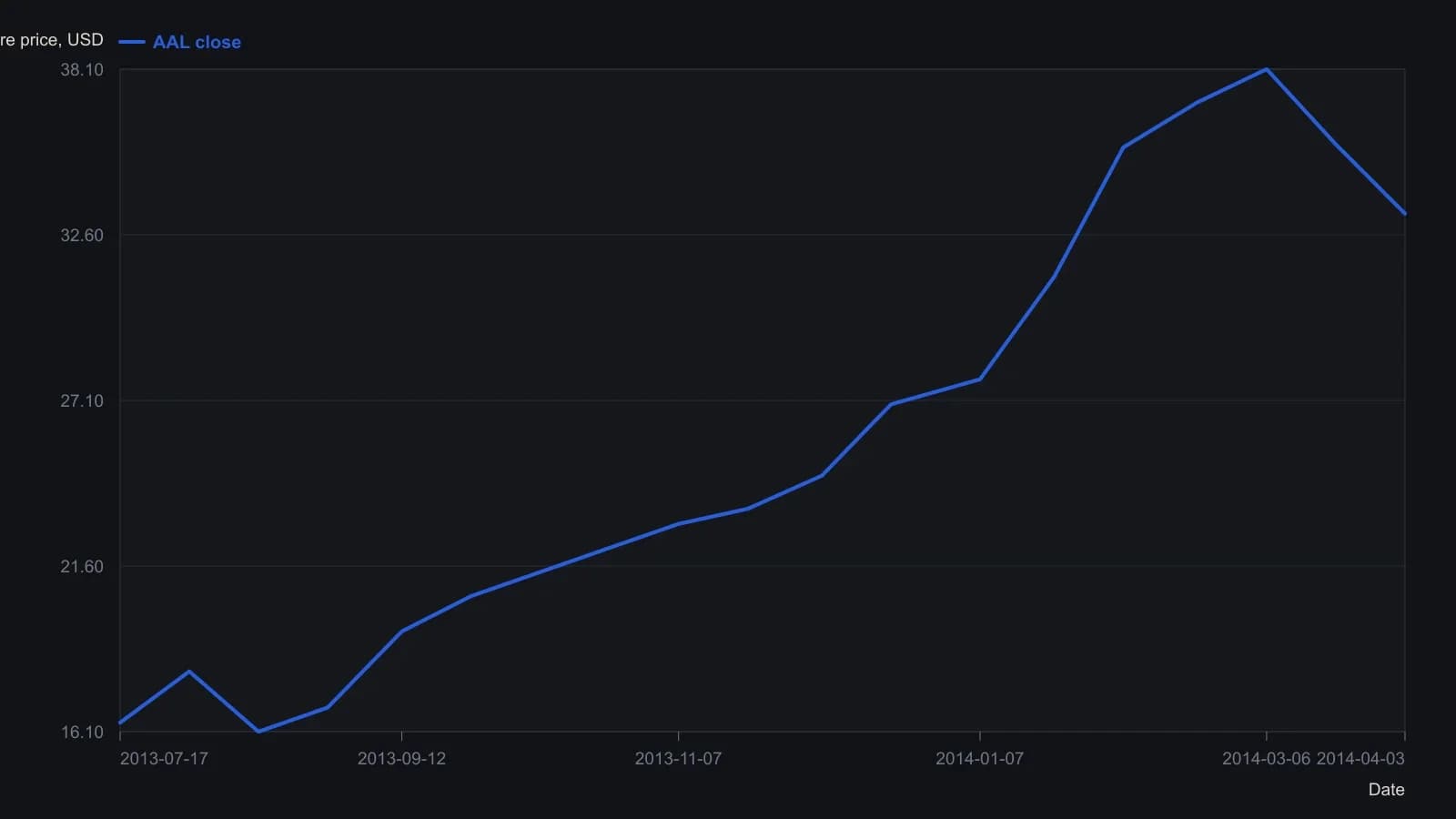
LBF was set to 4 rather than the article default of 50, which is why two adjacent flags appear. Only pole–flag pairs that actually break out are highlighted, and the source exits a target only when the close exceeds it. Unlabeled prices are digitized to one decimal from the candlestick path; 19.43 and 26.97 are printed on the chart.
All readings on this track · 26 readings
- 1986Constructing bounded relative-strength overlays from oscillator limits
- 1989Point-and-figure fulcrum, count, and flag as three jobs
- 1996The high, tight flag as a three-checkpoint continuation exam
- 2000Test chart patterns with confirmation, not names
- 2001Failed chart patterns as reverse breakout signals
- 2002Ascending triangle and flag: a three-checkpoint QQQ case study
- 2002Two-stage chart reading after breakouts
- 2002The second pattern after a breakout
- 2003Building flags, pennants, and triangles as continuation pauses
- 2003When trendline channels age into a wedge or a break
- 2004Bearish chart patterns need confirmation before the turn
- 2004Constructing flags, pennants, and triangles from swing pivots
- 2005Constructing flag and pennant rules from pole to exit
- 2005Fanline construction for testing trend health
- 2005When flag-and-pennant breakout scans fail a measurement audit
- 2006Testing a bear-flag target after the pause is confirmed
- 2007Homebuilder rebound as a bear-flag, trendline, and volume case study
- 2008Completed chart patterns as reward-to-risk arithmetic
- 2012Reading this file
- 2012Reading regime change: when to stop trading
- 2014Intraday flag construction with breakout and stop rules
- 2015Lock lookback and chart scale before you mark a flag or pennant
- 2017Constructing delayed buy-stops on bull flags and pennants
- 2018Copy an ABC swing as a ruler, then test flags and Fibonacci degree
- 2019Failed flags, pennants, and triangles as a completed experiment
- 2020Confirming candlestick and flag signals on a weekly chart