2002issue C041-5
The second pattern after a breakout
A completed breakout or breakdown is not the end of pattern work. The next triangle, flag-and-pennant, or head-and-shoulders structure is the live test of whether the new directional hypothesis still holds.
- A completed breakout or breakdown is not treated as the end of pattern work, because another recognizable structure can emerge from the same move.
- The post-breakout pattern is the second recognizable structure used to retest whether the new directional hypothesis still holds.
- Flags and pennants are brief, relatively tight countertrend pauses, generally lasting from three days to three weeks, and are read as continuation structures.
- A later apparent structure remains a hypothesis until price confirms it, including after a clean ascending-triangle breakout.
The first break is still a hypothesis
A completed breakout or breakdown is not treated as the end of pattern work, because another recognizable structure can emerge from the same move.
That later map is a post-breakout pattern: a second recognizable structure that forms after the completed break and is used to retest whether the new directional hypothesis still holds.
How the next structure is defined
A triangle pattern is a coil between two converging boundaries. A symmetrical triangle is defined as price tightening between lower highs and higher lows, with the usual reading that the prior primary trend resumes after price leaves the coil. An ascending triangle holds a flat high while lows rise. A descending triangle holds a flat low while highs fall.
Flags and pennants are brief, relatively tight countertrend pauses after a directional move. They generally last from three days to three weeks and are read as continuation structures rather than a new trend.
A head-and-shoulders map is a three-swing reversal of left shoulder, head, and right shoulder around a neckline. The neckline is the breakout or breakdown boundary. The neckline break is the event that later structures may confirm or challenge.
Two sequences after a completed break
One equity sequence shows a head-and-shoulders top breakdown later followed by a descending triangle of lower highs against a stable floor. That triangle's upper boundary aligned with a downtrend line from the prior peak.
One futures sequence shows a head-and-shoulders bottom breakout, then a short tight countertrend pullback characterized as a bull flag, after which price left the flag in the breakout direction.
Fluor Corp. head-and-shoulders top and the next descending triangle
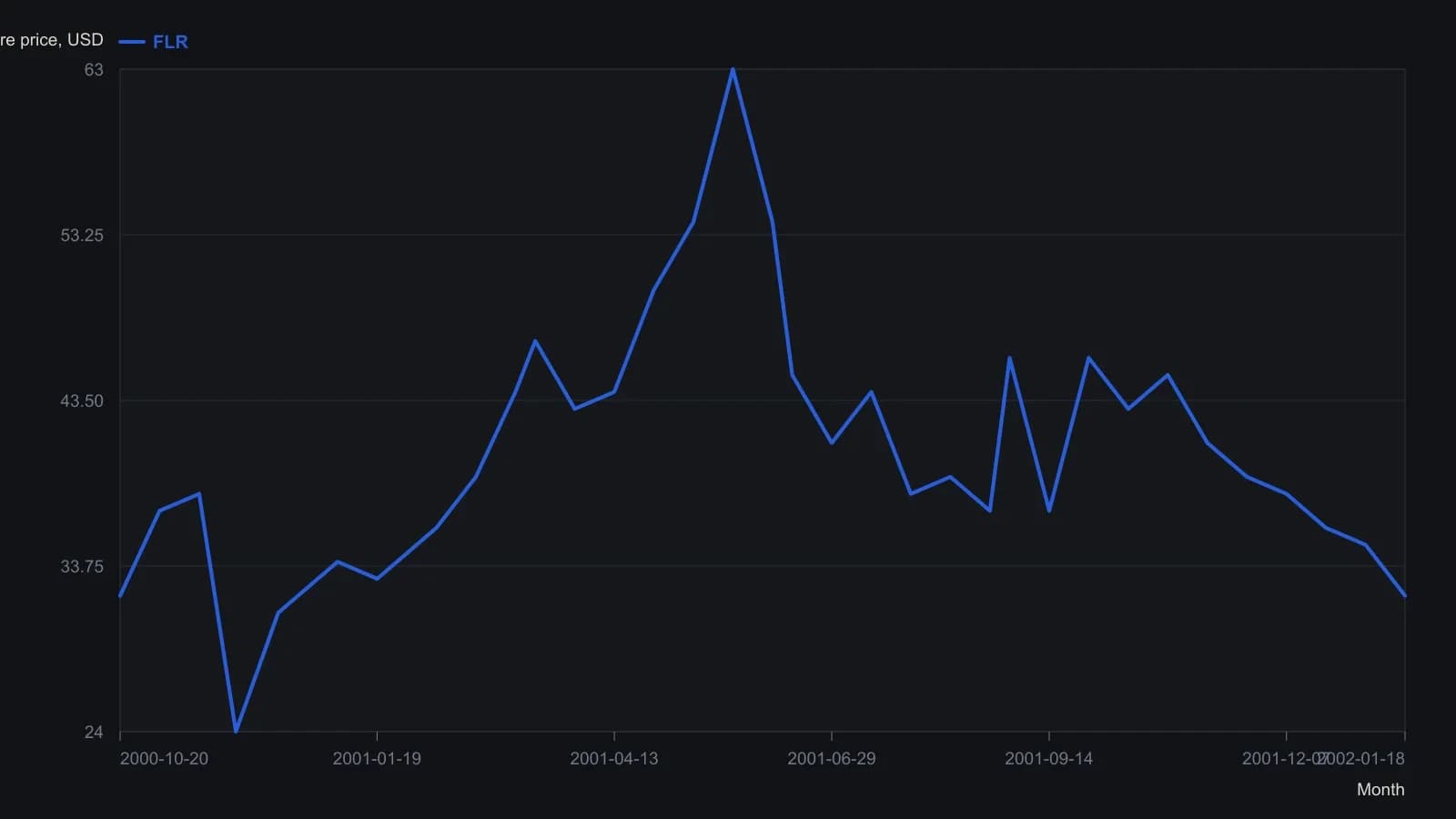
Closes are visual readings from the printed Metastock scale to the nearest dollar. The quote window prints the final close at 31.55. The article separately states a December 2000 print of 22, a May 2001 print of 55, a late-May peak in the low 60s, a measured objective near 44, and triangle support at 35.
What still stays a hypothesis
A poorly formed left shoulder, or a pullback that recrosses the neckline, is not treated as automatic invalidation of a head-and-shoulders top if the right-shoulder peak still holds.
A later apparent structure after a clean ascending-triangle breakout can fail to complete, so the second pattern remains a hypothesis until price confirms it.
All readings on this track · 26 readings
- 1986Constructing bounded relative-strength overlays from oscillator limits
- 1989Point-and-figure fulcrum, count, and flag as three jobs
- 1996The high, tight flag as a three-checkpoint continuation exam
- 2000Test chart patterns with confirmation, not names
- 2001Failed chart patterns as reverse breakout signals
- 2002Ascending triangle and flag: a three-checkpoint QQQ case study
- 2002Two-stage chart reading after breakouts
- 2002The second pattern after a breakout
- 2003Building flags, pennants, and triangles as continuation pauses
- 2003When trendline channels age into a wedge or a break
- 2004Bearish chart patterns need confirmation before the turn
- 2004Constructing flags, pennants, and triangles from swing pivots
- 2005Constructing flag and pennant rules from pole to exit
- 2005Fanline construction for testing trend health
- 2005When flag-and-pennant breakout scans fail a measurement audit
- 2006Testing a bear-flag target after the pause is confirmed
- 2007Homebuilder rebound as a bear-flag, trendline, and volume case study
- 2008Completed chart patterns as reward-to-risk arithmetic
- 2012Reading this file
- 2012Reading regime change: when to stop trading
- 2014Intraday flag construction with breakout and stop rules
- 2015Lock lookback and chart scale before you mark a flag or pennant
- 2017Constructing delayed buy-stops on bull flags and pennants
- 2018Copy an ABC swing as a ruler, then test flags and Fibonacci degree
- 2019Failed flags, pennants, and triangles as a completed experiment
- 2020Confirming candlestick and flag signals on a weekly chart