2018issue C0542-45
Retail sleeve construction through channel rotation and daily leverage
By the 2018 snapshot, six retail-themed ETFs were lined up against a broad consumer-discretionary sector fund, and none matched that fund's holdings mix. Weight scheme, channel concentration, share volume, and daily-reset leverage split the set.
- Retail sat inside consumer discretionary, a cyclical group spanning stores, autos, apparel, leisure, restaurants, and media, and was distinct from consumer staples.
- None of the six retail-themed ETFs matched the broad discretionary fund's holdings mix, so the lineup was a construction exercise rather than a like-for-like substitute test.
- An equal-weight retail fund held about 89 names with roughly 30 percent small-cap and 29 percent micro-cap, while a 26-name cap-weighted peer was about 95 percent large-cap, and daily volume ranged from about 5.3 million shares to about 1,079.
- An online sleeve, a concentrated single-name sleeve, a daily-reset triple-leveraged fund, and two late-2017 store-versus-online books each encoded a different channel or horizon choice.
Retail inside the consumer map
Retail sat inside consumer discretionary, the cyclical consumer group that includes retailing, autos, apparel, leisure, restaurants, and media. That group was distinct from consumer staples, the noncyclical set covering food, drugs, beverages, and tobacco. A physical-store book or an internet book was therefore only one slice of the wider cycle.
By the 2018 snapshot, physical-store contraction was already quantified. About 12,000 U.S. store closures were expected that year after 9,000 in 2017, and more than 50 chains had filed Chapter 11 in 2017. Industry rotation meant shifting a consumer sleeve among physical stores, internet retail, and a broader discretionary basket as the delivery mix changed.
A construction comparison, not a substitute test
Six retail-themed ETFs were lined up against a broad consumer-discretionary sector fund. None matched that fund's holdings mix, so the comparison was a construction exercise rather than a like-for-like substitute test.
Weight scheme and cap mix split the set. An equal-weight retail fund held about 89 names with roughly 30 percent small-cap and 29 percent micro-cap, while a 26-name cap-weighted peer was about 95 percent large-cap. Equal-weight starts each holding at a similar share instead of scaling by market capitalization.
Tradability was uneven. The most active dedicated retail fund printed about 5.3 million shares a day with about 541 million dollars in assets, while several peers traded under 80,000 shares and one listed about 1,079.
Cumulative return on XLY, RTH, XRT and PMR, December 2011–February 2018
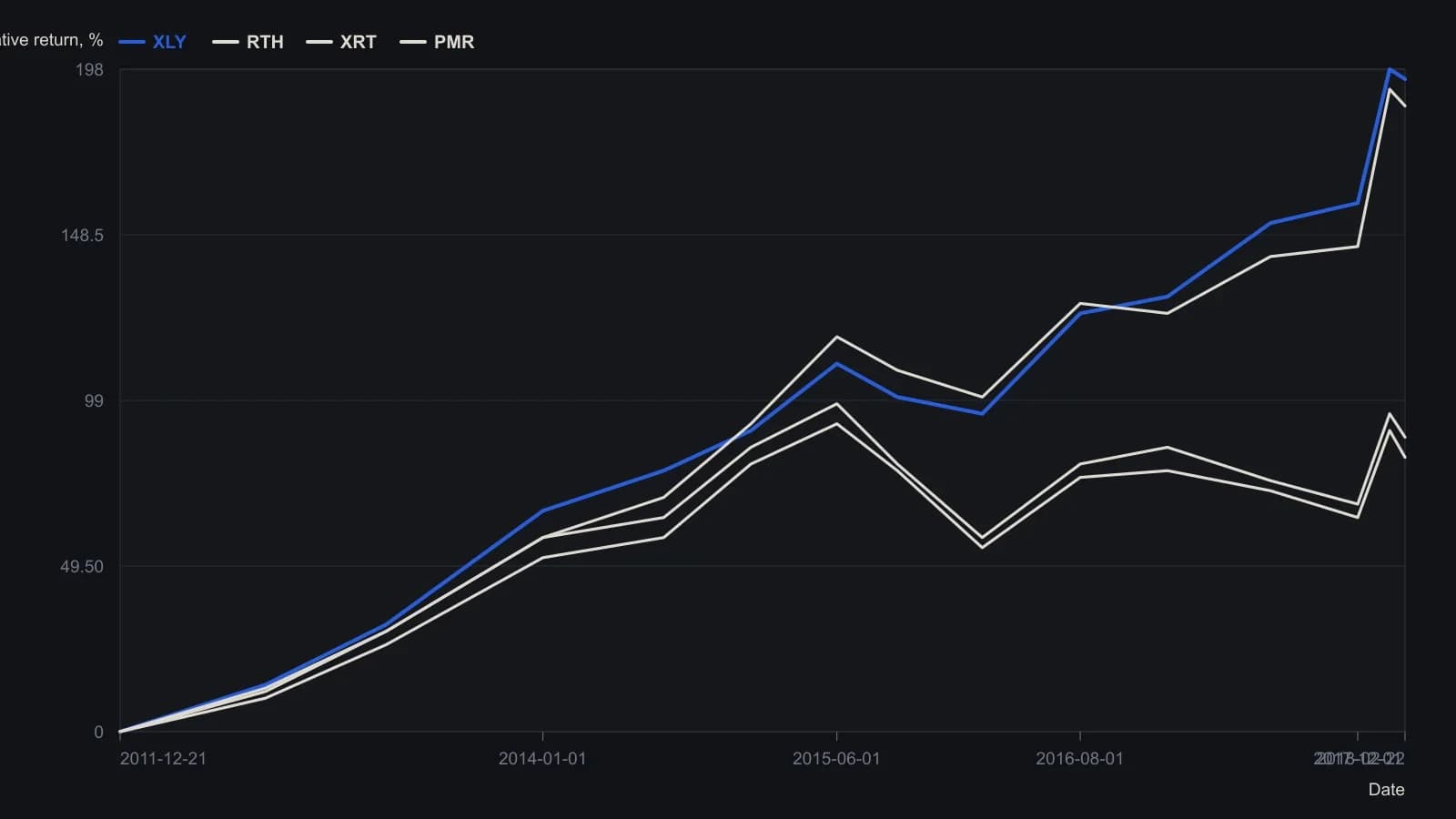
The source left 3x daily-reset RETL off this pane because it would not fit the same vertical scale; it quotes 670.23% for RETL over these dates.
Channel sleeves and name concentration
An online-retail sleeve placed about 68 percent of assets in internet and direct marketing across 40 equal-weighted names, a narrower channel-sleeve than store-heavy baskets. One concentrated retail sleeve listed a single internet retailer at about 22.8 percent of assets, so industry rotation inside that sleeve was dominated by one name's path.
Daily-reset and store-versus-online books
A triple-leveraged retail fund reset daily to a 300 percent move versus its benchmark. Because compounding can detach multi-day results from three times the index, the daily-reset design was framed as a short-horizon exposure filter rather than a multi-year hold. Leverage control meant bounding size and holding period when a vehicle targets a daily multiple or inverse exposure rather than an unlevered multi-week path.
Two late-2017 vehicles encoded store-versus-online rotation explicitly. One offered single-day inverse exposure to traditional stores, and another combined a 100 percent long online book with a 50 percent short physical-store book. Both were too new for a full review.
All readings on this track · 23 readings
- 1985Industry leadership carryover as a bull-regime test
- 1988Constructing industry-group breadth and rotation measures
- 1992Trendline holds, trailing stops, and industry rotation
- 1994Inflation-deflation regimes inside the stock cycle
- 1996Sector rotation across economic cycle phases
- 2001Rebased relative performance charts for sector rotation
- 2001Place a small-cap growth idea inside a regime map
- 2004Rebuild every industry as a share of one rank scoreboard
- 2004Rate-hike regimes and sector rotation as a case study
- 2005A two-name style-index sleeve makes rank rotation one procedure
- 2006Consumer staples after a smokestack cycle
- 2007An intra-sector regime split between builders and equity REITs
- 2008Country and sector weights in an Africa regional-sleeve
- 2011Trend permission, priced entries, and sector rotation
- 2012Construct a regime-aware context from sector rotation
- 2012Regime overlays versus rank rotation
- 2014Rank-based sector rotation as a portfolio test
- 2017Real estate as a ranked industry sleeve
- 2017Theme sleeves: liquidity and commission filters before industry rotation
- 2018Retail sleeve construction through channel rotation and daily leverage
- 2020Water sleeve construction: satellite size, industry mix, and liquidity
- 2020A ranked research terminal as a three-layer watchlist procedure
- 2020Regression channels for sector rotation context