1985issue C011-12
Industry leadership carryover as a bull-regime test
A regime test comes before a rotation choice. Measuring whether top industry groups reset or repeat helps place a single long idea in a new seasonal regime or in the second phase of an unfinished cycle.
- Early-advance breadth tends to lift most industry groups together before they later split into continuing leaders, choppy names, and laggards.
- The leadership-reset hypothesis treats a change in top industry groups as more consistent with a distinct new bull-market regime than with a continuation of the prior advance.
- When industry carryover exceeds a random baseline, leadership lists can be read inside a double-header cycle rather than only against the previous cycle.
- A 35-year review of 39 industry groups did not reveal reliable group-level cycles beyond a general tendency to follow the market averages.
Early-advance breadth and the regime question
In the opening months of a well-defined advance, most industry groups tend to rise together. That early-advance breadth later gives way to a split among continuing leaders, choppy names, and laggards.
After seven months of 1984 weakness, a three-session August advance of nearly 100 Dow points on record volume reopened a practical question: had a new bull market begun, or had an earlier advance resumed?
Leadership change as a hallmark
A contemporaneous market comment treated a change in industry leadership as a hallmark of a new bull market. It contrasted an energy-led late-1970s advance with a consumer-led early-1980s advance.
Relative-return tables for those two advances showed energy groups absent from the late-1970s top three, while consumer-oriented groups were strongly represented among the early-1980s top ten.
Overlap between those two top-ten lists still exceeded what a random draw from about 70 groups would imply. That left open whether the later advance was a new cycle or a second phase of the earlier one.
The leadership-reset hypothesis
Industry-return histories beginning in 1958 supplied six major bull-market cycles and five leadership transitions, with an average of 61.3 groups surveyed.
Across those five transitions, observed top-ten group overlap supported the leadership-reset hypothesis: a distinct new bull-market regime is more plausible when the top-performing industry groups differ from those that led the prior advance.
A 35-year review of 39 industry groups did not reveal reliable group-level cycles beyond a general tendency to follow the market averages.
Industry carryover inside a double-header cycle
A double-header cycle is a bull-market interval that unfolds in two similar up-phases separated by an interruption, so second-phase leadership is compared with first-phase leadership rather than only with the previous cycle.
In three historically similar two-phase advances, first-to-second-phase top-group overlap exceeded a random baseline. The phase-potency ratio in those cases put the second-phase percentage rise at about seven-eighths of the first-phase rise, over about 13 months.
All 73 reported industry groups rose above the 1982 low, though individual issues could still have failed to do so.
First-phase industry leaders in Double-Header No. 3, 1970-1971
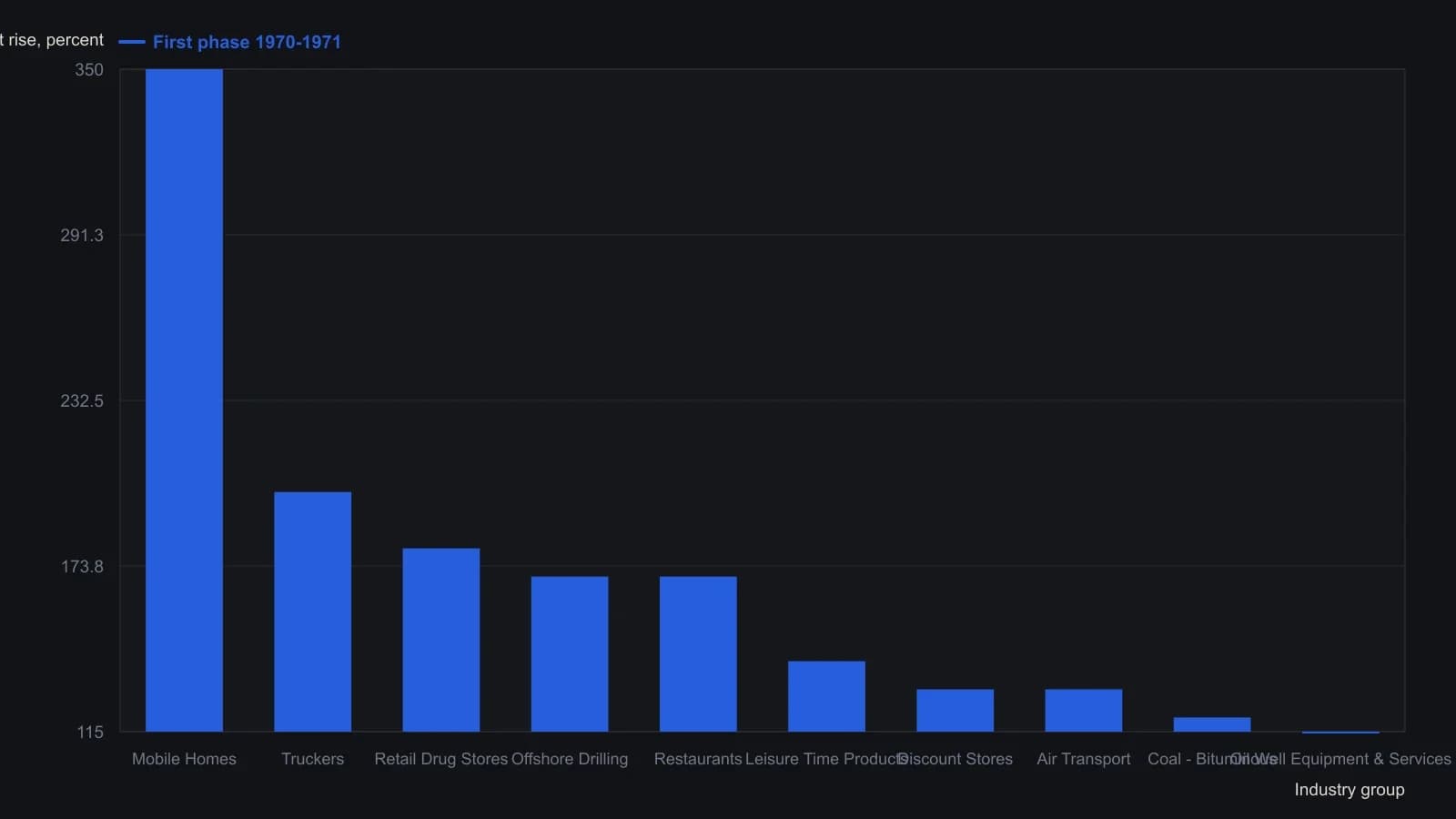
Percent-rise ranks were taken from the Securities Research industry breakdowns Dunbar used. In the companion second-phase column of the same table, a single asterisk marks a top-ten hold and a double asterisk a top-five hold.
All readings on this track · 23 readings
- 1985Industry leadership carryover as a bull-regime test
- 1988Constructing industry-group breadth and rotation measures
- 1992Trendline holds, trailing stops, and industry rotation
- 1994Inflation-deflation regimes inside the stock cycle
- 1996Sector rotation across economic cycle phases
- 2001Rebased relative performance charts for sector rotation
- 2001Place a small-cap growth idea inside a regime map
- 2004Rebuild every industry as a share of one rank scoreboard
- 2004Rate-hike regimes and sector rotation as a case study
- 2005A two-name style-index sleeve makes rank rotation one procedure
- 2006Consumer staples after a smokestack cycle
- 2007An intra-sector regime split between builders and equity REITs
- 2008Country and sector weights in an Africa regional-sleeve
- 2011Trend permission, priced entries, and sector rotation
- 2012Construct a regime-aware context from sector rotation
- 2012Regime overlays versus rank rotation
- 2014Rank-based sector rotation as a portfolio test
- 2017Real estate as a ranked industry sleeve
- 2017Theme sleeves: liquidity and commission filters before industry rotation
- 2018Retail sleeve construction through channel rotation and daily leverage
- 2020Water sleeve construction: satellite size, industry mix, and liquidity
- 2020A ranked research terminal as a three-layer watchlist procedure
- 2020Regression channels for sector rotation context