1995issue C011-3
A Kelly-style leverage grid and reshuffled paths
A completed blotter is first turned into commission-aware, side-signed returns and swept across a fixed leverage grid so compounded equity can be read against exposure. Those same returns are then redrawn with equal probability so the chosen multiple is treated as a control that must survive sequence change before the next order is sized.
- A leverage workbook is treated as adequate for measuring a candidate leverage only after at least 30 trades have been entered.
- Each trade is converted into a commission-adjusted return, signed by a long or short flag, then compounded across leverage factors that run from 1 to 9 in steps of 0.2.
- The last row of each leverage column is the terminal return on equity for that factor and is the series used to inspect return versus leverage.
- A second sheet assigns every historical return the same probability, draws 100 trades without reusing the original order, and reapplies the same grid under a reshuffled sequence.
Two sheets, two gates
The archive workflow is a two-sheet classroom sequence. The first sheet turns a completed blotter into commission-adjusted returns and compounds those returns across a stepped set of leverage factors. The second sheet pastes the same returns as values, gives every trade an equal probability, and compounds a newly drawn series on the same grid.
TradersWeek editorial reading: treat the two sheets as successive filters, not as a single backtest trophy. The first gate sets a pre-trade exposure bound. The second gate asks whether that bound still makes sense after the path is stressed by a change in sequence.
From blotter to commission-adjusted returns
A leverage workbook is treated as adequate for measuring a candidate leverage only after at least 30 trades have been entered.
Each trade return is signed by a long or short flag. The commission-adjusted return is the signed percentage result of a trade after contract count and transaction cost are included in both the gain or loss and the capital base. The building pieces are beginning value, ending value, contract count, and commission.
The fixed leverage grid
A leverage factor is a fixed multiplier applied to each trade return so several exposure levels can be compounded side by side. Fixed leverage factors begin at 1, increase by 0.2 in each later column, and the worked sweep is carried out to a leverage of 9.
Leveraged equity for the first trade is one plus leverage times that trade’s return. Each later trade multiplies the same growth factor by the previous equity cell so the path compounds. That running product is the compounded equity path: each period multiplies prior equity by one plus leverage times that period’s return.
The last row of each leverage column is the terminal return on equity for that factor and is the series used to inspect return versus leverage.
A classroom reading of the first curve
Leverage control, in the sense used here, is a pre-trade and in-position rule that keeps exposure inside a chosen multiple of equity instead of letting contract count or price path set the loss by default.
Editorial reading of the Kelly criterion: treat the peak or durable region on that return-versus-leverage curve as a classroom cue to pick a fraction of equity to apply before entry. The bound is kept only if it still makes sense after the path is stressed.
Compounded blotter equity across a 1.00–1.40 leverage grid
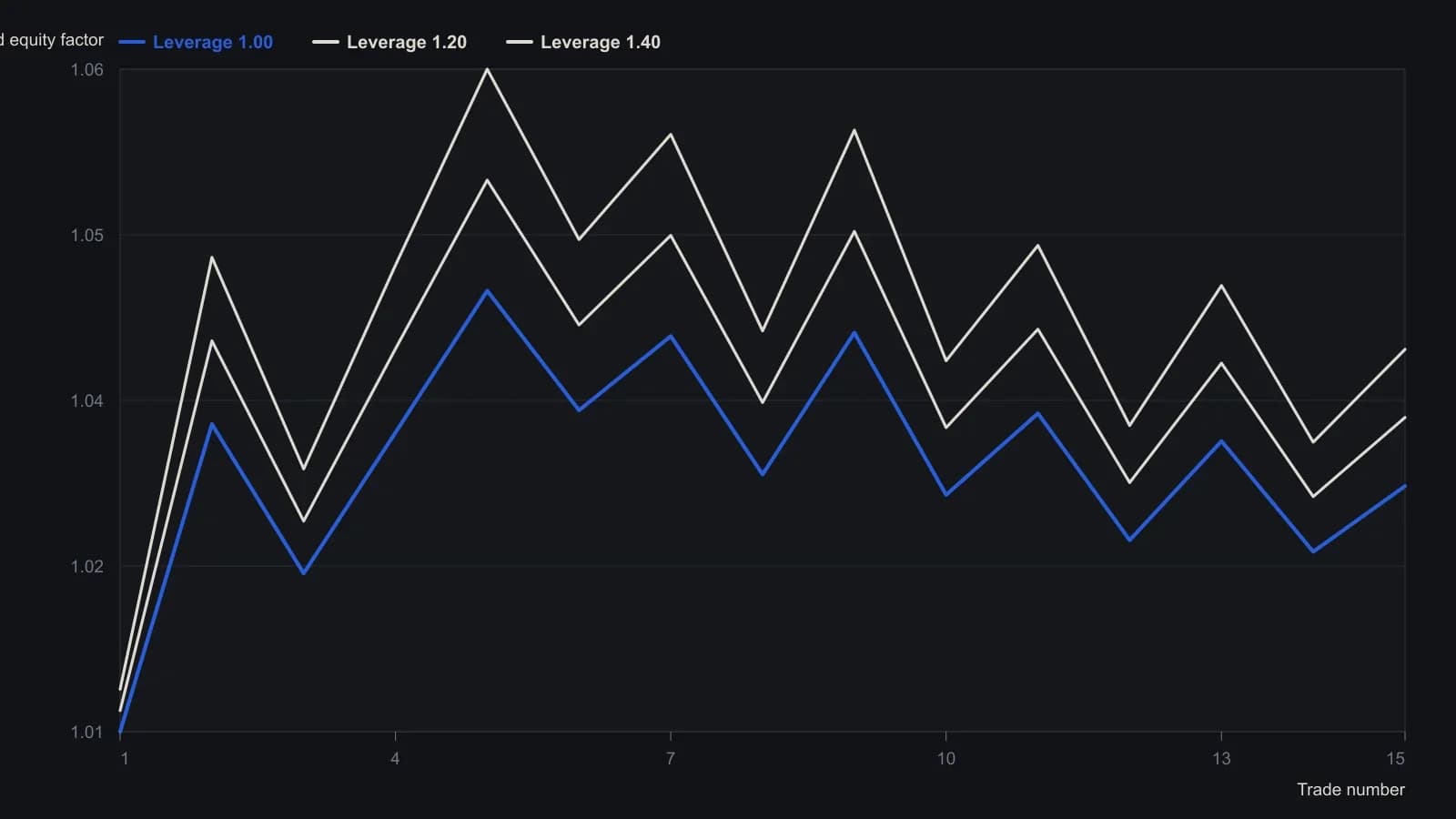
The sidebar asks for at least 30 trades and a grid continued toward 9; the printed sheet stops at trade 15 and leverage 1.40. Each row is one contract with a $20 commission.
Equal-probability redraws
A second sheet pastes those historical returns as values and assigns every trade the same probability, equal to one divided by the trade count, or 0.0333 when the count is 30. That equal-probability draw is the working assumption that every completed trade in the sample is equally likely to appear next when a future sequence is simulated.
A discrete random draw of 100 returns is taken from the paired return-and-probability list so the original trade order is not reused.
Editorial label: this redraw is Monte Carlo simulation, meaning historical trade returns are redrawn according to an explicit probability table so alternative sequences can be compounded and compared with the original ordered blotter.
The same grid on a reshuffled path
The same stepped leverage grid and compounding steps are applied to the 100-draw series. The final simulated row is read as return on equity versus leverage under a reshuffled sequence.
Editorial close: the chosen leverage factor is treated as a control that must survive sequence change before the next order is sized.
All readings on this track · 9 readings
- 1982Three gates for a futures book: equity risk, expected value, and shrinking pyramids
- 1995A Kelly-style leverage grid and reshuffled paths
- 2004Bound the loss before leverage changes size
- 2010Treat risk of ruin, drawdown limits, and Kelly sizing as consistent pre-trade filters
- 2010Fixed-fractional forex position sizing
- 2013Kelly fraction versus risk of ruin
- 2016Expected value versus leverage, drawdown, and Kelly sizing
- 2017Fixed-fraction sizing versus a theoretical pattern edge
- 2018Evaluating double-bottom breakouts as a testable system