2005issue C011-4
A two-name style-index sleeve makes rank rotation one procedure
This case study holds two style-index exchange-traded funds chosen by a relative-strength-score. Growth-versus-value and large-versus-small leadership is treated as something that changes with the market environment. In the editorial reading, a two-week review and a top-three band make leadership, replacement, and standing pat the same rank-rotation rule.
- Growth-versus-value and large-versus-small leadership is treated as something that changes with the market environment rather than as a permanent winner.
- The sleeve starts fully invested in the two highest-ranked style-index funds at equal dollar weight and is reviewed every two weeks.
- A holding stays if it remains among the top three ranks; if it leaves that band it is replaced by the highest-ranked name not already held.
- The historical workflow used index-substitution until each fund had its own price series, a year-end equal-weight-reset, next-session closing prices, and stated stand-in costs.
What this case is for
TradersWeek editorial reading: this is a lesson in rank-rotation as one procedure, not a claim that one style-index is permanently best. Leadership, replacement, and standing pat are meant to be tested with the same rule across growth, value, and size segments.
Growth-versus-value and large-versus-small leadership is treated as something that changes with the market environment rather than as a permanent winner.
The tradable universe
The tradable universe is a short list of exchange-traded funds that track style-index and size benchmarks. Growth and value choices sit at the large-cap and small-cap ends, and a single mid-cap tracker completes the list.
How the relative-strength-score is built
The ranking input is a relative-strength-score. It uses about 120 trading days split into quarters, averages those quarterly percentage changes, and places twice the weight on the most recent quarter.
Hold, replace, or stand pat
The sleeve starts fully invested in the two highest-ranked names at equal dollar weight and is reviewed every two weeks. Rank-rotation here holds only current leaders in that fixed universe.
A holding is left unchanged if it remains among the top three ranks. If it drops out of that band it is sold and replaced by the current highest-ranked name not already held.
Year-end equal-weight-reset
A year-end equal-weight-reset was applied so each calendar period started from balanced weights. That step requires selling part of the stronger holding.
Index-substitution and assumed costs
Because many of the funds lacked a long price history, the historical test used index-substitution. It bought the matching benchmark index until each fund's own series became available.
The historical procedure assumed next-session closing prices after a signal, a 25-dollar commission, and a 0.3 percent per-quarter charge meant to stand in for fees or slippage.
Creation-redemption and quiet names
Exchange-traded fund liquidity is described as depending on creation-redemption, the ability to create or redeem shares against the underlying basket, rather than on secondary-market volume alone. Wide spreads on quieter names are a reason to use limit orders.
Two-name style sleeve versus S&P 500 and Nasdaq Composite
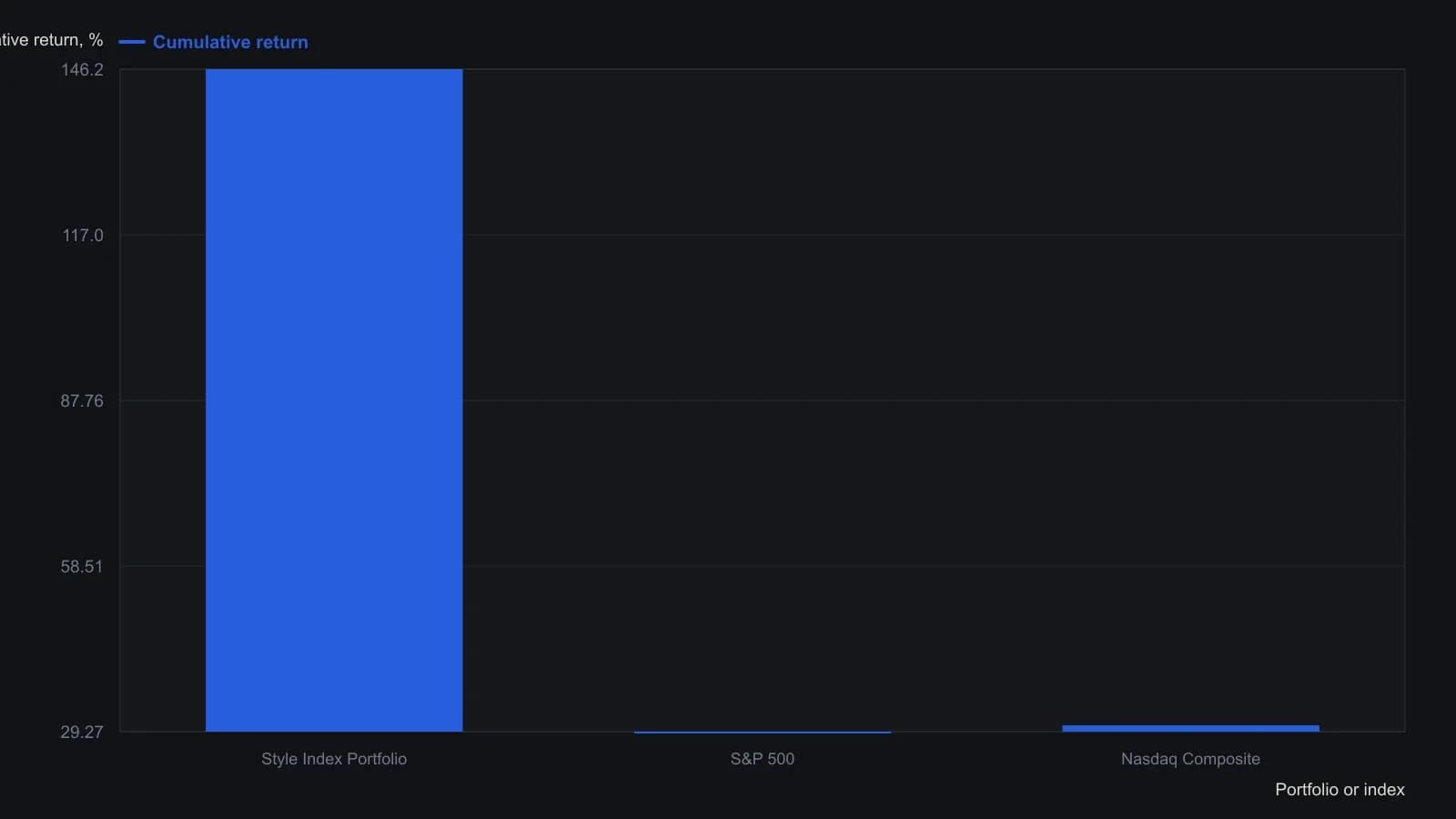
Hypothetical backtest, not live accounts: two names, fully invested, equal-weighted at each year-end (the author says that reset cut the compound return), fills at the next close, $25 commission, and 0.3 percent deducted each quarter. Before each ETF listed, the matching benchmark index was used. 2004 is only through 30 June.
All readings on this track · 23 readings
- 1985Industry leadership carryover as a bull-regime test
- 1988Constructing industry-group breadth and rotation measures
- 1992Trendline holds, trailing stops, and industry rotation
- 1994Inflation-deflation regimes inside the stock cycle
- 1996Sector rotation across economic cycle phases
- 2001Rebased relative performance charts for sector rotation
- 2001Place a small-cap growth idea inside a regime map
- 2004Rebuild every industry as a share of one rank scoreboard
- 2004Rate-hike regimes and sector rotation as a case study
- 2005A two-name style-index sleeve makes rank rotation one procedure
- 2006Consumer staples after a smokestack cycle
- 2007An intra-sector regime split between builders and equity REITs
- 2008Country and sector weights in an Africa regional-sleeve
- 2011Trend permission, priced entries, and sector rotation
- 2012Construct a regime-aware context from sector rotation
- 2012Regime overlays versus rank rotation
- 2014Rank-based sector rotation as a portfolio test
- 2017Real estate as a ranked industry sleeve
- 2017Theme sleeves: liquidity and commission filters before industry rotation
- 2018Retail sleeve construction through channel rotation and daily leverage
- 2020Water sleeve construction: satellite size, industry mix, and liquidity
- 2020A ranked research terminal as a three-layer watchlist procedure
- 2020Regression channels for sector rotation context