2011issue C0657-59
Trend permission, priced entries, and sector rotation
This case records an end-of-day procedure that issued buy and sell prices, stops, and targets across listed shares, exchange-traded funds, futures, and currency pairs. Editorial reading: stack trend permission, a priced rule entry, and an industry rotation rank as one testable procedure.
- Trend permission came from a home-panel read of major US equity indexes, the 10-year Treasury, and the US dollar on short- and long-term horizons, and it allowed, reversed, or withheld new trades.
- A priced rule entry became valid only at a predetermined support or resistance price, with a matching stop and target, and only in the direction of the prevailing trend.
- A color-coded 10-week industry rotation rank ordered 15 sectors from strongest to weakest, then opened industries and member names that already carried pending buy or sell prices.
- Scan horizon set daily holds of a few days to weeks or weekly holds of several months, using either a single exit or staged targets.
The documented end-of-day workflow
The documented end-of-day procedure issued specific buy and sell prices, stops, and targets across four market groups: listed shares, exchange-traded funds, futures, and currency pairs.
Entries and exits were tied to support and resistance, and the procedure was described as always taking trades in the direction of the prevailing trend.
Those alerts were an end-of-day release: signals computed after the session close and intended for the next session or for a later designated price touch.
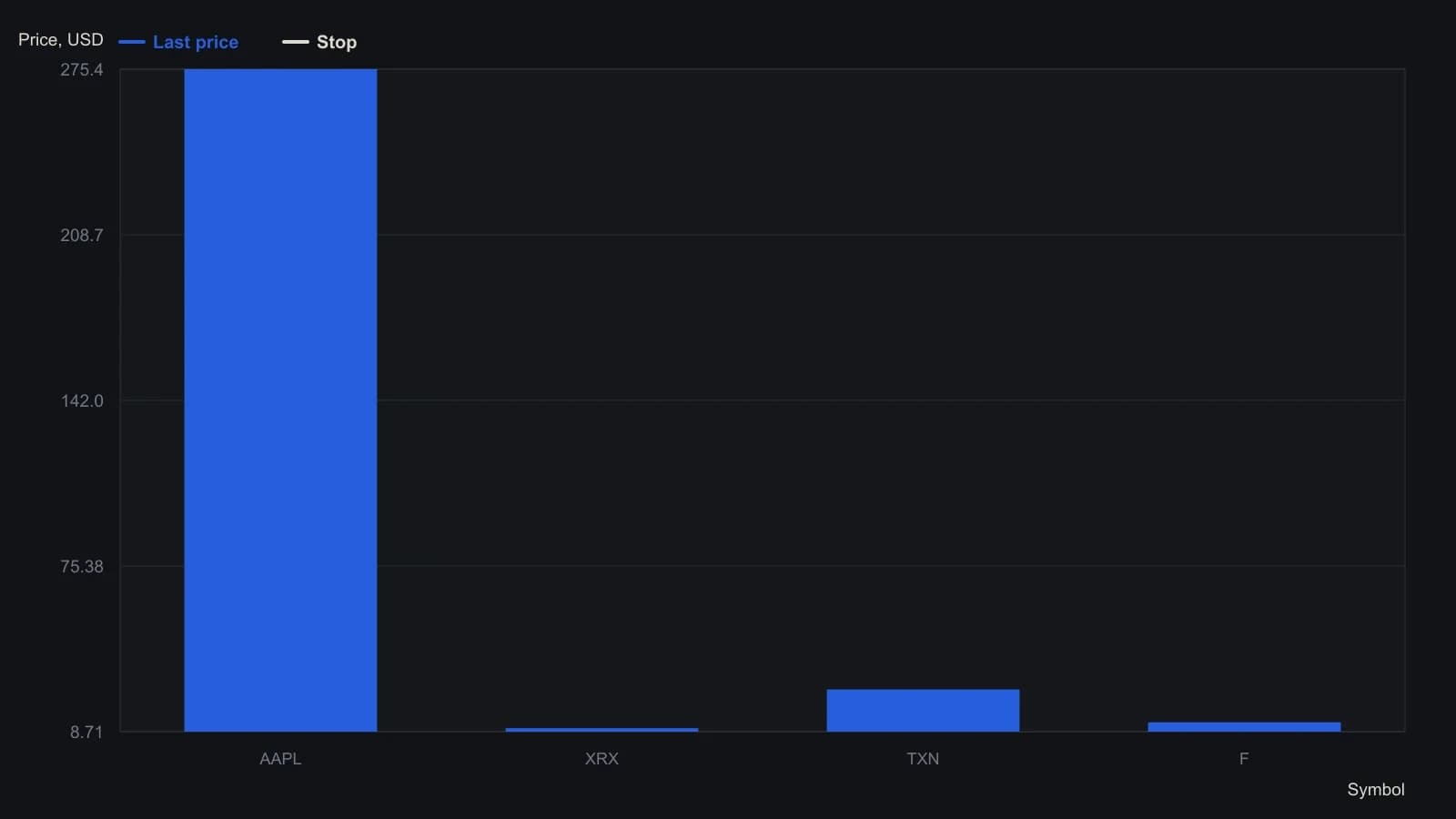
Wizard pre-buy scan: last price vs stop
Trend permission
Trend permission is a short- or long-term market-wide state used to allow, reverse, or withhold new trades so that positions stay aligned with the prevailing direction.
A home-panel trend read covered the Dow Jones 30, S&P 500, Nasdaq 100, Russell 2000, the 10-year Treasury, and the US dollar on both short- and long-term horizons.
Market calls were stored as historical backtested and live records in a color-coded annual calendar that could extend as far as 20 years, with green marking a bullish state and red a bearish one.
Editorial: that calendar is a log for backtesting, meaning a fixed rule set run on past prices first and then applied to later unseen prices to check whether the procedure stays consistent. It is not a claim about present-day results.
Priced rule entries and pending setups
A priced rule entry is a buy or sell that becomes valid only when a predetermined support or resistance price is reached, together with a matching stop and target.
A pending setup is a named long or short candidate that already carries an assigned entry price and stop before any fill occurs. After a pending buy or sell alert, the record showed the active long- or short-term trend, the stop, and how many days the setup had been in force.
Currency-pair alerts were issued on daily and weekly bars and on 15-, 60-, 120-, 240-, and 480-minute frames, released after the close for the next session or when a designated price was reached.
Industry rotation rank
Industry rotation rank is an ordered, color-coded list of sectors and member industries that shows which groups are strengthening or weakening over recent weeks.
Equities were grouped by sector, and a color-coded 10-week view of 15 sectors ranked the strongest groups at the top and the weakest at the bottom, with short- and long-term trend marks on each row.
Selecting a sector listed its industries, and selecting an industry listed member names together with any pending buy or sell prices already assigned.
Editorial: a climb toward the top of that list can be read as a breakout, the moment price leaves a prior range or trend boundary, used here as a cue that a group or name is rotating into leadership.
Scan horizon and exit style
Scan horizon is the bar length that sets how long a signal is expected to remain in force, from a few sessions on daily bars to several months on weekly bars.
Daily scans were described as lasting a few days to weeks, while weekly scans were described as lasting several months or longer.
Staged versus single exit names two profit-taking styles inside the same scan family. One scan style closed the full position at a single exit, while the other took profits in stages against program-set targets.
All readings on this track · 23 readings
- 1985Industry leadership carryover as a bull-regime test
- 1988Constructing industry-group breadth and rotation measures
- 1992Trendline holds, trailing stops, and industry rotation
- 1994Inflation-deflation regimes inside the stock cycle
- 1996Sector rotation across economic cycle phases
- 2001Rebased relative performance charts for sector rotation
- 2001Place a small-cap growth idea inside a regime map
- 2004Rebuild every industry as a share of one rank scoreboard
- 2004Rate-hike regimes and sector rotation as a case study
- 2005A two-name style-index sleeve makes rank rotation one procedure
- 2006Consumer staples after a smokestack cycle
- 2007An intra-sector regime split between builders and equity REITs
- 2008Country and sector weights in an Africa regional-sleeve
- 2011Trend permission, priced entries, and sector rotation
- 2012Construct a regime-aware context from sector rotation
- 2012Regime overlays versus rank rotation
- 2014Rank-based sector rotation as a portfolio test
- 2017Real estate as a ranked industry sleeve
- 2017Theme sleeves: liquidity and commission filters before industry rotation
- 2018Retail sleeve construction through channel rotation and daily leverage
- 2020Water sleeve construction: satellite size, industry mix, and liquidity
- 2020A ranked research terminal as a three-layer watchlist procedure
- 2020Regression channels for sector rotation context