2004issue C081-6
Rate-hike regimes and sector rotation as a case study
An editorial case-study frame for reading a rate-hike setting with market regime classification, industry rotation, and seasonal analysis. Approved archive facts for this article are placeholders, so no historical result is restated.
- The three linked methods share one use: put a single trade into a diversified or regime-aware context.
- The shared inputs are cross-market prices, volatility, carry, and portfolio weights.
- The shared horizon is weeks to months.
- Editorial reading: a rate-hike label is a regime backdrop for reviewing sector weights, not a return forecast.
What this case study covers
This article is a case-study frame for reading a rate-hike setting through portfolio and market context.
It links market regime classification, industry rotation, and seasonal analysis. Editorial note: the approved archive facts supplied here are placeholders, so the piece does not reconstruct a historical workflow or restate a result.
Registered method context
Each linked method is used to put a single trade into a diversified or regime-aware context.
The shared input set is cross-market prices, volatility, carry, and portfolio weights. The shared horizon is weeks to months.
Editorial reading
TradersWeek editorial reading: a rate-hike label is one market-regime backdrop. Industry rotation and seasonal analysis stay in the same role, which is to put a single trade into a diversified or regime-aware context.
This is not a claim about present markets and it is not investment advice.
KB Home through the 1994 tightening cycle
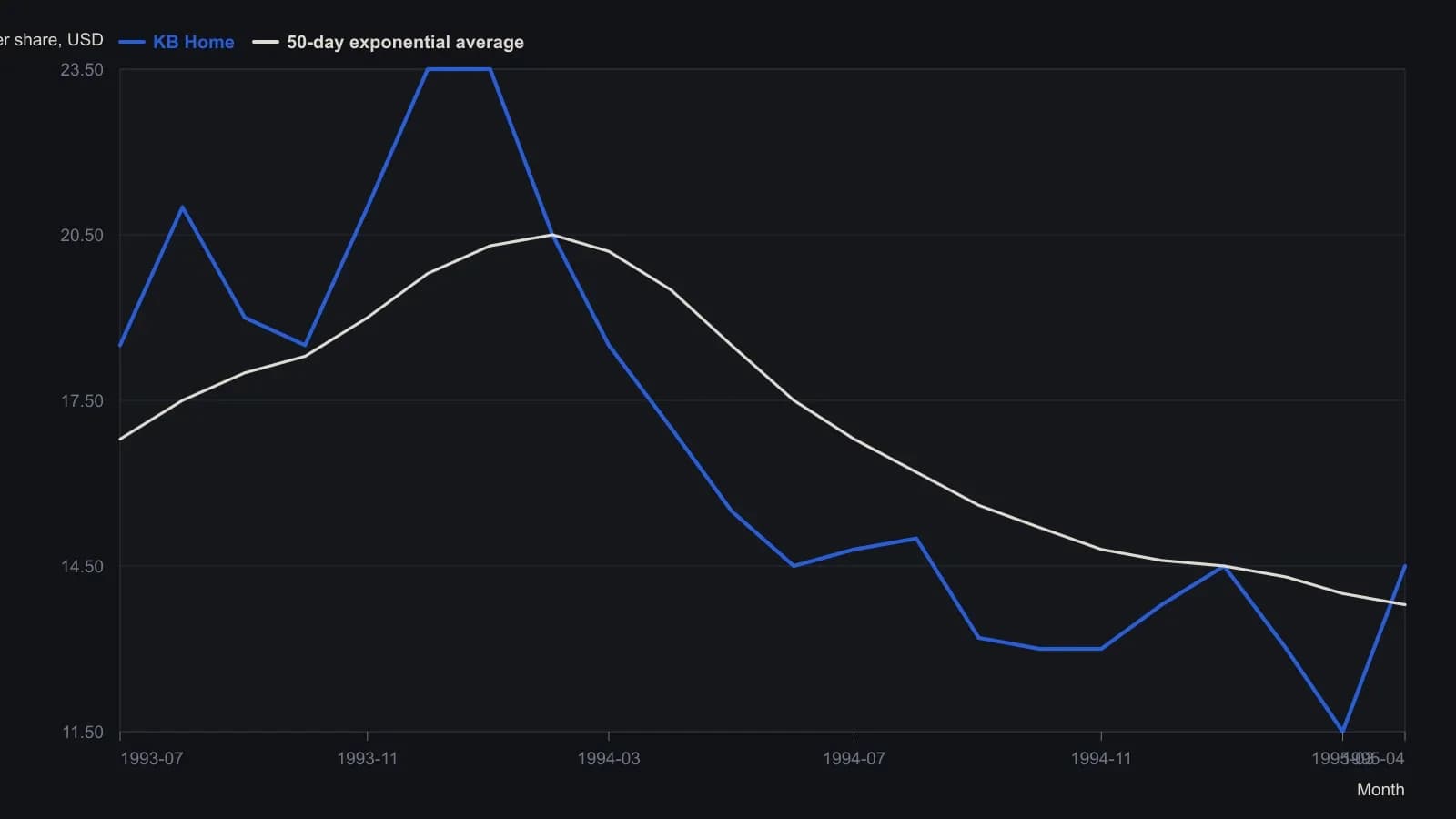
Read from a weekly Prophet candlestick raster on a one-dollar grid. The printed cursor gives a 13.00 close on 14 November 1994, and the 50-day exponential average is labeled 13.79 at the right edge. Monthly points are visual readings, not official prints.
All readings on this track · 23 readings
- 1985Industry leadership carryover as a bull-regime test
- 1988Constructing industry-group breadth and rotation measures
- 1992Trendline holds, trailing stops, and industry rotation
- 1994Inflation-deflation regimes inside the stock cycle
- 1996Sector rotation across economic cycle phases
- 2001Rebased relative performance charts for sector rotation
- 2001Place a small-cap growth idea inside a regime map
- 2004Rebuild every industry as a share of one rank scoreboard
- 2004Rate-hike regimes and sector rotation as a case study
- 2005A two-name style-index sleeve makes rank rotation one procedure
- 2006Consumer staples after a smokestack cycle
- 2007An intra-sector regime split between builders and equity REITs
- 2008Country and sector weights in an Africa regional-sleeve
- 2011Trend permission, priced entries, and sector rotation
- 2012Construct a regime-aware context from sector rotation
- 2012Regime overlays versus rank rotation
- 2014Rank-based sector rotation as a portfolio test
- 2017Real estate as a ranked industry sleeve
- 2017Theme sleeves: liquidity and commission filters before industry rotation
- 2018Retail sleeve construction through channel rotation and daily leverage
- 2020Water sleeve construction: satellite size, industry mix, and liquidity
- 2020A ranked research terminal as a three-layer watchlist procedure
- 2020Regression channels for sector rotation context