1992issue C101-6
Stop-first pyramid adds from locked profit
Adding contracts during a live trade is a different procedure from changing size only after a close. A shared trailing stop must first retire original capital, and only then may extra size be funded from a chosen reinvestment fraction of that locked cushion against the same stop distance.
- Adding contracts during a live trade is a different procedure from changing size only after a trade has been closed.
- A shared trailing stop first moves effective exposure from positive original risk to a negative reading of assured unrealized profit.
- The reinvestment fraction turns that locked cushion into additional exposure and incremental contract size, so net exposure on a locked-profit add stays at or below zero.
- Full reinvestment of locked profit is a special-case leverage expansion, because a retreat to the common stop can return the whole position to breakeven.
Adds during a live trade
Adding contracts during a live trade is a different procedure from changing size only after a trade has been closed. The two steps are not interchangeable.
The archive workflow advances a shared trailing stop for every lot in the position. That single protective stop is moved first to breakeven and then into locked profit, so original risk and any later add share the same exit bound.
Effective exposure on the standing position
Effective exposure is the dollar amount still at risk on the standing position. It is formed from entry price, the current stop, and contract count. The long form uses entry minus stop. The short form uses stop minus entry.
Until an unrealized profit exists, effective exposure is positive. A stop placed at the entry price sets that exposure to zero if prices do not gap through the stop.
After the trailing stop moves beyond breakeven, effective exposure becomes negative. That negative reading records assured unrealized profit: the portion of an open gain already protected by a stop placed beyond breakeven, assuming prices do not gap through that stop.
Funding the add from locked profit
The reinvestment fraction is the share of locked profit a trader is willing to put back at risk when adding size. It can range from none of the cushion to all of it. Zero means no add. One means the entire cushion is reused.
Additional exposure is the new dollar risk created by the add. It equals the reinvestment fraction times assured profit per contract times the existing contract count. Net exposure is that amount plus effective exposure. If the add is funded only from locked profit, net exposure on a winning trade stays at or below zero.
Incremental contract size is the added lots. It equals the reinvestment fraction times assured unrealized profits times current contracts, divided by the dollar risk allowed on each new contract.
Continuation patterns and the reinvestment fraction
A continuation-pattern add uses a consolidating flag, wedge, or symmetrical triangle to estimate remaining reward versus stop risk before choosing how large a fraction of locked profit to reinvest. Those consolidations supply explicit reward and risk references for the choice. A reward-to-risk ratio near 1 argues for a smaller reinvestment fraction.
A long gold illustration
In the long gold illustration, two contracts bought at 335 later have the stop raised to 345. That lock is 10 per ounce, or 2000 of assured profit, against 500 of risk per added contract. A reinvestment fraction of 0.25, 0.50, and 1.00 then sizes 1, 2, and 4 added contracts.
Scaled, symmetrical, and inverted adds
An add smaller than the standing position is a scaled-down pyramid. An add equal to the standing position is a symmetrical add. An add larger than the standing position is an inverted pyramid, also described as an inverted scaled-up pyramid. Larger plowback widens the profit swing between a further favorable move and a retreat to the common stop.
Full reinvestment of locked profit can return the whole position to breakeven if price falls back to the stop. That is why a complete plowback is treated as a special-case leverage expansion rather than a default.
Gold pyramid profits across four reinvestment fractions
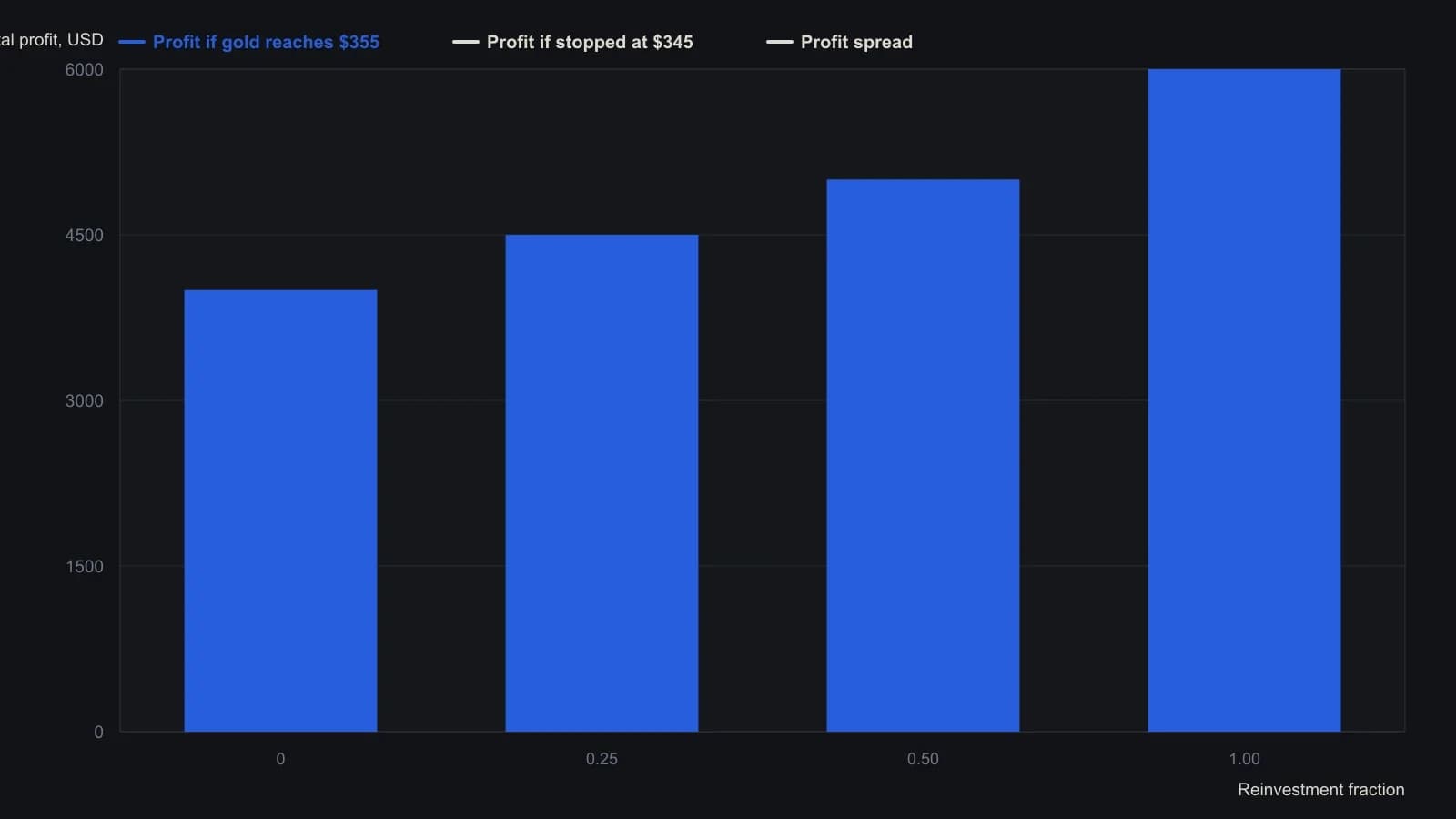
Source holds the starting book at two contracts, $500 of stop distance per added contract, and a common $345 stop on the whole position.
All readings on this track · 17 readings
- 1982Six-category classification as a trend and pyramiding case study
- 1986Fear signals an untested decision process
- 1987Paper lots, stop orders, and pyramids as a Wyckoff apprenticeship
- 1992A pre-trade checklist for locked stops and trend pyramiding
- 1992Stop-first pyramid adds from locked profit
- 1997Long-term trend following and pyramiding as one holding-period procedure
- 1999Pyramiding after a maximum favorable excursion support
- 1999Confirm early scale-ins, then shrink late units
- 2004Stacking crossovers, MACD and pyramiding across currency timeframes
- 2008Scale in after launch confirmation
- 2008Range-breakout trend entries with early stops and pyramids
- 2015Why win-rate chasing fails the decision process
- 2016Expectancy through loss cuts, add-ons, and bounded leverage
- 2018Wide-range breakout, trailing stops, and pyramiding
- 2019Inverse ETF pair daytrading with pyramiding and a trailing stop
- 2019One procedure for breakout entry, trailing stops, and pyramid adds
- 2020Scale-in construction for swing breakouts