2018issue C0432-37
Volume-confirmed pivots versus unregulated spot exposure
The archive used traded size to decide which short-horizon support and resistance bands were real enough to frame later bias. TradersWeek editorial reading: those confirmed levels still have to be booked on a venue that can actually pay them.
- Volume at a short-horizon support or resistance zone decides whether a pivot-level is significant enough to guide later bias.
- Confirmed bands are carried forward across sessions instead of being treated as same-bar noise.
- Longer-horizon direction can be frequently correct and still leave entries poorly timed, which is why volume-confirmation was added as an execution layer.
- Cash-market-exposure adds custody and intermediary risk that a listed-futures-safeguard is meant to remove, and a listing itself is not proof that the underlying market is durable.
How a pivot-level gets confirmed
Volume at a short-horizon support or resistance zone was used to decide whether a pivot-level was significant enough to guide later bias. In one illustrated case, traded volume clustered from 63.76 to 63.98 and then returned to 63.76, marking that band as a confirmed pivot.
That volume-confirmation treats traded size as the test of whether support or resistance is economically meaningful, instead of a visual line on a short-term chart. Mapped support and resistance can then be carried forward to frame the next session and later horizons, rather than treated as same-bar noise.
WTI ticks where added volume confirms the pivot
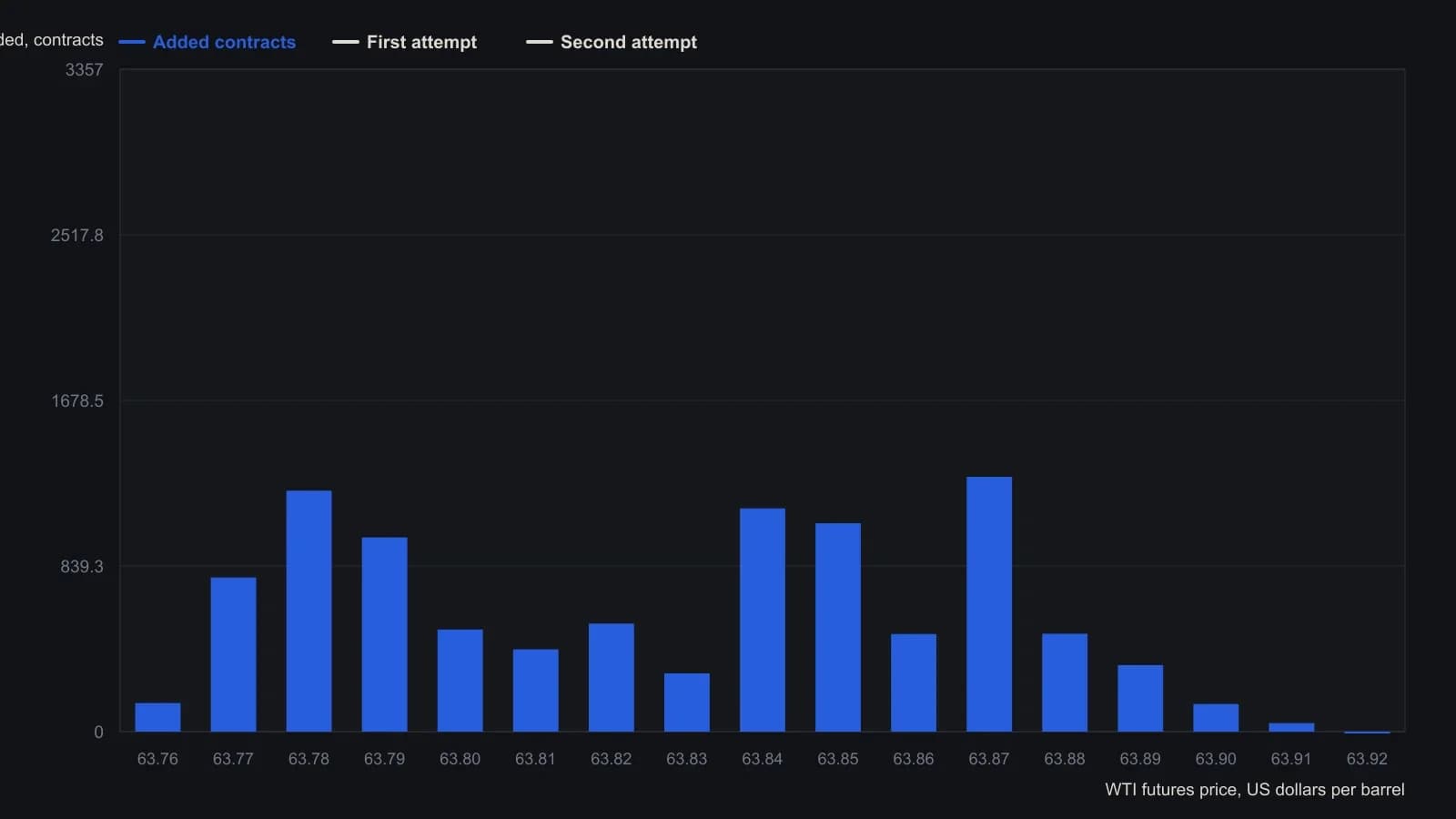
Total equals second-attempt contracts minus first-attempt contracts at the same tick. Prices above 63.92 have no second-attempt print in the source table and were left out rather than filled with zeros.
Direction can be right and still be mistimed
A tape-reading-analogue treats pivot interaction as the source of directional bias and of where price is likely to meet resistance or support. Bias is inferred from how price and size meet known levels, not from a complete historical rulebook.
Longer-horizon directional work can be frequently correct and still leave entries poorly timed. Volume-based pivots were added as an execution layer for that gap.
Collection depends on the venue
Unlike cash-market bitcoin, a listed futures position mainly requires being on the right side of the trade and posting required margin, because the exchange guarantees the transaction. That listed-futures-safeguard is the archive's reason for presenting the futures venue as the more efficient route if speculation in that volatile cash market is attempted at all. It offers stronger protection of speculator funds than a typical spot broker.
Cash-market-exposure holds the asset itself at an intermediary. Insolvent or fraudulent brokers, and lost access, can prevent gains from being realized even after a favorable price move.
All readings on this track · 51 readings
- 2002Single-stock futures and the sleeve that belongs on the ticket
- 2007Ethanol futures liquidity lagged the policy boom
- 2010Relative liquidity ranking for futures contract selection
- 2010A liquidity filter for executable futures contract selection
- 2010Screening futures by liquidity, open interest, and equal-dollar size
- 2010Ranking futures liquidity for executable contract choice
- 2010Liquidity and open interest screens for futures selection
- 2010Ranking futures by open interest and equal-dollar liquidity
- 2011Liquidity filter for futures contract selection
- 2011Futures liquidity rank as an execution filter
- 2011Silver contract-selection by size, hours, and carry
- 2011Filtering futures by liquidity, open interest and equal-dollar size
- 2011Liquidity and open interest as a screen for futures selection
- 2011A futures liquidity filter for equal-dollar execution
- 2012Ranking futures liquidity before choosing a contract
- 2013Liquidity-first futures contract selection
- 2013Equal-dollar liquidity filter for futures contract choice
- 2013Futures liquidity filters for executable contract selection
- 2013Filter listed futures by liquidity and open interest first
- 2013Ranking listed futures by liquidity and equal-dollar size
- 2013A pre-trade liquidity filter for futures contract selection
- 2014Why commodity futures are trades, not long-horizon holdings
- 2014Rank futures liquidity before selecting the contract
- 2014Filter futures by equal-dollar liquidity and open interest
- 2015Filter futures contracts by liquidity and open interest
- 2015A two-stage liquidity filter for futures contract selection
- 2015Screen futures contracts by liquidity and open interest
- 2015Equal-dollar futures choice as a liquidity filter
- 2016Evaluate futures liquidity before contract selection
- 2016Ranking futures liquidity before you pick the contract
- 2016Filter listed futures by relative liquidity and open interest
- 2017Evaluating futures liquidity for executable contract selection
- 2017A relative liquidity rank for choosing an executable futures contract
- 2017Constructing a futures liquidity filter for contract selection
- 2017Filter futures by liquidity, open interest, and equal-dollar size
- 2017Rank futures liquidity before contract selection
- 2017Build a futures liquidity filter from open interest
- 2018Evaluating futures liquidity for executable contract choice
- 2018Volume-confirmed pivots versus unregulated spot exposure
- 2018Executable futures selection from a 2018 liquidity board
- 2018Evaluate futures liquidity before contract selection
- 2018Open-interest liquidity filter for futures contract selection
- 2018Construct a futures liquidity filter from open interest and range
- 2018Ranking futures by liquidity, open interest, and equal-dollar cost
- 2019Ranking futures liquidity before contract selection
- 2019Ranking futures liquidity before you pick a contract
- 2019Screening futures by equal-dollar liquidity
- 2020Building an equal-dollar futures liquidity screen
- 2020Use liquidity and open interest as a futures execution screen
- 2020Compact index futures as diversified contract selection
- 2020Filter futures by range-scaled liquidity and open interest