2020issue C087
Compact index futures as diversified contract selection
Around 2020 a compact marketplace listed cash-settled index futures with equity-style ticks, a two-month-strip, and published basket weights. TradersWeek editorial reading treats those listing rules as a contract-selection check that comes before a directional view.
- Tick-equivalence and uniform-expiration let a compact index future be sized and dated with equity-style arithmetic instead of commodity point values.
- The two-month-strip and cash-settlement remove distant calendar spreads and physical delivery, so the live choice is which listed basket to hold.
- Published-basket-weights and the notional-multiplier show the dollar mix inside one lot and whether that mix is already an intermarket blend.
- The listed menu was a short set of diversified underlyings rather than a full single-commodity complex.
How the compact family was listed
Around 2020 a compact futures marketplace listed cash-settled index contracts priced like equities so profit, loss, and risk could be computed without memorizing traditional commodity point values. Three index futures were already trading and two more were planned, so the listed menu was a short set of diversified underlyings rather than a full single-commodity complex.
The archive facts describe that historical workflow. The editorial task is to read the same listing rules as a contract-selection step that comes before a directional view.
Tick-equivalence, expiry, and the two-month-strip
Every contract in that family moved in 0.01 increments worth one dollar. That tick-equivalence meant the contract could be sized with equity-style arithmetic. Every expiration fell on the third Friday of the month rather than on commodity-industry calendars, which is the uniform-expiration rule for the family.
Only the nearby month and the following month were listed at any time. Under that two-month-strip convention, calendar spreads beyond one month were not available. Because the contracts used cash-settlement, an unrolled position was adjusted to the difference between the entry price and the final settlement price instead of converting into physical delivery.
Published-basket-weights and the notional-multiplier
The published-basket-weights decided the intermarket exposure of a single position. The notional-multiplier was the factor of 100 applied to the displayed index price to obtain the dollar value of one contract.
The equity-basket contract held 75 names in five equally weighted sectors of 15 stocks each. Notional was 100 times the index, so a print of 50.00 implied 5000 dollars of stock exposure and the listed margin was 495 dollars.
The dollar-basket contract spread U.S. dollar exposure across seven currencies, with the euro at 33.9 percent, the Chinese renminbi at 21.3 percent, and the Mexican peso at 3.8 percent at the time of writing. Weights were updated annually. A print of 150.00 implied 15000 dollars of currency notional, and the listed margin was 159 dollars.
The precious-metals contract combined gold, silver, and platinum by global production, U.S. consumption, and trade volume. One contract then represented about 0.024 ounces of gold, 0.963 ounces of silver, and 0.0051 ounces of platinum, or roughly 69 percent, 24 percent, and 7 percent of the mix.
Small US Dollar published currency weights
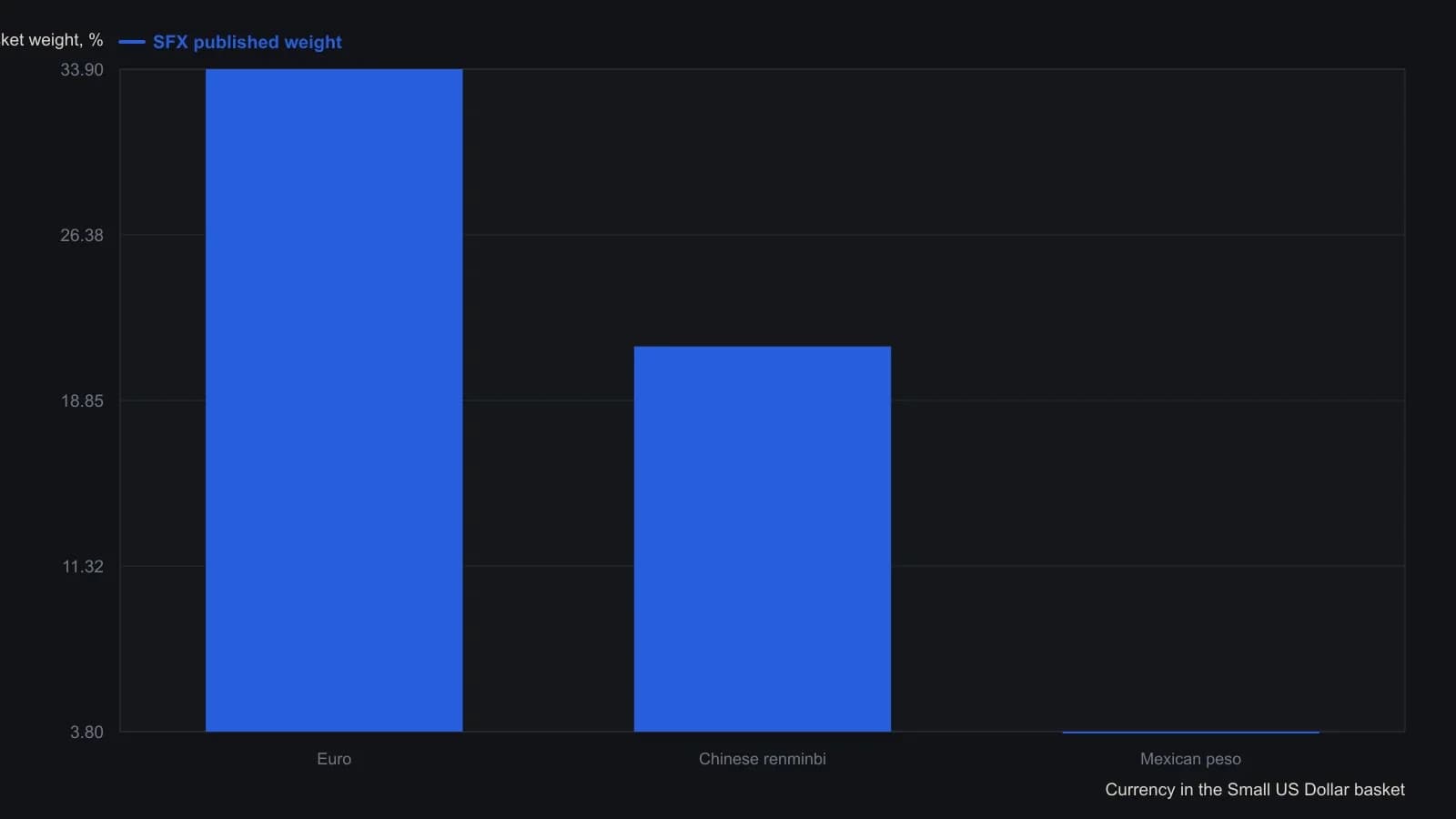
The source states that the allocation is updated annually and names only the largest two components and the smallest; remaining currencies in the seven-name basket are not given individual weights.
Editorial reading of the listed mix
Editorial reading: one equity-basket lot already embeds a five-sector stock mix, one dollar-basket lot already embeds a seven-currency mix, and one precious-metals lot already embeds a three-metal mix. The two-month-strip does not list a longer calendar that would separate those mixes.
The selection question is therefore which published basket belongs in the book, not which distant month of a single commodity to roll. The archive does not rank these contracts or state a later result.
All readings on this track · 51 readings
- 2002Single-stock futures and the sleeve that belongs on the ticket
- 2007Ethanol futures liquidity lagged the policy boom
- 2010Relative liquidity ranking for futures contract selection
- 2010A liquidity filter for executable futures contract selection
- 2010Screening futures by liquidity, open interest, and equal-dollar size
- 2010Ranking futures liquidity for executable contract choice
- 2010Liquidity and open interest screens for futures selection
- 2010Ranking futures by open interest and equal-dollar liquidity
- 2011Liquidity filter for futures contract selection
- 2011Futures liquidity rank as an execution filter
- 2011Silver contract-selection by size, hours, and carry
- 2011Filtering futures by liquidity, open interest and equal-dollar size
- 2011Liquidity and open interest as a screen for futures selection
- 2011A futures liquidity filter for equal-dollar execution
- 2012Ranking futures liquidity before choosing a contract
- 2013Liquidity-first futures contract selection
- 2013Equal-dollar liquidity filter for futures contract choice
- 2013Futures liquidity filters for executable contract selection
- 2013Filter listed futures by liquidity and open interest first
- 2013Ranking listed futures by liquidity and equal-dollar size
- 2013A pre-trade liquidity filter for futures contract selection
- 2014Why commodity futures are trades, not long-horizon holdings
- 2014Rank futures liquidity before selecting the contract
- 2014Filter futures by equal-dollar liquidity and open interest
- 2015Filter futures contracts by liquidity and open interest
- 2015A two-stage liquidity filter for futures contract selection
- 2015Screen futures contracts by liquidity and open interest
- 2015Equal-dollar futures choice as a liquidity filter
- 2016Evaluate futures liquidity before contract selection
- 2016Ranking futures liquidity before you pick the contract
- 2016Filter listed futures by relative liquidity and open interest
- 2017Evaluating futures liquidity for executable contract selection
- 2017A relative liquidity rank for choosing an executable futures contract
- 2017Constructing a futures liquidity filter for contract selection
- 2017Filter futures by liquidity, open interest, and equal-dollar size
- 2017Rank futures liquidity before contract selection
- 2017Build a futures liquidity filter from open interest
- 2018Evaluating futures liquidity for executable contract choice
- 2018Volume-confirmed pivots versus unregulated spot exposure
- 2018Executable futures selection from a 2018 liquidity board
- 2018Evaluate futures liquidity before contract selection
- 2018Open-interest liquidity filter for futures contract selection
- 2018Construct a futures liquidity filter from open interest and range
- 2018Ranking futures by liquidity, open interest, and equal-dollar cost
- 2019Ranking futures liquidity before contract selection
- 2019Ranking futures liquidity before you pick a contract
- 2019Screening futures by equal-dollar liquidity
- 2020Building an equal-dollar futures liquidity screen
- 2020Use liquidity and open interest as a futures execution screen
- 2020Compact index futures as diversified contract selection
- 2020Filter futures by range-scaled liquidity and open interest