2018issue C0758
Open-interest liquidity filter for futures contract selection
Listed futures are restated on one executable scale before directional size is chosen. A liquidity filter multiplies an equal-dollar contract count by open interest and a volume factor so relative contract liquidity decides which market can be entered and exited.
- A liquidity filter ranks listed futures by how readily a position can be implemented, using size, range, activity, and open interest rather than a price forecast.
- Markets are first equalized with an equal-dollar contract count from contract or tick dollar value times a three-year dollar range of maximum price travel.
- Relative contract liquidity is that count multiplied by total open interest and by a volume factor that floors thin markets and lifts very active ones.
- Effective percent margin expresses posted margin as a share of the same three-year dollar range, and contracts with one activity mark or none are treated as weaker speculative candidates.
A common executable scale
The archive workflow rebuilds every listed future onto one executable scale. Open interest, a three-year dollar range, and a volume adjustment are used to judge which market can be entered and exited. Futures contract selection is the later choice among listed expiries and products after each market has been restated on that common dollar-range and liquidity scale.
A liquidity filter is a pre-trade screen that ranks listed futures by how readily a position can be implemented, using size, range, activity, and open interest rather than a price forecast. Open interest analysis uses outstanding contract inventory as a capacity input so a market is judged by how much size is already on, not only by recent prints.
Equal-dollar contract count
Markets are first equalized by counting how many contracts produce the same dollar profit potential. That equal-dollar contract count uses contract or tick dollar value times the three-year maximum price excursion.
The price-move input is taken from a three-year window of maximum conceivable or observed price travel. That lookback is the three-year dollar range used when converting a contract into comparable dollars.
Relative contract liquidity and the volume factor
A relative futures-liquidity score can be constructed as the product of contract point value, a historically observed maximum price move, open interest, and a volume adjustment. Relative contract liquidity is then the equal-dollar contract count multiplied by total open interest and by a volume factor. The rank is comparative and is meaningful only against other contracts in the same construction.
The volume factor is the greater of 1 and exp(ln(volume) / ln(5000) - 2). It is described as typically falling in a 1-to-4 range when activity is unusually low or high. The multiplier lifts very active markets and floors thin ones so raw open interest is not treated as executable size by itself.
Equal-dollar contract counts across listed futures
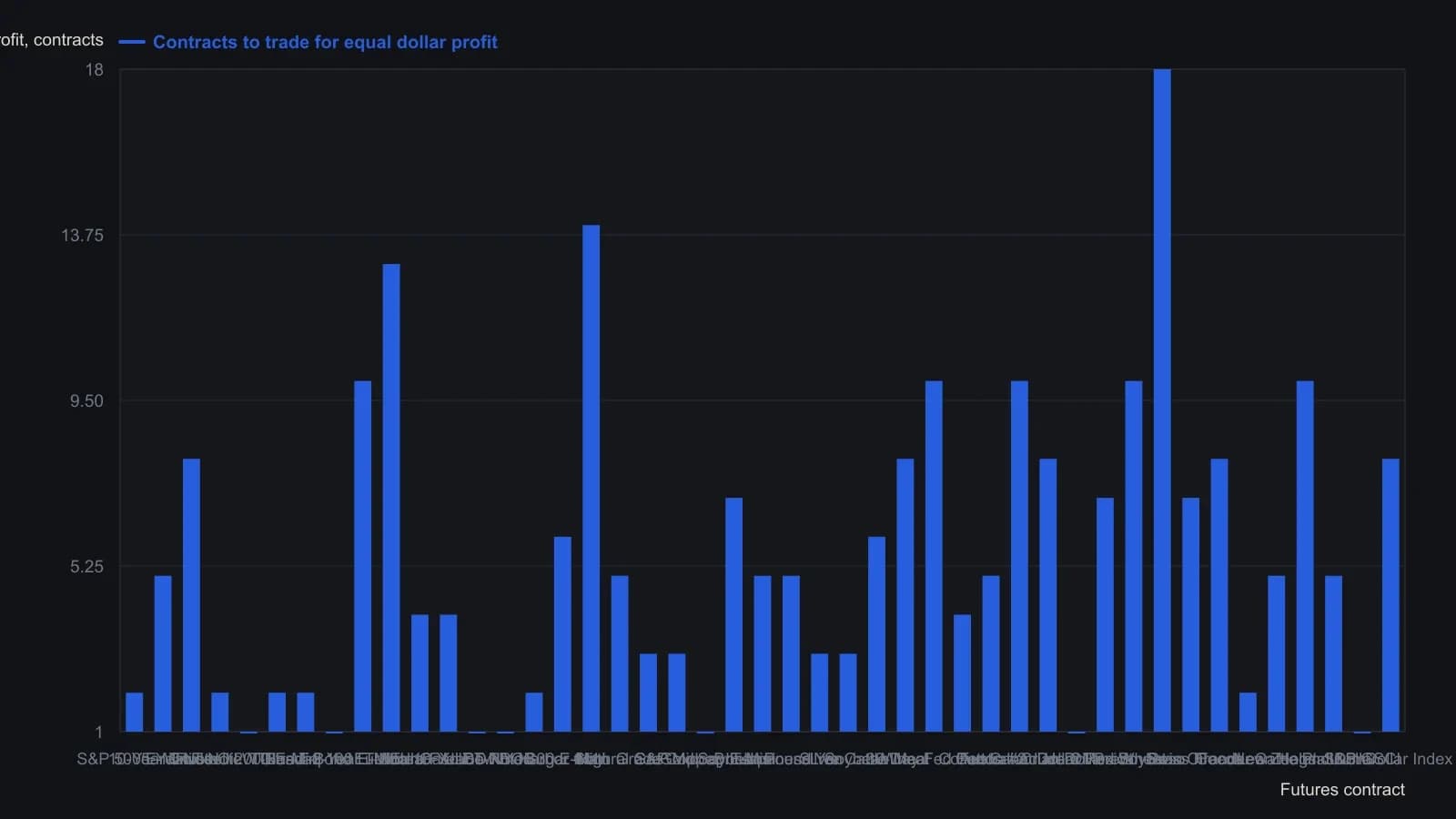
The magazine holds tick value times the three-year maximum price excursion equal across the column. Relative-liquidity dots on the original page are a separate ranking (this count times open interest times a volume factor) and are not converted into a numeric series here.
Effective percent margin and thin activity
Effective percent margin is constructed as margin dollars divided by the three-year dollar range of the contract, then multiplied by 100. Posted margin is thereby expressed as a share of the contract's multi-year dollar range, so capital use is compared to realized travel rather than face value alone.
Contracts showing one activity mark or none are treated as having little trading activity and therefore as weaker candidates for speculative execution. For listed shares, period volume as a percentage of shares outstanding is offered as a turnover-rate proxy for trading liquidity.
All readings on this track · 51 readings
- 2002Single-stock futures and the sleeve that belongs on the ticket
- 2007Ethanol futures liquidity lagged the policy boom
- 2010Relative liquidity ranking for futures contract selection
- 2010A liquidity filter for executable futures contract selection
- 2010Screening futures by liquidity, open interest, and equal-dollar size
- 2010Ranking futures liquidity for executable contract choice
- 2010Liquidity and open interest screens for futures selection
- 2010Ranking futures by open interest and equal-dollar liquidity
- 2011Liquidity filter for futures contract selection
- 2011Futures liquidity rank as an execution filter
- 2011Silver contract-selection by size, hours, and carry
- 2011Filtering futures by liquidity, open interest and equal-dollar size
- 2011Liquidity and open interest as a screen for futures selection
- 2011A futures liquidity filter for equal-dollar execution
- 2012Ranking futures liquidity before choosing a contract
- 2013Liquidity-first futures contract selection
- 2013Equal-dollar liquidity filter for futures contract choice
- 2013Futures liquidity filters for executable contract selection
- 2013Filter listed futures by liquidity and open interest first
- 2013Ranking listed futures by liquidity and equal-dollar size
- 2013A pre-trade liquidity filter for futures contract selection
- 2014Why commodity futures are trades, not long-horizon holdings
- 2014Rank futures liquidity before selecting the contract
- 2014Filter futures by equal-dollar liquidity and open interest
- 2015Filter futures contracts by liquidity and open interest
- 2015A two-stage liquidity filter for futures contract selection
- 2015Screen futures contracts by liquidity and open interest
- 2015Equal-dollar futures choice as a liquidity filter
- 2016Evaluate futures liquidity before contract selection
- 2016Ranking futures liquidity before you pick the contract
- 2016Filter listed futures by relative liquidity and open interest
- 2017Evaluating futures liquidity for executable contract selection
- 2017A relative liquidity rank for choosing an executable futures contract
- 2017Constructing a futures liquidity filter for contract selection
- 2017Filter futures by liquidity, open interest, and equal-dollar size
- 2017Rank futures liquidity before contract selection
- 2017Build a futures liquidity filter from open interest
- 2018Evaluating futures liquidity for executable contract choice
- 2018Volume-confirmed pivots versus unregulated spot exposure
- 2018Executable futures selection from a 2018 liquidity board
- 2018Evaluate futures liquidity before contract selection
- 2018Open-interest liquidity filter for futures contract selection
- 2018Construct a futures liquidity filter from open interest and range
- 2018Ranking futures by liquidity, open interest, and equal-dollar cost
- 2019Ranking futures liquidity before contract selection
- 2019Ranking futures liquidity before you pick a contract
- 2019Screening futures by equal-dollar liquidity
- 2020Building an equal-dollar futures liquidity screen
- 2020Use liquidity and open interest as a futures execution screen
- 2020Compact index futures as diversified contract selection
- 2020Filter futures by range-scaled liquidity and open interest