2010issue C0793
Ranking futures liquidity for executable contract choice
A relative contract liquidity rank sorts listed futures by combining a scaled contract count, total open interest, and a volume factor. The same three-year range then equalizes contract size and effective percent margin so each column is read only against the other markets in that column.
- Relative contract liquidity combines a scaled contract count, total open interest, and a volume factor, then displays the result as more or fewer marks.
- The volume factor is the greater of 1 and the exponential of natural-log volume minus 2, with volume measured in units of 5000.
- Contracts to trade for equal dollar profit and effective percent margin both use the three-year dollar range, so size and margin sit on the same lookback.
- Contracts with one mark or none are treated as low-activity markets and are less suitable when the goal is executable size.
What the rank combines
A relative liquidity rank for listed futures can be built by combining a scaled contract count, total open interest, and a volume factor. Relative contract liquidity is then shown as more or fewer marks so markets can be compared for ease of trading.
Open interest is the stock of outstanding futures positions. Used together with volume, it is used to judge how much size the market can absorb. The volume factor in that rank is the greater of 1 and the exponential of natural-log volume minus 2, with volume measured in units of 5000.
Scale every market to the same dollar range
Contracts needed for an equal dollar range equal tick dollar value times the three-year maximum price excursion, so every market in that column is scaled to the same dollar value. That figure is the contracts to trade for equal dollar profit count. Each listed count therefore represents the same dollar exposure.
Compare margin on the same lookback
Effective percent margin is margin dollars divided by the three-year dollar range of the contract, then multiplied by 100. Margin use can then be compared on the same lookback used to scale the contracts.
Use the marks as a liquidity filter
Markets at the top of the relative-liquidity column are described as easier to buy and sell. Markets at the bottom are described as the most difficult. Contracts shown with one mark or none are treated as low-activity markets and therefore less suitable when the goal is executable size.
A liquidity filter keeps contracts with dense activity marks and drops thin markets before a trade is sized.
What the July 2010 ranking showed
In the July 2010 ranking, short-rate contracts such as three-month Euribor and Eurodollar sit at the top of the liquidity marks, while many agricultural, metal, and currency contracts sit near the bottom.
Contracts needed to match the same three-year dollar range
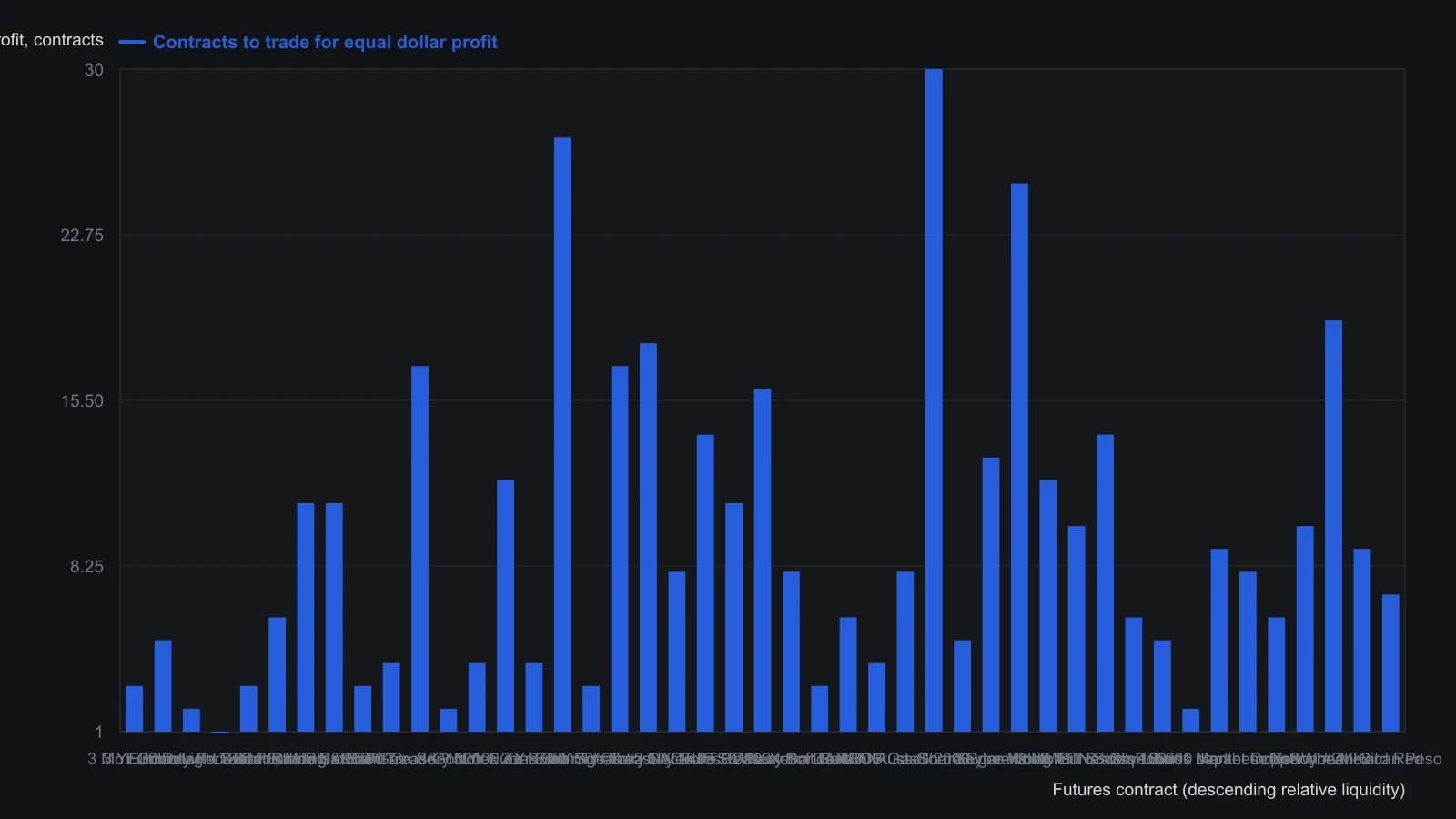
Each bar uses the same three-year maximum price excursion, so the dollar profit being equalized is identical across names. Relative-liquidity dots from the source are a separate ranking and are not plotted here.
Editorial reading of the workflow
Editorial. TradersWeek reads this archive workflow as a construction problem for the futures shortlist, not as a claim about returns. First apply the liquidity filter so only markets that can actually be entered and exited remain. Then size with the contracts to trade for equal dollar profit count so a comparable dollar move is comparable. Then check how much effective percent margin that choice consumes against the same three-year range.
Futures contract selection, in this editorial reading, is the last step. It is the choice of which listed contract to trade after liquidity rank, scaled contract count, and margin efficiency have been compared across markets.
All readings on this track · 51 readings
- 2002Single-stock futures and the sleeve that belongs on the ticket
- 2007Ethanol futures liquidity lagged the policy boom
- 2010Relative liquidity ranking for futures contract selection
- 2010A liquidity filter for executable futures contract selection
- 2010Screening futures by liquidity, open interest, and equal-dollar size
- 2010Ranking futures liquidity for executable contract choice
- 2010Liquidity and open interest screens for futures selection
- 2010Ranking futures by open interest and equal-dollar liquidity
- 2011Liquidity filter for futures contract selection
- 2011Futures liquidity rank as an execution filter
- 2011Silver contract-selection by size, hours, and carry
- 2011Filtering futures by liquidity, open interest and equal-dollar size
- 2011Liquidity and open interest as a screen for futures selection
- 2011A futures liquidity filter for equal-dollar execution
- 2012Ranking futures liquidity before choosing a contract
- 2013Liquidity-first futures contract selection
- 2013Equal-dollar liquidity filter for futures contract choice
- 2013Futures liquidity filters for executable contract selection
- 2013Filter listed futures by liquidity and open interest first
- 2013Ranking listed futures by liquidity and equal-dollar size
- 2013A pre-trade liquidity filter for futures contract selection
- 2014Why commodity futures are trades, not long-horizon holdings
- 2014Rank futures liquidity before selecting the contract
- 2014Filter futures by equal-dollar liquidity and open interest
- 2015Filter futures contracts by liquidity and open interest
- 2015A two-stage liquidity filter for futures contract selection
- 2015Screen futures contracts by liquidity and open interest
- 2015Equal-dollar futures choice as a liquidity filter
- 2016Evaluate futures liquidity before contract selection
- 2016Ranking futures liquidity before you pick the contract
- 2016Filter listed futures by relative liquidity and open interest
- 2017Evaluating futures liquidity for executable contract selection
- 2017A relative liquidity rank for choosing an executable futures contract
- 2017Constructing a futures liquidity filter for contract selection
- 2017Filter futures by liquidity, open interest, and equal-dollar size
- 2017Rank futures liquidity before contract selection
- 2017Build a futures liquidity filter from open interest
- 2018Evaluating futures liquidity for executable contract choice
- 2018Volume-confirmed pivots versus unregulated spot exposure
- 2018Executable futures selection from a 2018 liquidity board
- 2018Evaluate futures liquidity before contract selection
- 2018Open-interest liquidity filter for futures contract selection
- 2018Construct a futures liquidity filter from open interest and range
- 2018Ranking futures by liquidity, open interest, and equal-dollar cost
- 2019Ranking futures liquidity before contract selection
- 2019Ranking futures liquidity before you pick a contract
- 2019Screening futures by equal-dollar liquidity
- 2020Building an equal-dollar futures liquidity screen
- 2020Use liquidity and open interest as a futures execution screen
- 2020Compact index futures as diversified contract selection
- 2020Filter futures by range-scaled liquidity and open interest