2010issue C1293
Ranking futures by open interest and equal-dollar liquidity
A listed-futures liquidity rank multiplies contract point value, a three-year maximum conceivable price move, open interest, and a volume adjustment. Contracts-to-trade for equal dollar profit puts every market on the same historical dollar range, and relative contract liquidity then orders how readily those books can be traded.
- A listed-futures liquidity rank multiplies contract point value, a three-year maximum conceivable price move, open interest, and a volume adjustment usually between 1 and 4.
- Contracts-to-trade for equal dollar profit scales each market so every count represents the same historical dollar range, then relative contract liquidity orders those books by how readily they can be traded.
- Contracts marked with one activity indicator or none are treated as thinly traded, and a liquidity filter drops them before a directional idea is treated as interchangeable with more active names.
- Effective percent margin places posted dollar margin on that shared three-year dollar range so it can be compared with ordinary percent margin.
Forming a listed-futures liquidity rank
A listed-futures liquidity rank can be formed by multiplying contract point value, a three-year maximum conceivable price move, open interest, and a volume adjustment usually between 1 and 4.
The open-interest weight is the outstanding-contract count. It stands for the size of the book that must be absorbed when ranking how executable a future is.
The volume factor is a multiplier, typically from 1 to 4, that down-weights very thin or extremely heavy volume when the liquidity rank is formed.
Contracts to trade for equal dollar profit
Contracts-to-trade for equal dollar profit scales each market by tick dollar value times the three-year maximum price excursion so every count in that column represents the same historical dollar range.
Contracts to trade for equal three-year dollar profit
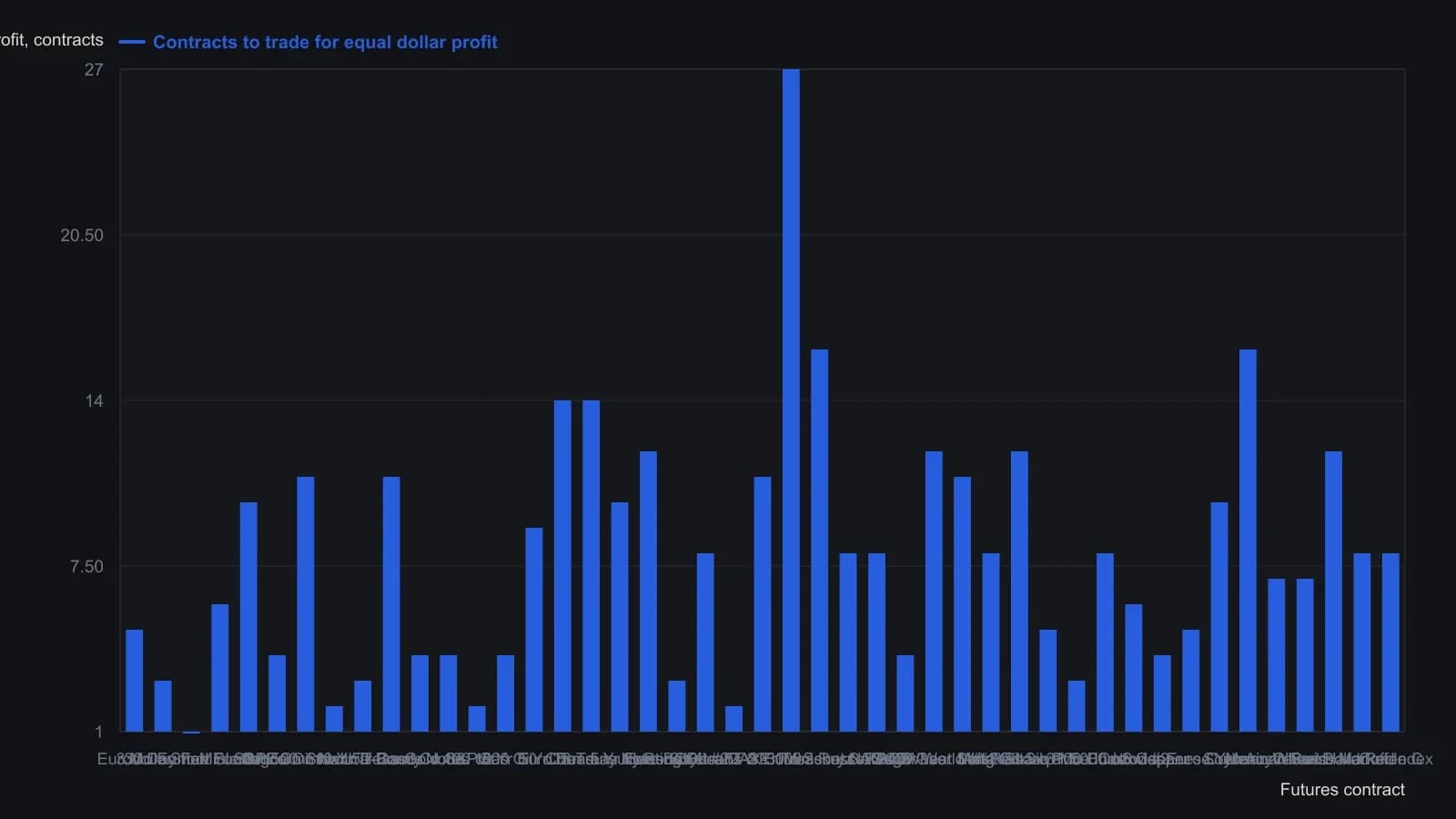
Contracts to trade equals tick dollar value times the three-year maximum price excursion, so every name is scaled to the same historical dollar range. Relative-contract-liquidity dots are a separate ranking and are not plotted here.
Relative contract liquidity
Relative contract liquidity is defined as the equal-dollar contract count times total open interest times a volume factor equal to the greater of 1 or exp(ln volume / ln 5000) minus 2.
Each liquidity comparison is a proportional measure. Names at the top of the relative-liquidity column are easier to buy and sell than those at the bottom, and a figure is meaningful only against other entries in the same column.
A liquidity filter for thin names
On that rank, contracts marked with one activity indicator or none are treated as thinly traded and therefore less suitable when a speculator must enter and exit.
A liquidity filter is a pre-trade screen that drops thinly marked contracts before a directional futures idea is treated as interchangeable with more active names.
Posted margin on the same dollar range
Effective percent margin is posted dollar margin divided by the three-year price range of the contract's dollar value, then multiplied by 100.
Percent margin and effective percent margin are offered as a side-by-side comparison of how posted margin maps onto that shared three-year dollar range.
A turnover proxy in listed shares
For listed shares, period volume as a percentage of shares outstanding is treated as a turnover-rate proxy for trading liquidity.
All readings on this track · 51 readings
- 2002Single-stock futures and the sleeve that belongs on the ticket
- 2007Ethanol futures liquidity lagged the policy boom
- 2010Relative liquidity ranking for futures contract selection
- 2010A liquidity filter for executable futures contract selection
- 2010Screening futures by liquidity, open interest, and equal-dollar size
- 2010Ranking futures liquidity for executable contract choice
- 2010Liquidity and open interest screens for futures selection
- 2010Ranking futures by open interest and equal-dollar liquidity
- 2011Liquidity filter for futures contract selection
- 2011Futures liquidity rank as an execution filter
- 2011Silver contract-selection by size, hours, and carry
- 2011Filtering futures by liquidity, open interest and equal-dollar size
- 2011Liquidity and open interest as a screen for futures selection
- 2011A futures liquidity filter for equal-dollar execution
- 2012Ranking futures liquidity before choosing a contract
- 2013Liquidity-first futures contract selection
- 2013Equal-dollar liquidity filter for futures contract choice
- 2013Futures liquidity filters for executable contract selection
- 2013Filter listed futures by liquidity and open interest first
- 2013Ranking listed futures by liquidity and equal-dollar size
- 2013A pre-trade liquidity filter for futures contract selection
- 2014Why commodity futures are trades, not long-horizon holdings
- 2014Rank futures liquidity before selecting the contract
- 2014Filter futures by equal-dollar liquidity and open interest
- 2015Filter futures contracts by liquidity and open interest
- 2015A two-stage liquidity filter for futures contract selection
- 2015Screen futures contracts by liquidity and open interest
- 2015Equal-dollar futures choice as a liquidity filter
- 2016Evaluate futures liquidity before contract selection
- 2016Ranking futures liquidity before you pick the contract
- 2016Filter listed futures by relative liquidity and open interest
- 2017Evaluating futures liquidity for executable contract selection
- 2017A relative liquidity rank for choosing an executable futures contract
- 2017Constructing a futures liquidity filter for contract selection
- 2017Filter futures by liquidity, open interest, and equal-dollar size
- 2017Rank futures liquidity before contract selection
- 2017Build a futures liquidity filter from open interest
- 2018Evaluating futures liquidity for executable contract choice
- 2018Volume-confirmed pivots versus unregulated spot exposure
- 2018Executable futures selection from a 2018 liquidity board
- 2018Evaluate futures liquidity before contract selection
- 2018Open-interest liquidity filter for futures contract selection
- 2018Construct a futures liquidity filter from open interest and range
- 2018Ranking futures by liquidity, open interest, and equal-dollar cost
- 2019Ranking futures liquidity before contract selection
- 2019Ranking futures liquidity before you pick a contract
- 2019Screening futures by equal-dollar liquidity
- 2020Building an equal-dollar futures liquidity screen
- 2020Use liquidity and open interest as a futures execution screen
- 2020Compact index futures as diversified contract selection
- 2020Filter futures by range-scaled liquidity and open interest