1990issue C091-2
Synthetic option parity in limit-locked futures
When a commodity future locks at its daily trading limit, the listed month can stop accepting orders. This archive case follows a locked soybean session and a same-day wheat comparison through contract selection, the same-strike synthetic long, and conversion linkage.
- A daily trading limit can halt further trade in the direction of a large move and leave an existing futures position unable to exit in the listed contract.
- When the listed month is locked, an earlier workaround was to select another delivery or a related commodity that was still open and hold that market as a spread against the frozen position.
- Buying a call and selling a put at the same strike builds a synthetic long futures position intended to move with the underlying contract even while that contract is locked.
- When the listed future is locked limit-up or limit-down, the still-trading synthetic can adjust a directional position and show how much strength sits beyond the posted limit.
Many commodity futures sessions halt further trade in the direction of a large move once price has traveled a set distance from the prior close. That daily trading limit can leave an existing futures position unable to exit in the listed contract.
A locked-limit session
A locked-limit session is a session in which the listed future is bid or offered at the allowed extreme and cannot print a farther price, while options on that contract may still trade.
Selecting a contract that can still trade
When the listed month is locked, an earlier workaround was to select another delivery or a related commodity that was still open and hold that market as a spread against the frozen position. Contract selection asks which delivery month or related commodity is still open, and whether the target listing is locked, so any hedge is placed in a market that can still accept orders.
The same-strike synthetic long
Buying a call and selling a put at the same strike builds a synthetic long futures position intended to move with the underlying contract even while that contract is locked at its daily limit. That option spread, the paired purchase and sale of a call and a put at one strike, funds and prices the synthetic futures equivalent so the package tracks the listed contract when the future cannot trade through its daily limit.
A locked soybean print
On 5 July 1989, November 1989 soybeans finished limit bid at 7.02 while the 7.00 call settled at 55.5 cents and the 7.00 put at 44 cents, so the same-strike synthetic long cost about 11.5 cents. After removing about 2 cents of intrinsic value from those 7.00 calls, the soybean synthetic stood about 9.5 cents above the locked futures print, which was the price at which a long equivalent could still be bought.
A trader already short that locked soybean future could open the long synthetic as protection against a further advance that the listed contract could not yet print.
Conversion in an unrestricted session
Listed futures and the same-strike synthetic stay linked by conversion. In an unrestricted session, buying the cheaper futures and selling the synthetic long continues until the two prices reconverge. That conversion-arbitrage buys the cheaper of the listed future and the synthetic long and sells the richer until those prices reconverge.
A same-day wheat comparison
On the same date, December 1989 wheat closed at 4.23-3/4, up 8.5 cents, and the 4.20 call and put showed matching 18-cent residual time value after 3.75 cents of call intrinsic value was removed.
What still updates at the limit
When the listed future is locked limit-up or limit-down, the still-trading synthetic both allows a directional position to be adjusted and shows how much strength sits beyond the posted limit.
Locked November soybeans: synthetic long versus the limit
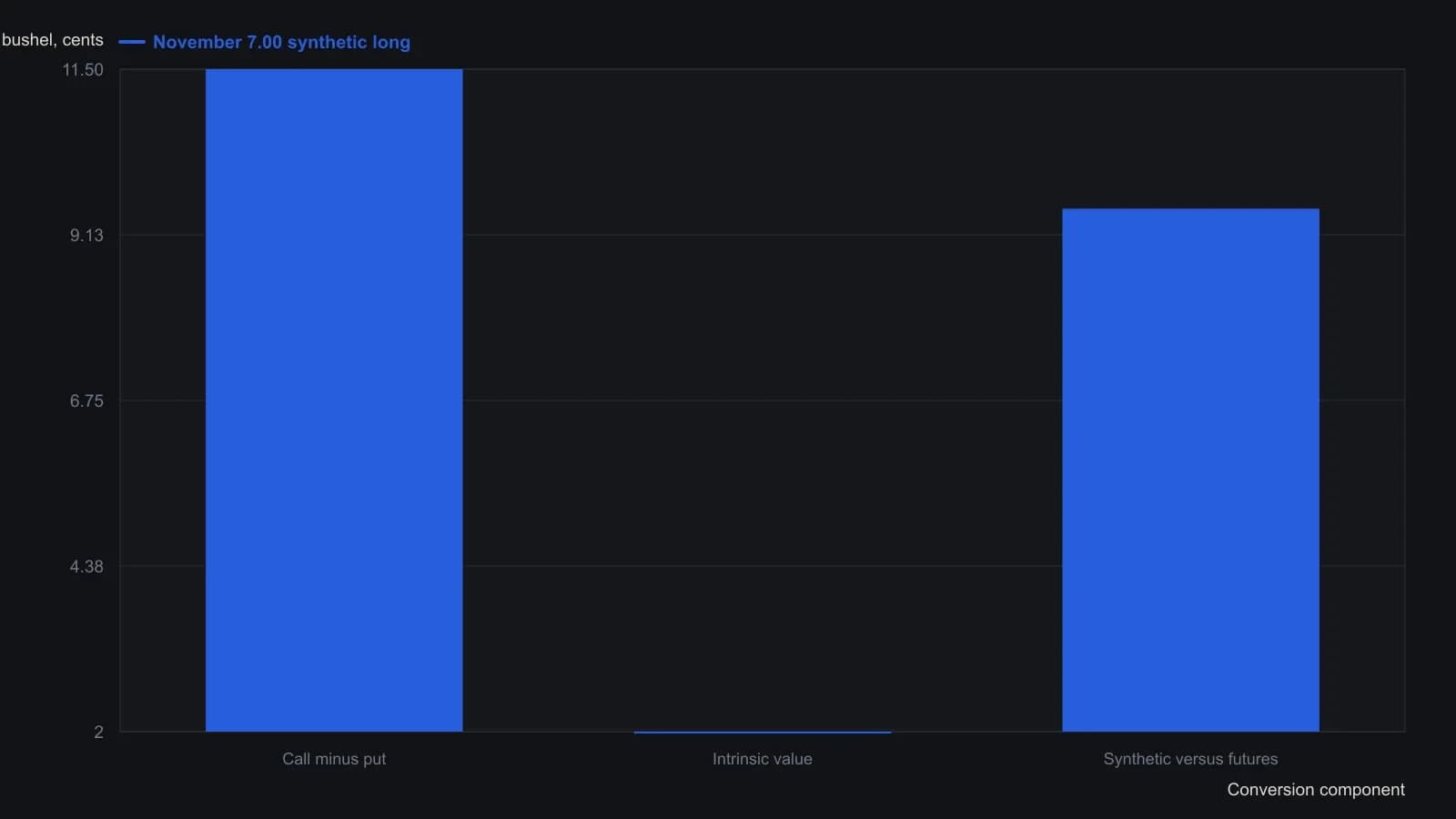
Nearest-the-money 7.00 strike on CBT November 1989 soybeans; the article notes any same-strike call-and-put pair leaves the same residual after intrinsic.
All readings on this track · 16 readings
- 1990Synthetic option parity in limit-locked futures
- 1991Constructing synthetic option positions with puts and spreads
- 1991Synthetic stock and protective put payoff construction
- 1993Equivalent option strategies as a capital and execution checklist
- 1993Keep a futures loss bounded when stops fail
- 2001Financed call ratio repair for a gapped long
- 2003Synthetic long construction with delta and margin checks
- 2003Cash-covered split-synthetic after a decline
- 2004Constructing synthetic calls and puts with stock
- 2006In-the-money calls as bounded synthetic leverage
- 2006Credit construction of a synthetic long call via futures and a long put
- 2006Convert a support-and-resistance range into one synthetic option procedure
- 2007Long-call adjustment via a synthetic straddle
- 2008Constructing protective puts and synthetic option packages
- 2018An uneven vertical debit spread as a stock proxy
- 2020Out-of-the-money strikes as a delta budget for synthetic futures