2018issue C0658
Evaluate futures liquidity before contract selection
Treat listed-futures contract choice as an execution exam. Convert a three-year price range into an equal-dollar unit, then let open interest and a volume factor decide whether that size is bookable.
- Restate each listed market as an equal-dollar unit by combining contract value with the largest three-year price change so every candidate is sized on the same dollar swing.
- Relative contract liquidity multiplies that contracts-to-trade count by total open interest and a volume factor floored at one, so a wide range cannot disguise a thin book.
- Each ranking column is meaningful only against other contracts in the same column. More activity marks mean more trading, and one mark or none indicates a thin book treated as less suitable for speculative use.
- On the 2018 listing, equity-index and Treasury-note futures held the highest relative-liquidity ranks, while several agricultural, metal, and currency contracts sat at a single mark.
Contract choice as an execution exam
TradersWeek editorial reading: contract choice is an execution exam. Convert a three-year range into an equal-dollar contract count, then let open interest and a volume factor decide whether that size is bookable. A market is eligible only when the book can carry the implementation implied by its own history.
A listed-futures liquidity rank can be formed by multiplying contract point value, a three-year historical maximum price move, open interest, and a volume adjustment usually set between 1 and 4.
Build an equal-dollar unit
An equal-dollar column multiplies contract value by the largest price change observed in the prior three years so every entry in that column represents the same dollar unit.
The contracts-to-trade count equals tick dollar value times the three-year maximum price excursion. That count is the equal-dollar unit: the number of contracts required to match the same three-year historical dollar swing as other listed markets.
In this workflow, futures contract selection means choosing among listed markets and expiries only after candidates have been restated on one equal-dollar unit and ranked by how readily that unit can be implemented.
Contracts to trade for equal dollar profit, June 2018
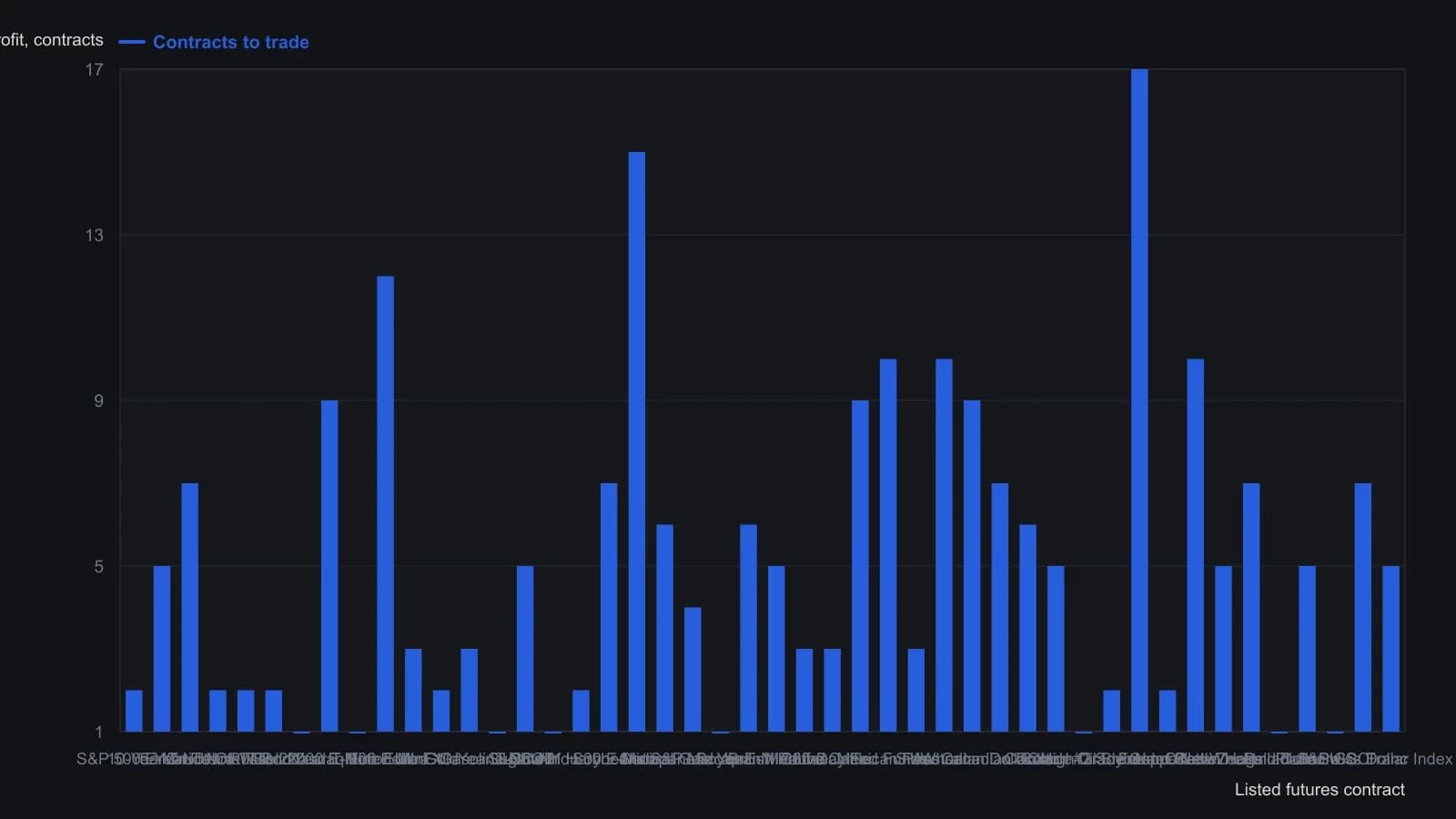
Each count is tick dollar value times the prior three-year maximum price excursion, so every bar shares one dollar scale. Rows stay in the source’s relative-liquidity order (that count times open interest times a volume factor), not sorted by the count itself.
Test the book with open interest
Relative contract liquidity equals that contracts-to-trade count times total open interest times a volume factor. The product is a cross-market ranking of how readily an entire listed complex can be bought or sold, built from the equal-dollar unit, open interest, and the volume factor.
Open interest analysis uses outstanding contracts as the capacity term in that liquidity product so a wide historical range cannot disguise a book too small to absorb the implied size.
The volume factor is the greater of 1 and the exponential of the natural log of volume divided by the natural log of 5000, minus 2. It is a multiplier floored at one that reduces the liquidity product when volume is thin relative to a 5000-contract logarithmic benchmark.
A liquidity filter keeps only listed contracts whose activity, book size, and implementation cost can support an executable order over the life of that order.
Activity marks on the 2018 listing
Relative activity is marked on a comparative scale. More marks indicate more trading, and one mark or none indicates a thin book treated as less suitable for speculative use.
On the 2018 listing, equity-index and Treasury-note futures occupied the highest relative-liquidity ranks, while several agricultural, metal, and currency contracts sat at a single mark.
Effective percent margin
Effective percent margin equals posted margin dollars divided by the contract's three-year dollar price range, then multiplied by 100. It expresses posted margin as a percentage of the same three-year dollar range used to size the equal-dollar unit.
Equity turnover as a contrast
Equity trading liquidity is framed as period volume divided by shares outstanding, a turnover rate used as a proxy for how easily a stock can be traded.
TradersWeek editorial note: that turnover rate is a stock-market contrast. It is not the futures product of equal-dollar unit, open interest, and volume factor.
Editorial reading
TradersWeek editorial reading: a listed market clears this exam only when its book can carry the equal-dollar unit implied by its own three-year range. Open interest and the volume factor decide whether that size is bookable. The liquidity filter is the gate. Futures contract selection comes after.
The same three-year dollar range that sizes the equal-dollar unit is the denominator for effective percent margin, so implementation size and posted margin stay on one historical unit. Highest ranks for equity-index and Treasury-note futures on the 2018 listing record books that cleared that test more readily than contracts left at a single mark.
All readings on this track · 51 readings
- 2002Single-stock futures and the sleeve that belongs on the ticket
- 2007Ethanol futures liquidity lagged the policy boom
- 2010Relative liquidity ranking for futures contract selection
- 2010A liquidity filter for executable futures contract selection
- 2010Screening futures by liquidity, open interest, and equal-dollar size
- 2010Ranking futures liquidity for executable contract choice
- 2010Liquidity and open interest screens for futures selection
- 2010Ranking futures by open interest and equal-dollar liquidity
- 2011Liquidity filter for futures contract selection
- 2011Futures liquidity rank as an execution filter
- 2011Silver contract-selection by size, hours, and carry
- 2011Filtering futures by liquidity, open interest and equal-dollar size
- 2011Liquidity and open interest as a screen for futures selection
- 2011A futures liquidity filter for equal-dollar execution
- 2012Ranking futures liquidity before choosing a contract
- 2013Liquidity-first futures contract selection
- 2013Equal-dollar liquidity filter for futures contract choice
- 2013Futures liquidity filters for executable contract selection
- 2013Filter listed futures by liquidity and open interest first
- 2013Ranking listed futures by liquidity and equal-dollar size
- 2013A pre-trade liquidity filter for futures contract selection
- 2014Why commodity futures are trades, not long-horizon holdings
- 2014Rank futures liquidity before selecting the contract
- 2014Filter futures by equal-dollar liquidity and open interest
- 2015Filter futures contracts by liquidity and open interest
- 2015A two-stage liquidity filter for futures contract selection
- 2015Screen futures contracts by liquidity and open interest
- 2015Equal-dollar futures choice as a liquidity filter
- 2016Evaluate futures liquidity before contract selection
- 2016Ranking futures liquidity before you pick the contract
- 2016Filter listed futures by relative liquidity and open interest
- 2017Evaluating futures liquidity for executable contract selection
- 2017A relative liquidity rank for choosing an executable futures contract
- 2017Constructing a futures liquidity filter for contract selection
- 2017Filter futures by liquidity, open interest, and equal-dollar size
- 2017Rank futures liquidity before contract selection
- 2017Build a futures liquidity filter from open interest
- 2018Evaluating futures liquidity for executable contract choice
- 2018Volume-confirmed pivots versus unregulated spot exposure
- 2018Executable futures selection from a 2018 liquidity board
- 2018Evaluate futures liquidity before contract selection
- 2018Open-interest liquidity filter for futures contract selection
- 2018Construct a futures liquidity filter from open interest and range
- 2018Ranking futures by liquidity, open interest, and equal-dollar cost
- 2019Ranking futures liquidity before contract selection
- 2019Ranking futures liquidity before you pick a contract
- 2019Screening futures by equal-dollar liquidity
- 2020Building an equal-dollar futures liquidity screen
- 2020Use liquidity and open interest as a futures execution screen
- 2020Compact index futures as diversified contract selection
- 2020Filter futures by range-scaled liquidity and open interest