2017issue C0758
Constructing a futures liquidity filter for contract selection
A futures liquidity rank multiplies contract point value, a three-year maximum price move, open interest, and a volume adjustment, then uses equal-dollar contract count to order listings by how easily a two-sided trade can be completed.
- A futures liquidity rank is assembled by multiplying contract point value, a three-year maximum price move, open interest, and a volume adjustment usually set between 1 and 4.
- Equal-dollar contract count states how many contracts of each market match the same three-year dollar range, so size sits on one common profit scale.
- Relative contract liquidity multiplies that count by total open interest and a volume factor, then orders markets from easiest to hardest to buy and sell.
- Effective percent margin expresses posted margin as a percentage of the three-year dollar range so capital lockup can be compared across listings.
The archive builds a futures liquidity rank so contract choice can be filtered by whether a listing can be entered and exited. The inputs are contract point value, a three-year maximum price move, open interest, and a volume adjustment.
Open interest is used as an open-interest weight. It is the count of outstanding positions, taken as a capacity input so a theoretically large tick range is not selected in a contract few traders hold.
How the liquidity rank is assembled
A futures liquidity rank can be assembled by multiplying contract point value, a three-year maximum price move, open interest, and a volume adjustment usually set between 1 and 4.
Equal-dollar contract count
An equal-dollar sizing column counts how many contracts of each market are needed to match the same three-year dollar range, so every entry in that column sits on one common profit scale.
The equal-dollar contract count is the number of contracts of one market needed to match another market's three-year dollar range, so size is compared on one money scale.
Contracts needed for equal dollar profit
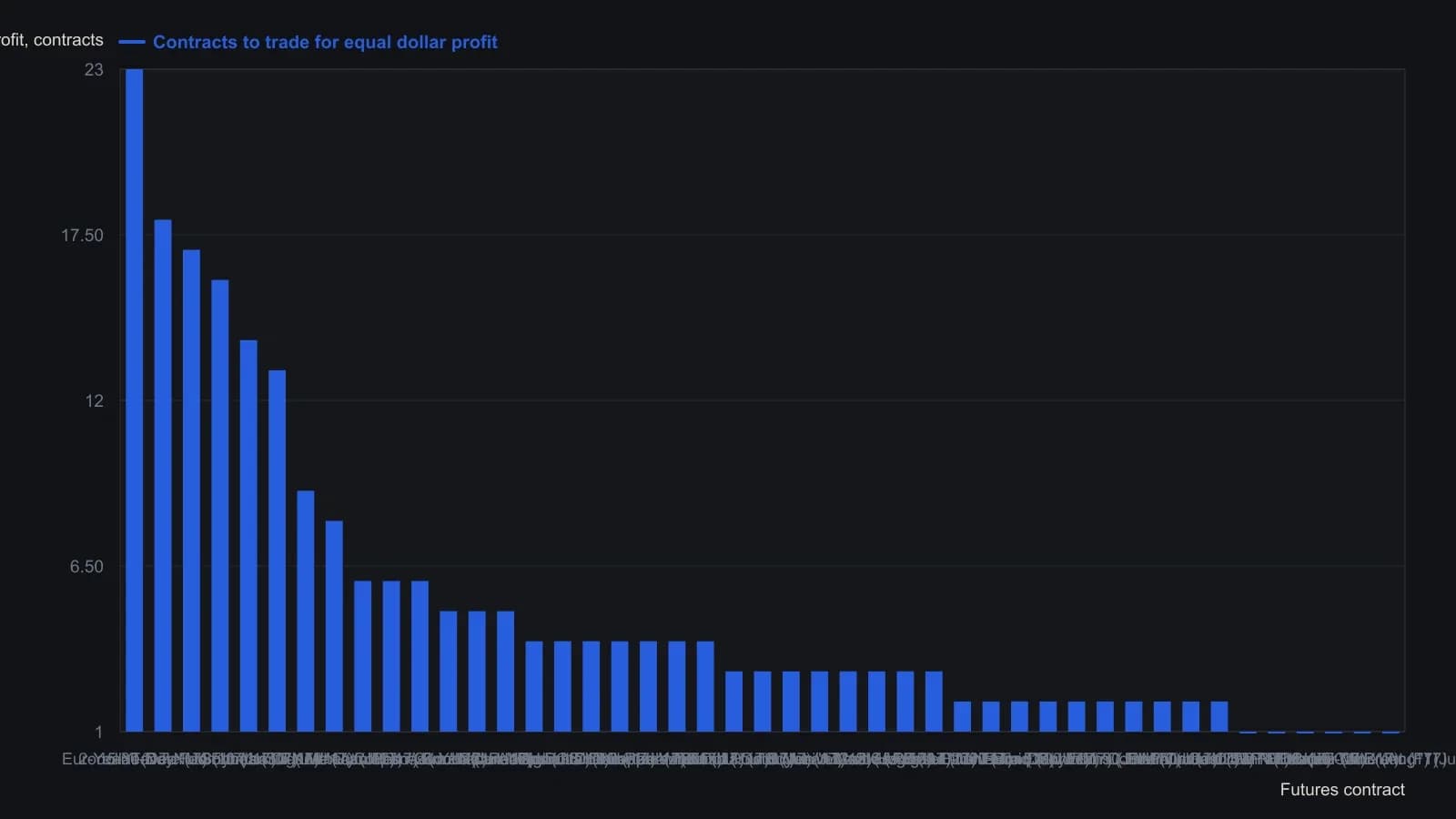
The source equalizes all listings to the same three-year dollar-profit target; relative liquidity dots are a separate open-interest and volume factor and are not plotted here.
Relative contract liquidity
Relative contract liquidity is the equal-dollar contract count multiplied by total open interest and by a volume factor equal to the greater of 1 and the exponential of log volume over log 5000, minus 2.
The volume factor is a floor-at-one exponential adjustment on traded volume that down-weights thin activity and up-weights heavy activity inside the liquidity rank.
The score is comparative. It scales equal-dollar contract size by outstanding positions and a volume adjustment, then supports an ordering of markets by how easily a two-sided trade can be completed.
Effective percent margin
Effective percent margin is posted margin dollars divided by the three-year dollar range of the contract, then multiplied by 100, so margin outlay can be compared across markets.
Posted margin is thereby expressed as a percentage of the contract's three-year dollar price range and used to compare capital lockup across listings.
Ordering markets as a filter
Markets are ordered so those at the top of the relative-liquidity list are the easiest to buy and sell and those at the bottom are the hardest, making the list a filter for executable contract choice.
A different construction for equities
Equity liquidity is treated as a different construction: period volume as a percentage of shares outstanding, read as a share-turnover rate rather than an open-interest-weighted futures score.
All readings on this track · 51 readings
- 2002Single-stock futures and the sleeve that belongs on the ticket
- 2007Ethanol futures liquidity lagged the policy boom
- 2010Relative liquidity ranking for futures contract selection
- 2010A liquidity filter for executable futures contract selection
- 2010Screening futures by liquidity, open interest, and equal-dollar size
- 2010Ranking futures liquidity for executable contract choice
- 2010Liquidity and open interest screens for futures selection
- 2010Ranking futures by open interest and equal-dollar liquidity
- 2011Liquidity filter for futures contract selection
- 2011Futures liquidity rank as an execution filter
- 2011Silver contract-selection by size, hours, and carry
- 2011Filtering futures by liquidity, open interest and equal-dollar size
- 2011Liquidity and open interest as a screen for futures selection
- 2011A futures liquidity filter for equal-dollar execution
- 2012Ranking futures liquidity before choosing a contract
- 2013Liquidity-first futures contract selection
- 2013Equal-dollar liquidity filter for futures contract choice
- 2013Futures liquidity filters for executable contract selection
- 2013Filter listed futures by liquidity and open interest first
- 2013Ranking listed futures by liquidity and equal-dollar size
- 2013A pre-trade liquidity filter for futures contract selection
- 2014Why commodity futures are trades, not long-horizon holdings
- 2014Rank futures liquidity before selecting the contract
- 2014Filter futures by equal-dollar liquidity and open interest
- 2015Filter futures contracts by liquidity and open interest
- 2015A two-stage liquidity filter for futures contract selection
- 2015Screen futures contracts by liquidity and open interest
- 2015Equal-dollar futures choice as a liquidity filter
- 2016Evaluate futures liquidity before contract selection
- 2016Ranking futures liquidity before you pick the contract
- 2016Filter listed futures by relative liquidity and open interest
- 2017Evaluating futures liquidity for executable contract selection
- 2017A relative liquidity rank for choosing an executable futures contract
- 2017Constructing a futures liquidity filter for contract selection
- 2017Filter futures by liquidity, open interest, and equal-dollar size
- 2017Rank futures liquidity before contract selection
- 2017Build a futures liquidity filter from open interest
- 2018Evaluating futures liquidity for executable contract choice
- 2018Volume-confirmed pivots versus unregulated spot exposure
- 2018Executable futures selection from a 2018 liquidity board
- 2018Evaluate futures liquidity before contract selection
- 2018Open-interest liquidity filter for futures contract selection
- 2018Construct a futures liquidity filter from open interest and range
- 2018Ranking futures by liquidity, open interest, and equal-dollar cost
- 2019Ranking futures liquidity before contract selection
- 2019Ranking futures liquidity before you pick a contract
- 2019Screening futures by equal-dollar liquidity
- 2020Building an equal-dollar futures liquidity screen
- 2020Use liquidity and open interest as a futures execution screen
- 2020Compact index futures as diversified contract selection
- 2020Filter futures by range-scaled liquidity and open interest