2012issue C1173
Ranking futures liquidity before choosing a contract
A historical workflow forms a relative futures-liquidity rank from contract point value, three-year price motion, open interest, and a volume factor usually between 1 and 4. Equal-dollar contract count and effective percent margin sit beside that rank when a listed futures contract is chosen.
- A liquidity filter ranks whether a futures contract is executable from order-book activity, open interest, recent range, and margin cost over the life of the order.
- Relative contract liquidity multiplies equal-dollar contract count, total open interest, and a volume factor so names can be ordered by how easily their full book can be traded.
- Equal-dollar contract count scales each market to the same three-year dollar-range potential, while effective percent margin compares capital locked against that range.
- Period-to-period rank changes are attributed to compressed recent volatility, activity falling below one-hundredth of earlier levels, or simultaneous shifts in popularity and volatility.
A pre-trade liquidity filter
A liquidity filter is a pre-trade screen that ranks whether a futures contract is executable from order-book activity, open interest, recent range, and margin cost over the life of the order.
Open-interest analysis uses outstanding contract inventory, together with volume, as a capacity input when judging how readily size can be transacted.
Futures contract selection chooses among listed futures by comparing liquidity, equal-dollar contract count, and margin efficiency rather than by directional thesis alone.
Equal-dollar contract count
An equal-dollar contract count is obtained by multiplying the contract's dollar tick value by the largest price change observed over the prior three years, so every market in that column is scaled to the same dollar-range potential.
Three-year price motion is that largest price change. It is used both to equalize dollar-profit potential and to scale the liquidity product.
Equal-dollar futures lots in liquidity order
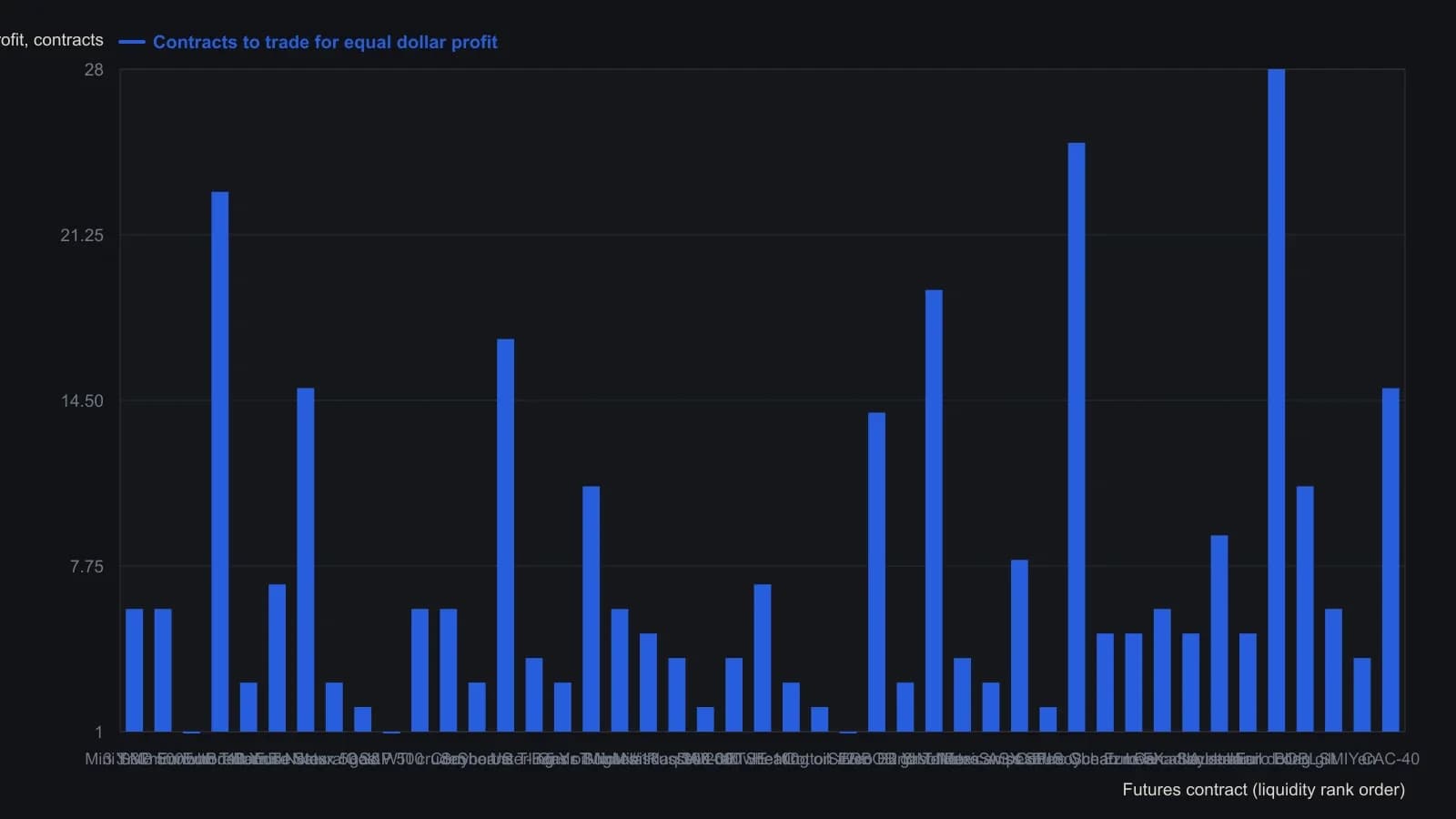
The source sets the count as tick dollar value times the three-year maximum price excursion, so every bar is scaled to the same dollar profit potential. The attached floor photograph carries no series; these figures come from the printed table.
Volume factor and activity marks
The volume factor is a multiplier, typically from 1 to 4 for thin or heavy activity, and formally the greater of 1 or an exponential transform of volume versus a 5,000-contract reference.
In the historical workflow that transform is the greater of 1 or the exponential of the natural log of volume divided by the natural log of 5000, minus 2.
Contracts marked with one activity dot or none are classified as showing little activity relative to names with the densest marks.
How relative contract liquidity is formed
A relative futures-liquidity rank is formed by multiplying contract point value, a three-year historical maximum price motion, open interest, and a volume-related factor that is usually between 1 and 4 depending on how thin or heavy activity is.
Relative contract liquidity equals that equal-dollar contract count times total open interest times the volume factor, so names can be ordered by how easily their full book can be traded.
Effective percent margin
Effective percent margin equals dollar margin divided by the three-year range of the contract's dollar value, then multiplied by 100.
The figure lets capital locked against that range be compared across markets, so margin cost can sit beside the liquidity rank when a contract is chosen.
Why ranks change from period to period
Period-to-period rank changes are attributed to compressed recent volatility, especially in interest-rate-linked futures, to activity falling below one-hundredth of earlier levels, or to simultaneous shifts in popularity and volatility.
Share-market liquidity as turnover
Share-market liquidity is treated as a turnover rate: volume over a given period expressed as a percentage of shares outstanding.
All readings on this track · 51 readings
- 2002Single-stock futures and the sleeve that belongs on the ticket
- 2007Ethanol futures liquidity lagged the policy boom
- 2010Relative liquidity ranking for futures contract selection
- 2010A liquidity filter for executable futures contract selection
- 2010Screening futures by liquidity, open interest, and equal-dollar size
- 2010Ranking futures liquidity for executable contract choice
- 2010Liquidity and open interest screens for futures selection
- 2010Ranking futures by open interest and equal-dollar liquidity
- 2011Liquidity filter for futures contract selection
- 2011Futures liquidity rank as an execution filter
- 2011Silver contract-selection by size, hours, and carry
- 2011Filtering futures by liquidity, open interest and equal-dollar size
- 2011Liquidity and open interest as a screen for futures selection
- 2011A futures liquidity filter for equal-dollar execution
- 2012Ranking futures liquidity before choosing a contract
- 2013Liquidity-first futures contract selection
- 2013Equal-dollar liquidity filter for futures contract choice
- 2013Futures liquidity filters for executable contract selection
- 2013Filter listed futures by liquidity and open interest first
- 2013Ranking listed futures by liquidity and equal-dollar size
- 2013A pre-trade liquidity filter for futures contract selection
- 2014Why commodity futures are trades, not long-horizon holdings
- 2014Rank futures liquidity before selecting the contract
- 2014Filter futures by equal-dollar liquidity and open interest
- 2015Filter futures contracts by liquidity and open interest
- 2015A two-stage liquidity filter for futures contract selection
- 2015Screen futures contracts by liquidity and open interest
- 2015Equal-dollar futures choice as a liquidity filter
- 2016Evaluate futures liquidity before contract selection
- 2016Ranking futures liquidity before you pick the contract
- 2016Filter listed futures by relative liquidity and open interest
- 2017Evaluating futures liquidity for executable contract selection
- 2017A relative liquidity rank for choosing an executable futures contract
- 2017Constructing a futures liquidity filter for contract selection
- 2017Filter futures by liquidity, open interest, and equal-dollar size
- 2017Rank futures liquidity before contract selection
- 2017Build a futures liquidity filter from open interest
- 2018Evaluating futures liquidity for executable contract choice
- 2018Volume-confirmed pivots versus unregulated spot exposure
- 2018Executable futures selection from a 2018 liquidity board
- 2018Evaluate futures liquidity before contract selection
- 2018Open-interest liquidity filter for futures contract selection
- 2018Construct a futures liquidity filter from open interest and range
- 2018Ranking futures by liquidity, open interest, and equal-dollar cost
- 2019Ranking futures liquidity before contract selection
- 2019Ranking futures liquidity before you pick a contract
- 2019Screening futures by equal-dollar liquidity
- 2020Building an equal-dollar futures liquidity screen
- 2020Use liquidity and open interest as a futures execution screen
- 2020Compact index futures as diversified contract selection
- 2020Filter futures by range-scaled liquidity and open interest