2001issue C061-4
Constructing a color stack from every lookback
A conventional price plot becomes a stacked trend pane when every lookback's interval polarity is marked under each bar. Matching hues form same-color clusters, and only the dominant right-edge hue is taken as the parent trend filter for the window.
- Build the pane by marking interval polarity for every lookback under the first bar, then repeat that full color stack under each later price point.
- Assign rising and falling lookbacks to two hue families, reserve brighter shades for steeper slopes, and read matching hues as same-color clusters rather than isolated ticks.
- Take parent direction from the dominant right-edge hue, and treat every smaller block as running inside that parent filter.
- Read a nested trend cycle as short lookbacks flipping first and reverting first, then convert only parent-hue and cluster-boundary readings through one trend-following procedure.
Start from the price plot
The display is built from a conventional price plot. Under the first bar, mark whether the shortest lookback is rising or falling, then repeat that polarity mark for each longer lookback until the pane is filled.
After the first bar is fully stacked, the same all-lookback coloring is repeated under every later price point. Interval polarity is whether ordered prices over a chosen bar count are classified as rising or falling at one date. The finished vertical column under a bar is the color stack: one mark per lookback, with shade intensity scaled to slope.
DJ-30 closes from January to December 1924
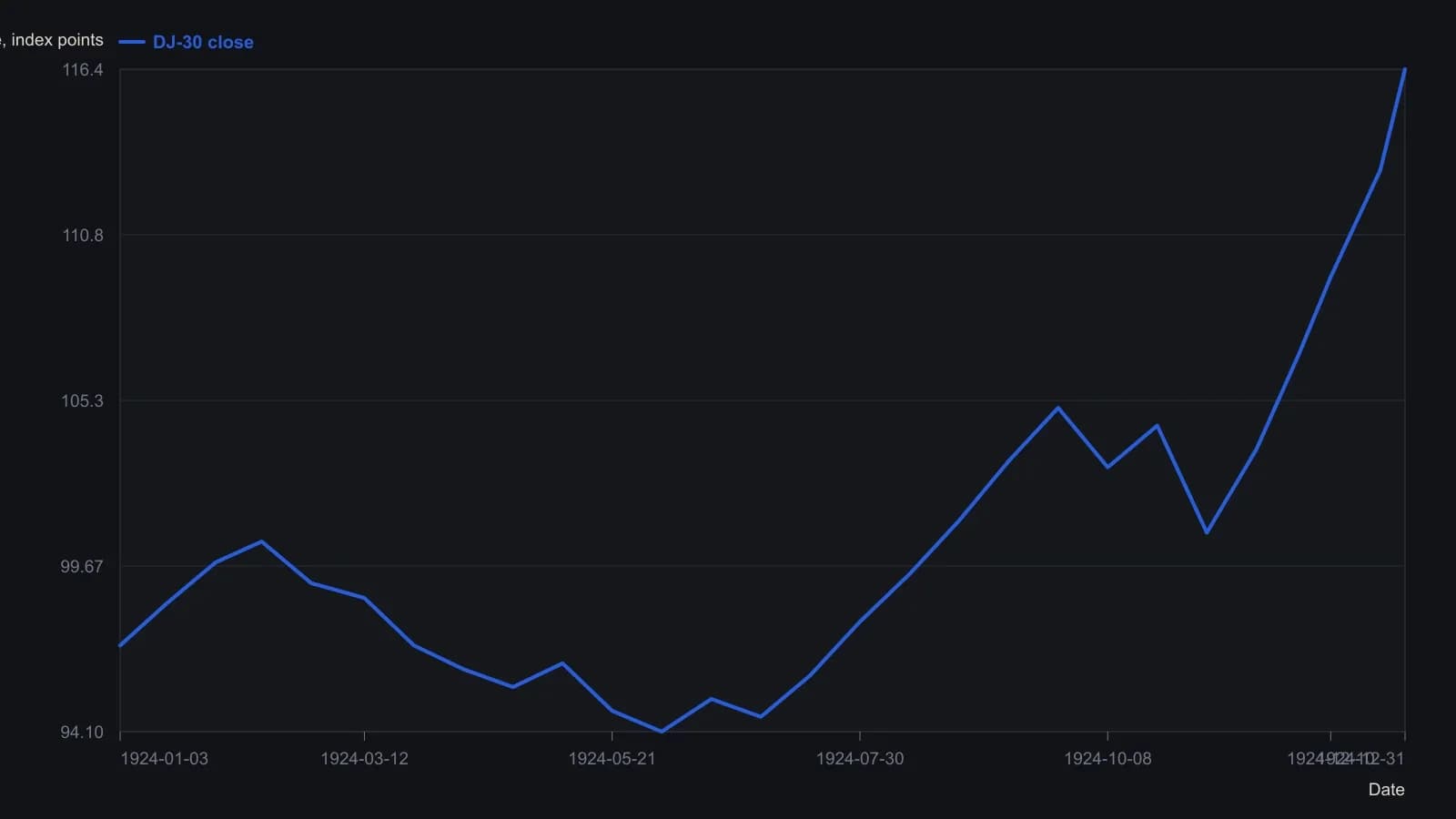
Closes were sampled from the printed price pane against the labeled DJ-30 scale. The raster cannot support a true daily print, so turning points and roughly biweekly stations are given to one decimal. Dates are mapped across the titled window 3 January–31 December 1924 because the figure has no dated x ticks.
Assign two hue families
Rising lookbacks are assigned one hue family and falling lookbacks another. Brighter shades are reserved for steeper slopes. Only two polarity families are used, and the brightest shades still belong to those families.
Read matching hues as one object
Matching hues form contiguous blocks. Each block is identified as one multi-horizon trend object rather than a random scatter of interval readings. That contiguous block is a same-color cluster.
Several blocks run at once, with smaller blocks forming inside larger ones. A TradersWeek editorial reading treats those same-color clusters as nested channels under the price pane.
Take parent direction from the newest columns
Parent direction for the window is taken from whichever hue occupies more of the right-hand side of the stack. The dominant right-edge hue is that polarity: the one that occupies more of the newest columns and is treated as the parent trend filter for the window.
The right-edge majority hue is identified with the largest block spanning the window. Every smaller block is treated as operating inside that parent filter, which is given as why a single column can look conflicting.
Watch how a block ends
A completed down-block is shown with price already rising at its right edge, and a completed up-block with price already falling. After one block ends, an opposite-polarity block and an ordinary swing in that new direction are described as often starting promptly, but not in every case.
Follow the nested trend cycle
An impulse is described as recoloring short lookbacks first and longer lookbacks only after a larger directional move. When the impulse fades, short lookbacks revert first and long lookbacks last. That sequence is one nested trend cycle.
Hand the reading to one procedure
A trend filter is a defined-lookback classifier that labels each bar rising or falling from ordered prices. A moving average is a same-horizon quantitative baseline on ordered prices; stacking every lookback is taught as inspecting that full baseline family at once instead of selecting one length.
Trend following is a single procedure that converts parent-hue and cluster-boundary readings into entry, exit, or abstention signals over the swing holding period. A TradersWeek editorial reading allows that procedure to treat only the dominant right-edge hue as the parent baseline, and to read conflicting marks in the same column as smaller blocks inside that filter.
All readings on this track · 38 readings
- 1986A Marshall Wave book is assembled one confirmed stance at a time
- 1987Operator gut check when two systems conflict
- 1988Visual trend rules need one testable procedure
- 1988Audit trend and breakout rules sold without tests
- 1992Weekly 4 percent close reversal case study
- 1992Write down the plan, then wait for the cross
- 1994Constructing a three-rule moving-average system
- 1995Weekly long-only trend rules with a gated retracement exit
- 1997Constructing rainbow charts with repeated smoothing
- 1997Three-line break as a one-parameter mechanical filter
- 2000Nested horizon trend alignment with a momentum stack
- 2001When certainty turns off the stop
- 2001Price must confirm every setup
- 2001Constructing a color stack from every lookback
- 2002Evaluating mechanical trend signals from ten-session average excursions
- 2004Trend pullbacks with a fifty-day average and relative strength index
- 2005Stochastic overbought as a trend-regime state
- 2005Trend-following as one testable signal procedure
- 2007One checklist for entry, exit and abstention after a market switch
- 2008Parallel listings and divergent trend behavior
- 2008Recovery headlines versus trend-regime rules
- 2008Constructing an intraday trend procedure with confirming close, retest, and planned exits
- 2010Mechanical trend-following system design, stops, and validation
- 2010A trading-plan that sets entry, stop, trail, and pause together
- 2010Multi-horizon cycle signals, trend filters, and stops
- 2012Weekly bear-market and shock signals as a mechanical procedure
- 2013A 2013 rates week as a structure-first exit drill
- 2013Trend following as one testable procedure
- 2013A forex veto checklist: trend, pair economy, and crowd bias
- 2015Relative-strength-index rules under a 20-percent trend filter
- 2015Trend-gated oscillator entry and exit rules
- 2016Trend process versus end-goal trading
- 2017Gold as a classroom for one midterm-trend procedure
- 2017Falling-knife FX longs wait for a four-hour trend turn
- 2018A closed procedure for quarterly sector rank slots
- 2018A recursive median as shared state for trend rules
- 2020Moving-average construction as an objective trend filter
- 2020Constructing first and second cross trend entries