2015issue C0651-55
Trend-gated oscillator entry and exit rules
Coded studies allowed oscillator trades only when a percentage-retracement trend state was aligned with the intended side. The crossing threshold, the trend gate, the chosen exit, and an explicit stay-flat rule were specified together as one procedure.
- Coded studies combined oscillator signals with a prevailing-trend constraint so new trades were allowed only when the market was classified as aligned with that trend.
- A trend change was defined as a 20 percent retracement from the extreme price of the current trend, and a trailing filter could withhold entries that would fire during the down state.
- The unfiltered baseline bought on a close when the oscillator moved below 30 and sold when it moved above 70; a rising-oscillator-threshold variant required a cross up through 50 instead.
- Lookback, reversal percentage, trend-filter, rising-oscillator, and close-on-reversal switches were independent, so subsets of the same rule-based-entry procedure could be tested.
A complete procedure, not a lone crossing
The relative-strength-index is a bounded oscillator computed from ordered up and down closes over a fixed lookback, used here as a forecast-style baseline whose crossings can be compared with gated variants.
Coded studies combined those oscillator signals with a prevailing-trend constraint so new trades were allowed only when the market was classified as aligned with that trend. Trend-following, in this workflow, is a directional state taken from a percentage advance or retracement of a recent extreme, used to permit, block, or liquidate oscillator trades.
Editorial reading: the oscillator becomes a complete, testable procedure only when a percentage-retracement trend state, a chosen crossing threshold, a reversal-or-overbought exit, and an explicit stay-flat rule are specified together. That package is a rule-based-entry design: a fully specified long-entry, exit, and abstention procedure whose inputs, market-state tests, and holding-period rules can be coded and backtested as one system.
Baseline crossings and the trend state
The unfiltered baseline was specified as buying on a close when the oscillator moved below 30 and selling when it moved above 70. At least one coded study was long-only with chart-level parameters for backtesting.
A trend change was defined as a 20 percent retracement from the extreme price of the current trend. Percentage-retracement is that flip: the state changes when price gives back a stated fraction of the move from the current extreme.
A trailing uptrend filter turned on after price rose more than 20 percent from a low, with the inverse rule for a downtrend, so entries that would fire during the down state could be withheld. An optional exit closed an open long when an identified uptrend reversed by a decline of 20 percent or more from the last uptrend peak.
American Express daily closes through the 2011 break and the 2012 uptrend
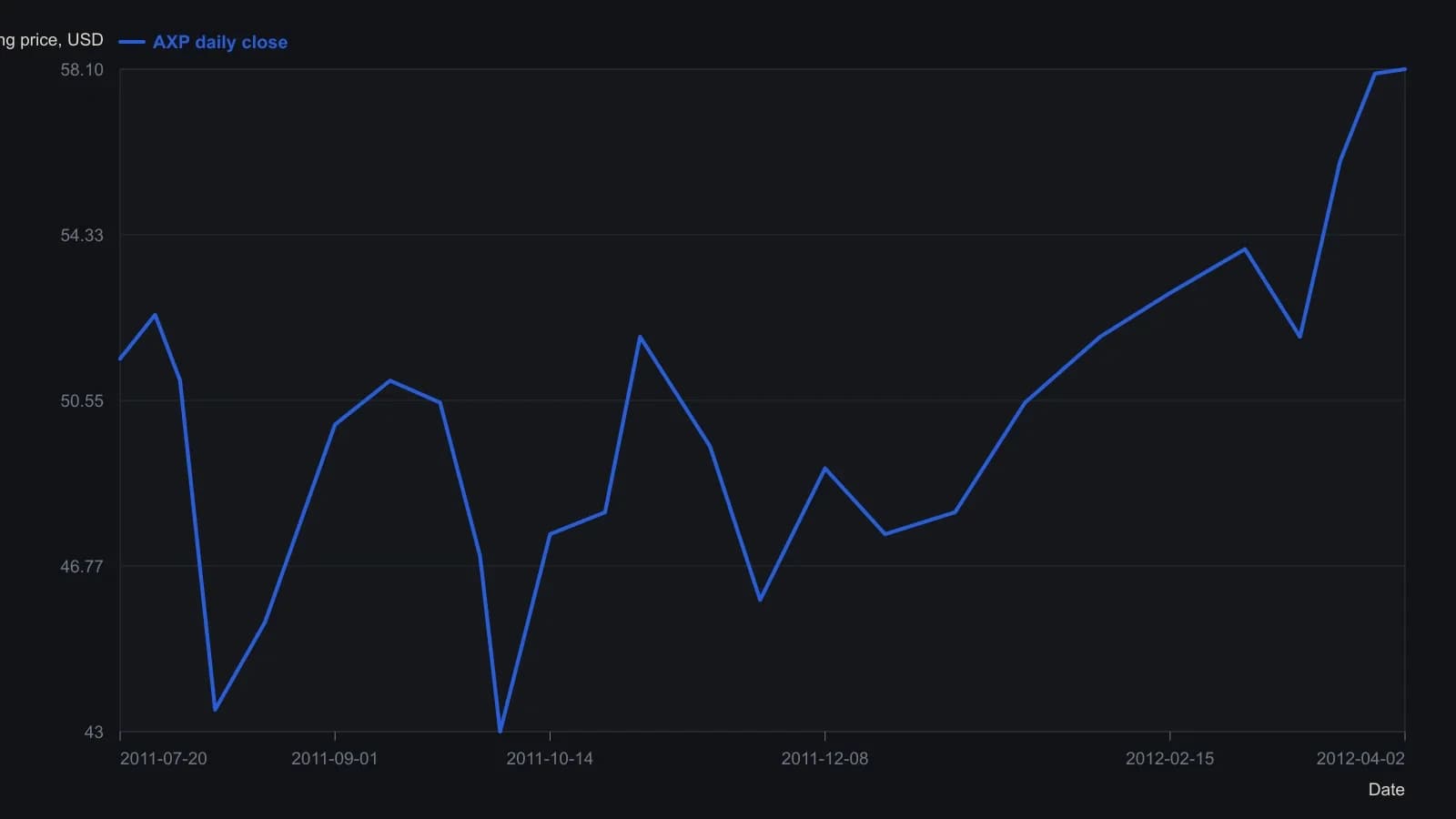
The source paints the 20 percent reversal downtrend pink (stay flat) and the uptrend green. The upper pane is RSI(14) with dashed 50 and 70 lines; those oscillator values were not traced. Digitised closes are approximate except the final 58.10.
Universe screen and switchable entries
A second selection rule limited candidates to names with shorter average trend lengths, using a scan-oriented trend-length measure to build a list before portfolio testing. Trend-length is the measured duration of an identified trend, used as a universe screen before any entry signal is applied.
A second entry variant required the oscillator to cross up through 50 rather than 30. Coded studies treated that mid-range cross as a switchable alternative to the classic oversold cross. The rising-oscillator-threshold is that mid-range requirement rather than a deeply oversold cross.
One programmable specification exposed oscillator lookback, reversal percentage, trend-filter on or off, rising-oscillator on or off, and close-on-reversal on or off as independent parameters so subsets of the same procedure could be tested.
Two long-only encodings
A calendar-window variant marked an uptrend when close exceeded 1.2 times the 252-bar low and a downtrend when close fell below 0.8 times the 252-bar high. It bought only while that state was up and a 14-period oscillator crossed 50, and sold when the state ended or the oscillator crossed 70.
Another long-only encoding required both a longer-horizon and a shorter-horizon percentage-advance-from-low test, with defaults of 20 percent above a 250-bar low and 5 percent above a 20-bar low, plus an oscillator crossing up through 50. It exited when the longer-horizon uptrend failed or the oscillator crossed down through 70.
All readings on this track · 38 readings
- 1986A Marshall Wave book is assembled one confirmed stance at a time
- 1987Operator gut check when two systems conflict
- 1988Visual trend rules need one testable procedure
- 1988Audit trend and breakout rules sold without tests
- 1992Weekly 4 percent close reversal case study
- 1992Write down the plan, then wait for the cross
- 1994Constructing a three-rule moving-average system
- 1995Weekly long-only trend rules with a gated retracement exit
- 1997Constructing rainbow charts with repeated smoothing
- 1997Three-line break as a one-parameter mechanical filter
- 2000Nested horizon trend alignment with a momentum stack
- 2001When certainty turns off the stop
- 2001Price must confirm every setup
- 2001Constructing a color stack from every lookback
- 2002Evaluating mechanical trend signals from ten-session average excursions
- 2004Trend pullbacks with a fifty-day average and relative strength index
- 2005Stochastic overbought as a trend-regime state
- 2005Trend-following as one testable signal procedure
- 2007One checklist for entry, exit and abstention after a market switch
- 2008Parallel listings and divergent trend behavior
- 2008Recovery headlines versus trend-regime rules
- 2008Constructing an intraday trend procedure with confirming close, retest, and planned exits
- 2010Mechanical trend-following system design, stops, and validation
- 2010A trading-plan that sets entry, stop, trail, and pause together
- 2010Multi-horizon cycle signals, trend filters, and stops
- 2012Weekly bear-market and shock signals as a mechanical procedure
- 2013A 2013 rates week as a structure-first exit drill
- 2013Trend following as one testable procedure
- 2013A forex veto checklist: trend, pair economy, and crowd bias
- 2015Relative-strength-index rules under a 20-percent trend filter
- 2015Trend-gated oscillator entry and exit rules
- 2016Trend process versus end-goal trading
- 2017Gold as a classroom for one midterm-trend procedure
- 2017Falling-knife FX longs wait for a four-hour trend turn
- 2018A closed procedure for quarterly sector rank slots
- 2018A recursive median as shared state for trend rules
- 2020Moving-average construction as an objective trend filter
- 2020Constructing first and second cross trend entries