2018issue C0222-25
A closed procedure for quarterly sector rank slots
The case-study system ranks eligible sector funds by last-quarter close-to-close change, buys a chosen rank slot at that same close, and scores the next quarter. Editorial reading: lock the universe, the rank formula, the entry bar, the one-period hold, and the skip filter, then read every rank slot on that same grid before treating last-quarter leadership as an automatic entry.
- A mechanical rotation is testable only after the universe, rank formula, entry bar, one-period hold, and skip filter are locked as one procedure.
- Each rank slot is its own rule, from always holding last quarter's first-ranked fund through always holding the ninth-ranked fund.
- A moving-average filter allows a rank-based buy only when the chosen fund is above a simple average of quarterly closes.
- An equal-weight sector basket is the competing allocation, because last-quarter leadership often fails to persist into the next quarter.
The system in one procedure
The case-study workflow is a mechanical trading system: a fully specified rotation procedure that names universe, rank formula, entry bar, hold length, exit, and abstention with no discretion.
The system ranks eligible sector funds by the close-to-close percentage price change of the quarter just ended. A selected rank is purchased at that same quarter close and then scored on the following quarter's close-to-close change.
Quarterly results inside each calendar year are added to form an annual total, and each rank slot is summarized with average annual return, standard deviation, and maximum annual drawdown. A rank slot is the ordered place a sector occupies after last-quarter close-to-close returns are sorted from strongest to weakest.
The ranking universe
The ranking universe starts from ten industry sector funds and drops the later-launched real-estate fund, leaving nine names in the sort.
Once that universe is locked, rule-based entry is fixed as well: buy only the sector that occupies a pre-chosen rank slot at the quarter close, and only when any required trend gate is also true.
Each rank slot is a separate rule
Rank slots are tested as separate mechanical rules: always hold last quarter's first-ranked fund, always hold the second-ranked fund, and so on through the ninth-ranked fund.
The 2000 to 2016 rank sweep tabulates the first-ranked and ninth-ranked rules against a large-cap equity benchmark on average annual return, volatility, and maximum drawdown.
The nine-slot risk-reward chart isolates the third-, fifth-, and sixth-ranked rules as the mid-rank cluster used for later filter tests.
Average annual return by quarterly sector rank slot
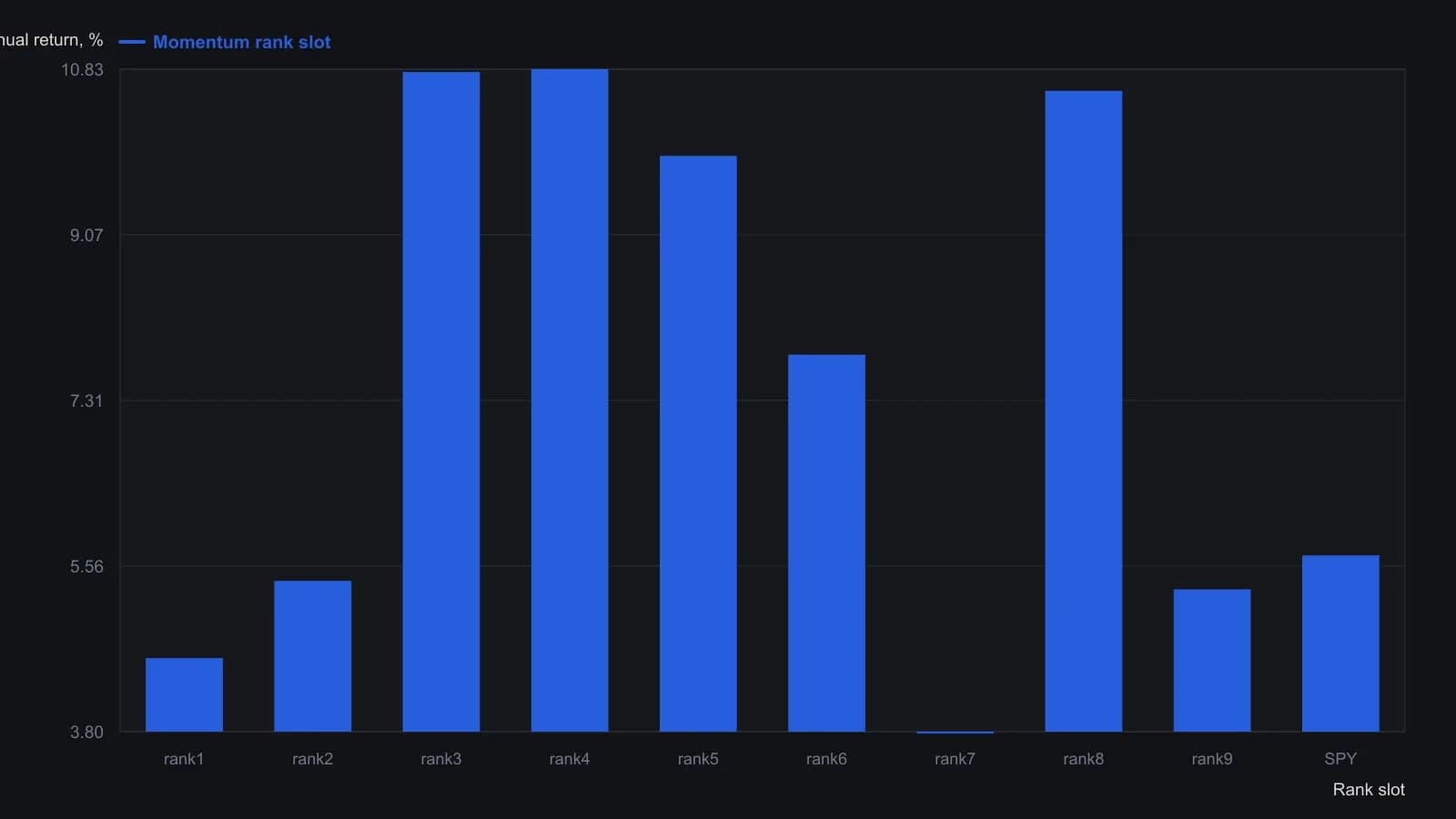
Nine sector SPDRs ranked on prior-quarter close-to-close return (XLRE omitted as too new), bought at that same close, held one quarter. The source scatter plotted return against risk with bubble size equal to max annual drawdown; this rebuild keeps the return coordinate by slot. Hypothetical backtest.
A moving-average filter as the skip gate
Trend following in this procedure means stay aligned with sectors whose recent price change leads peers, and stand aside when a chosen name fails a trend overlay.
A moving-average filter is a simple average of quarterly closes used as a gate that blocks a rank-based buy when price is below that average. A simple moving average with look-backs from two to ten quarters is added so a rank-based buy is allowed only when the chosen fund is above that average.
Averaged across the nine rank rules, the moving-average overlay lowers standard deviation and maximum drawdown without raising average annual returns.
Equal weight as the competing allocation
An equal-weight of the sector funds is specified as a competing mechanical allocation. That equal-weight sector basket holds every eligible sector fund in the same size instead of selecting one rank.
Last-quarter leadership is treated as a signal that often fails to persist into the next quarter.
Editorial close: last-quarter leadership is only one cell on the locked grid. The procedure is complete when every rank slot, including the mid-rank cluster and the skip cases, is read on that same quarterly hold.
All readings on this track · 38 readings
- 1986A Marshall Wave book is assembled one confirmed stance at a time
- 1987Operator gut check when two systems conflict
- 1988Visual trend rules need one testable procedure
- 1988Audit trend and breakout rules sold without tests
- 1992Weekly 4 percent close reversal case study
- 1992Write down the plan, then wait for the cross
- 1994Constructing a three-rule moving-average system
- 1995Weekly long-only trend rules with a gated retracement exit
- 1997Constructing rainbow charts with repeated smoothing
- 1997Three-line break as a one-parameter mechanical filter
- 2000Nested horizon trend alignment with a momentum stack
- 2001When certainty turns off the stop
- 2001Price must confirm every setup
- 2001Constructing a color stack from every lookback
- 2002Evaluating mechanical trend signals from ten-session average excursions
- 2004Trend pullbacks with a fifty-day average and relative strength index
- 2005Stochastic overbought as a trend-regime state
- 2005Trend-following as one testable signal procedure
- 2007One checklist for entry, exit and abstention after a market switch
- 2008Parallel listings and divergent trend behavior
- 2008Recovery headlines versus trend-regime rules
- 2008Constructing an intraday trend procedure with confirming close, retest, and planned exits
- 2010Mechanical trend-following system design, stops, and validation
- 2010A trading-plan that sets entry, stop, trail, and pause together
- 2010Multi-horizon cycle signals, trend filters, and stops
- 2012Weekly bear-market and shock signals as a mechanical procedure
- 2013A 2013 rates week as a structure-first exit drill
- 2013Trend following as one testable procedure
- 2013A forex veto checklist: trend, pair economy, and crowd bias
- 2015Relative-strength-index rules under a 20-percent trend filter
- 2015Trend-gated oscillator entry and exit rules
- 2016Trend process versus end-goal trading
- 2017Gold as a classroom for one midterm-trend procedure
- 2017Falling-knife FX longs wait for a four-hour trend turn
- 2018A closed procedure for quarterly sector rank slots
- 2018A recursive median as shared state for trend rules
- 2020Moving-average construction as an objective trend filter
- 2020Constructing first and second cross trend entries