1989issue C071-4
Evaluating smoothed free reserves and funds-discount spreads
A policy-desk residual is specified from free reserves, paired smoothers, and a funds-to-discount comparison. Later equity episodes are read only as casework against that locked baseline.
- Policy is set at closed meetings eight times a year and carried out through weekly reserve targets, so equities sit inside a rates-and-reserves regime.
- Free reserves are total reserves minus required reserves minus discount-window borrowings, and that leftover is the series the residual is built from.
- The residual subtracts a 3.8 percent exponential average, treated as about a 52-week moving average, from a 33 percent exponential average, treated as about a five-week moving average.
- A weekly funds-to-discount comparison is the second policy-stance series, and later equity episodes are casework against those locked specifications.
A residual from the reserve desk
Policy strategy is described as being set at closed meetings held eight times a year and carried out through weekly reserve targets at an open-market desk. Open-market purchases are described as crediting seller reserves and easing money, while sales are described as draining reserves and tightening money.
Tightening of the money supply is presented as raising interest rates and lowering bond and stock prices, with easing presented as the reverse, so equities sit inside a rates-and-reserves regime.
The free-reserve identity
Free reserves are defined as total reserves minus required reserves minus borrowings at the discount window. That leftover is the series the overlay is built from.
Editorial reading: the identity is locked before any overlay is applied. It is not revised when equity prices later move.
Paired lookbacks on free reserves
Free-reserve swings are reduced by subtracting a 3.8 percent exponential average, treated as about a 52-week moving average, from a 33 percent exponential average, treated as about a five-week moving average.
Exponential smoothing here is a decaying-weight filter applied to free reserves at those two coefficients so a short-horizon level can be differenced from a long-horizon level. The same two smoothers are treated as roughly a five-week average and a 52-week average, giving an explicit lookback pair for the reserve residual.
Paired-exponential residual of free reserves
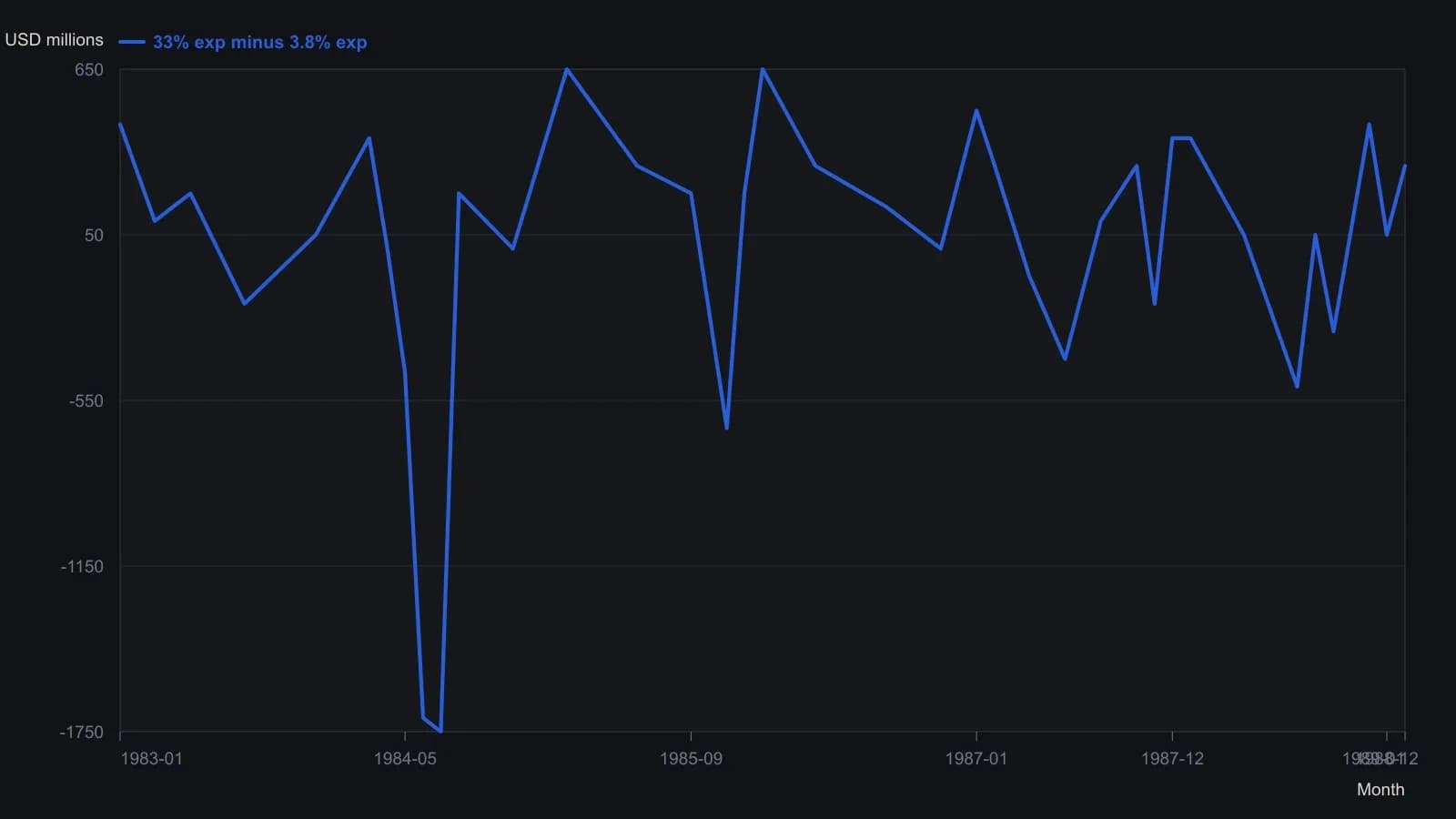
The source subtracts a 3.8% exponential (about 52 weeks) from a 33% exponential (about five weeks) applied to daily-average free reserves. Quartile guides on the plate have no printed values and were not digitized.
The funds-to-discount comparison
The overnight interbank funds rate is smoothed with a weekly average of daily observations and compared with the discount rate as a second policy-stance series. A funds rate far above the discount rate is treated as upward pressure on the discount rate, while a funds rate only slightly above or below the discount rate is treated as downward pressure, and 1984 is listed as an exception to that mapping.
A late-1986 funds-rate spike, with trades as high as 38 percent, is attributed to a year-end shortfall versus required daily reserves after an 18-billion-dollar Treasury-note settlement, a tax-law change, and balance-sheet adjustments that sent banks to the discount window. Editorial reading: that spike is an operational episode inside the funds-to-discount comparison, not a reason to change the specified overlay.
Equity history as casework
The evaluation compares a six-year free-reserve history with a major industrial equity average and states a six-to-12-month lead-time window, while treating a February 1987 high as usable at a 26-week horizon but not at a one-year horizon.
Equities are read against reserve residuals, overnight funds, the discount rate, and bond-price direction rather than from a single-market series. Editorial reading: those later equity episodes are casework against the already specified baseline. They do not turn the residual into a stand-alone trade cue.
All readings on this track · 41 readings
- 1984Matching average age across price filters
- 1984Residual-impact construction of exponential smoothers
- 1988Constructing simple and exponential moving averages as specified filters
- 1989Evaluating smoothed free reserves and funds-discount spreads
- 1990Integer construction of moving averages and exponential smoothing
- 1990Constructing incremental moving average filters
- 1991Constructing a double-smoothed stochastic oscillator
- 1991Constructing an exponential average from a smoothing weight
- 1991Constructing a double-smoothed momentum oscillator family
- 1991Competing certainty rules from exponential-average conditions
- 1991Hybrid construction of a mechanical timing system from smoothed signals
- 1991Constructing an exponential smoother from a moving-average length
- 1991Equivalent relative-strength-index constructions from a ratio and from smoothed momentum
- 1991Constructing the true strength index from double-smoothed momentum
- 1991True strength index from signed, double-smoothed momentum
- 1992Constructing exponential averages from simple lookbacks
- 1992Constructing exponential averages by the smoothing constant, startup length and lag
- 1992Nested range smoothing and windowed high-low damping
- 1992A weekly equity stance from the discount-bill spread
- 1993Double-smoothed stochastics momentum index construction
- 1993Constructing the true strength index with double exponential smoothing
- 1994Polarized fractal efficiency with a shared exponential smoother
- 1994Five-interval exponential smoothing of ten-interval signed path-efficiency
- 1994Hand-ranked price-volume series with stacked smoothing and stochastic
- 1995Range expansion filter on multi-horizon averages
- 1995The exponential smoothing constant from averaging lag
- 1997Construct a nested-average rainbow band and oscillator
- 1998Filter stacks that combine a moving average with exponential smoothing
- 2002Smoothed relative-strength construction from wilder-averaging and a price prefilter
- 2003Reverse-engineered RSI price targets
- 2004Piecewise trend quality from moving-average reversals
- 2004Nested smoothing recipes versus unaudited oscillator experiments
- 2008Weight construction beyond the N-day label
- 2010A consensus filter for objective RSI and smoothing construction
- 2012Sentiment-zone oscillator from signed closes
- 2012Classic RSI one-over-N smoothing versus the standard exponential average
- 2013Why exponential smoothing uses two over n plus one
- 2015Constructing ratio indicators with moving-average and exponential-smoothing weights
- 2015Slow relative-strength index from an exponentially smoothed price
- 2017Rebuilding the relative strength index as open-scale buy-sell pressure
- 2017Comparing Wilder and exponential smoothing inside a relative-strength index