2014issue C0155
Order routing, pass-through rebates, and liquidity choice
Editorial reading: treat every equity fill as a two-part implementation-cost filter. First choose whether the order will rest or sweep, then select a destination whose fee-and-rebate schedule matches that action and confirm the broker will pass both credits and charges through.
- Editorial reading: treat every equity fill as a two-part implementation-cost filter that first chooses rest or sweep, then a destination whose fee-and-rebate schedule matches that action.
- Parking a bid or offer is providing-liquidity. A marketable-order that hits a bid or lifts an offer is taking-liquidity.
- Brokers may or may not pass venue rebates and venue fees through to the account, so both credits and charges need explicit confirmation.
- Default destinations can be set in advance, and a sequential smart-router can attempt preferred venues in a chosen order in less than a second.
A two-part filter
Editorial reading: treat every equity fill as a two-part implementation-cost filter. First choose whether the order will rest or sweep. Then select a destination whose fee-and-rebate schedule matches that action and confirm the broker will pass both credits and charges through before share size grows.
The notes below describe that historical workflow. They are not a present-day map of venues, fees, or fill quality.
Rest or sweep
Parking a bid or offer provides liquidity. Sending a marketable-order that hits a bid or lifts an offer takes liquidity.
Editorial reading: that is the first cut. Providing-liquidity adds displayed size by posting a resting bid or offer. Taking-liquidity removes displayed size by trading against a resting bid or offer.
Where the order can go
A handful of electronic communication networks plus a primary listing exchange can concentrate a large share of liquidity. The destination set expands once dark-pool destinations are included.
Matching the schedule to the action
Some routing choices accept a take fee in exchange for speed and size. Others accept a charge to rest at a venue that lets the parked order stand ahead of other providers there.
In highly liquid names, one preference is to collect a credit on both the providing side and the taking side. A rebate is a venue credit paid for a specified liquidity action, often for providing size and sometimes for taking it.
Defaults and a smart-router
Default destinations can be set in advance, and a sequential smart-router can attempt preferred venues in a chosen order in less than a second.
An illustrated taking-liquidity comparison
An illustrated taking-liquidity comparison showed a 9.15-dollar difference per trade, equal to 91.50 dollars across 10 trades in that example.
Editorial note: the archive used that illustration to show why destination choice can change implementation cost on taking-liquidity fills. It is not a performance result and it is not a present-day quote.
Take-liquidity rebate or charge by destination, 2000-share GE buy
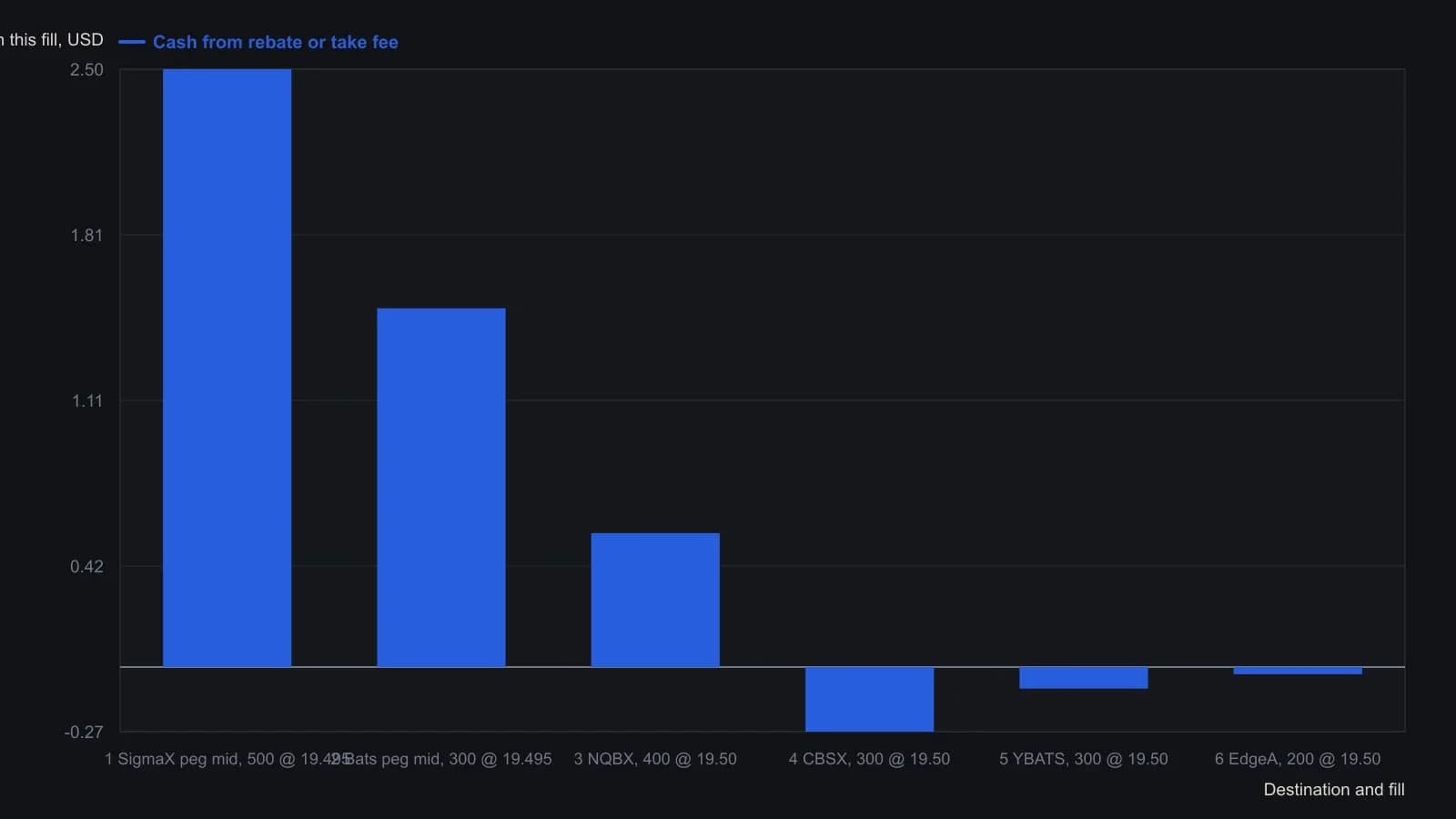
Example assumes a Seeker buy of 2000 GE at 19.50, with 800 shares filled at 19.495 on SigmaX and Bats peg-mid and the rest at 19.50. Per-share rates are the green figures on the slide (0.00500, 0.00500, 0.00140, 0.00090, 0.00030, 0.00015). Destination 4–6 take fees are shown as negative cash.
All readings on this track · 30 readings
- 1988Why instant basket routing overwhelms specialist liquidity
- 2004Retail forex tickets as implementation-cost contracts
- 2005A two-gate liquidity filter for futures order routing
- 2006Manual after-hours routing and open-outcry fill risk
- 2010A futures brokerage quote is an execution specification
- 2011Smart order routing, maker-taker, and midpoint execution costs
- 2012Compare equivalent listings before routing
- 2012Rebate-aware routing and execution cost
- 2012Platform routing, fees, and server-side stops
- 2013Compare equivalent listings, then route the order
- 2013Confirm routing, margin, and fill cost before a live forex order
- 2013Brokerage choice as an execution-cost and routing filter
- 2014Order routing, pass-through rebates, and liquidity choice
- 2014Comparing exchange venues before routing the order
- 2014Selecting a futures broker as an execution-architecture problem
- 2014Commission shopping is the wrong first filter for a futures order
- 2015Routing orders when equivalent products trade on multiple venues
- 2015Forex venue checks for speed, margin, and implementation cost
- 2015Backup venues and symbol splits in futures routing
- 2016Route orders across competing exchange venues
- 2016Filter exchange venues before routing orders
- 2017Venue choice as an order-routing filter
- 2017Venue routing for equivalent listed contracts
- 2017Forex broker checks for fill speed, quote honor, and margin
- 2017Brokerage choice as an execution-speed and commission filter
- 2018Routing equivalent contracts across competing venues
- 2018Forex venue selection by fill speed, margin terms, and price honor
- 2019Forex execution filters for routing, cost, and liquidity
- 2020Routing equivalent listings across competing exchanges
- 2020Brokerage filters for routing, commissions, and liquidity