2020issue C1059
Brokerage filters for routing, commissions, and liquidity
Treat brokerage choice as three gates that run before a strategy is live: confirm the firm can route the intended instrument, score commissions and other implementation cost, then filter for markets, data, and tradable access.
- Start a brokerage search by confirming the firm handles the intended instrument, then choose full-service brokerage or discount brokerage.
- Compare commissions, execution speed, and other implementation cost before an order is submitted.
- Use a liquidity filter to check markets, real-time data, and tradable access, including market statistics in futures and similar markets.
- Ask about clearing operations and, for equities, Securities Investor Protection Corp. coverage, and treat traffic lists as traffic rather than ratings.
A three-gate lab before a live strategy
TradersWeek editorial: treat brokerage choice as a three-gate execution lab that runs before any strategy is live. The gates are sequential. Confirm that the firm can route the intended instrument. Score commission and other implementation cost. Then apply a liquidity filter so the account can reach the markets, data, and size the order needs.
Confirm the instrument can be routed
A brokerage search begins by confirming the firm handles the intended instrument. Order routing means choosing a brokerage path that can send that instrument to an accessible market over the life of the order.
The next choice is between full-service brokerage and discount brokerage. Full-service brokerage is a sit-down relationship in which the client meets with a broker who provides advice. Discount brokerage is an online self-directed path that does not include professional advice.
Institutions that offer full-service brokerage often also offer a discount or online option.
Score commissions and implementation cost
Commission analysis compares explicit commissions and related trading costs before an order is submitted. Implementation cost is the combined effect of commissions, delays, and limited market access on a completed order.
Self-directed traders compare brokerages on speed, pricing efficiency, and accounting quality. Practical checks include execution speed, commissions, and support. Execution speed is how quickly a submitted order is completed.
Apply a liquidity filter
A liquidity filter screens whether a brokerage supplies the markets, data, and tradable access needed to complete an order. Practical checks include real-time data, market access, and account minimums.
In futures and other highly commercial but less intensively studied markets, a brokerage's market statistics and hedging-activity reports can matter to trading decisions.
Review safety and how lists were used
Account-safety review includes asking about clearing operations and, for equities, Securities Investor Protection Corp. coverage. Clearing operations are the post-trade process that settles activity and holds customer funds and positions.
A click-count list of brokerage pages was presented as traffic order, not as an editorial rating or ranking. Widely available company information online had, by that period, reduced the standalone value of retail brokerage research relative to earlier practice.
Most-clicked brokerage listings on Traders’ Resource
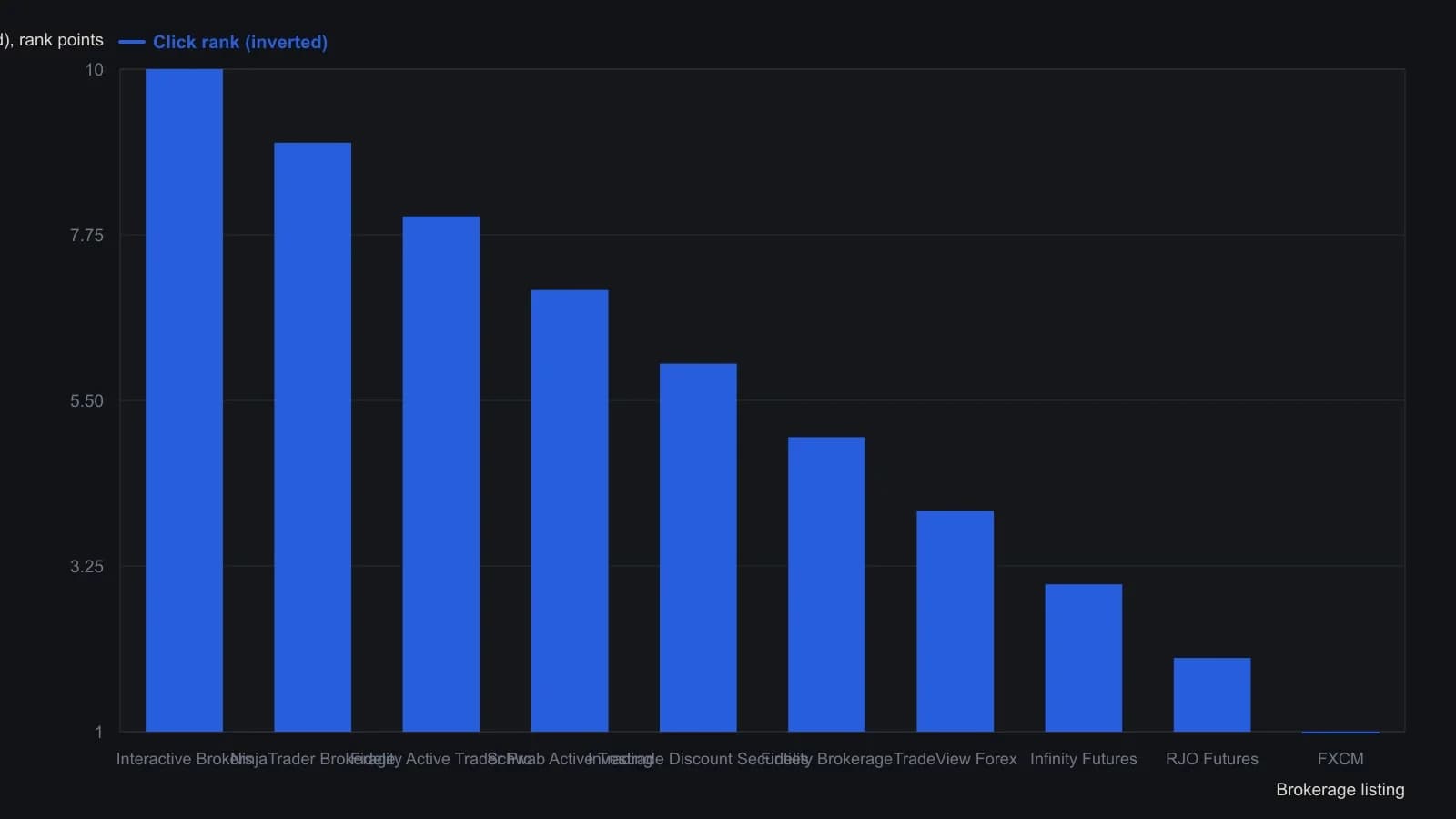
The magazine states this is click order on Traders.com, not an editorial rating; no click counts are printed, so the series uses reverse rank as the plotted height.
All readings on this track · 30 readings
- 1988Why instant basket routing overwhelms specialist liquidity
- 2004Retail forex tickets as implementation-cost contracts
- 2005A two-gate liquidity filter for futures order routing
- 2006Manual after-hours routing and open-outcry fill risk
- 2010A futures brokerage quote is an execution specification
- 2011Smart order routing, maker-taker, and midpoint execution costs
- 2012Compare equivalent listings before routing
- 2012Rebate-aware routing and execution cost
- 2012Platform routing, fees, and server-side stops
- 2013Compare equivalent listings, then route the order
- 2013Confirm routing, margin, and fill cost before a live forex order
- 2013Brokerage choice as an execution-cost and routing filter
- 2014Order routing, pass-through rebates, and liquidity choice
- 2014Comparing exchange venues before routing the order
- 2014Selecting a futures broker as an execution-architecture problem
- 2014Commission shopping is the wrong first filter for a futures order
- 2015Routing orders when equivalent products trade on multiple venues
- 2015Forex venue checks for speed, margin, and implementation cost
- 2015Backup venues and symbol splits in futures routing
- 2016Route orders across competing exchange venues
- 2016Filter exchange venues before routing orders
- 2017Venue choice as an order-routing filter
- 2017Venue routing for equivalent listed contracts
- 2017Forex broker checks for fill speed, quote honor, and margin
- 2017Brokerage choice as an execution-speed and commission filter
- 2018Routing equivalent contracts across competing venues
- 2018Forex venue selection by fill speed, margin terms, and price honor
- 2019Forex execution filters for routing, cost, and liquidity
- 2020Routing equivalent listings across competing exchanges
- 2020Brokerage filters for routing, commissions, and liquidity