2004issue C061-4
Retail forex tickets as implementation-cost contracts
This archive critique treats a retail foreign-exchange ticket as an implementation-cost contract. The quoted spread is the dealing charge, stops and requotes may never reach a live market, and high leverage can turn a few points of friction into an equity event.
- Read the customer bid-offer as the true dealing charge, including any spread-markup beyond the interbank market, even when the ticket is labelled commission-free.
- Check whether a market, stop, or limit is watched internally, passed to a correspondent bank, filled through an untraded print, or interrupted by a requote.
- Size notional so the embedded spread, a few points of slippage, and a modest adverse move cannot consume a large share of equity before the position is tested.
- A usable platform shows live positions and equity, holds margin in a segregated insured deposit, completes withdrawals within two business days, and does not exit at a level the market never traded.
The ticket without a dealing standard
The retail foreign-exchange venue described here had no shared execution benchmark and no central body that set or enforced dealing standards for platform operators.
Editorial: without a common tape or an enforcer of dealing rules, the customer has to read each ticket as an implementation-cost contract before any notional is chosen.
Read the spread as the dealing charge
Commission analysis on this venue means reading the customer bid-offer as the true dealing charge, including any widening beyond the interbank market, whether or not a commission line appears on the statement.
A commission-free label can still hide a dealing charge when an interbank one-to-two-pip market is widened for the customer. Buying one million euros at 1.1506 against an interbank market of 1.1501-02, with the operator covering at 1.1502, left a four-hundred-dollar operator take. That extra width is the spread-markup the platform adds to an interbank quote and keeps as its dealing take.
Buying and selling the same currency at the same time on one platform creates no net exposure and still pays the spread, often plus a doubled dealing charge.
Ask where the stop is routed
Order routing asks whether a market, stop, or limit is watched internally, passed to a correspondent bank, filled through an untraded print, or interrupted by a requote before it can hit a live bid or offer.
A sell-stop at 1.1565 was filled four points through an overnight low of 1.1570 that three New York banks and one London bank confirmed. The platform said the fill followed how its technology was set up.
Editorial: an official-print is a high or low accepted only when enough volume actually traded at that rate on the interbank systems that set the tape. A stop filled through a bank-confirmed low is a routing outcome, not evidence that the tape printed there.
After a stop is triggered, one to three points of slippage was described as typical once the next live bid or offer is taken. Some retail platforms were said to take twenty-five to thirty points on moves that merited a five-to-seven-point fill.
Some platforms interrupt a deal with a requote that offers a usually less favorable working rate instead of completing the ticket at the shown price. A requote replaces the shown dealable rate with a new, usually worse, working rate before the ticket is completed.
Bound leverage before the ticket is sized
Advertised leverage of 100-to-1 and 400-to-1 allowed a ten-thousand-dollar account to control four million dollars of currency notional.
On a five-point spread at 200-to-1 leverage, selling two million euros at 1.1510 and buying them back at 1.1515 produced a one-thousand-dollar loss with no market move, equal to one-tenth of the stated starting capital. Five points against the position doubled that loss, and forty-five further points exhausted the account.
Leverage of no more than 20-to-1 was presented as leaving room for stop-loss orders while limiting how quickly spread and adverse ticks consume equity.
Editorial: margin management here is not a price forecast. It is sizing notional so that the embedded spread, a few points of slippage, and a modest adverse move cannot consume a large share of account equity before the position is tested.
Interbank composite bid-offer spreads by currency pair
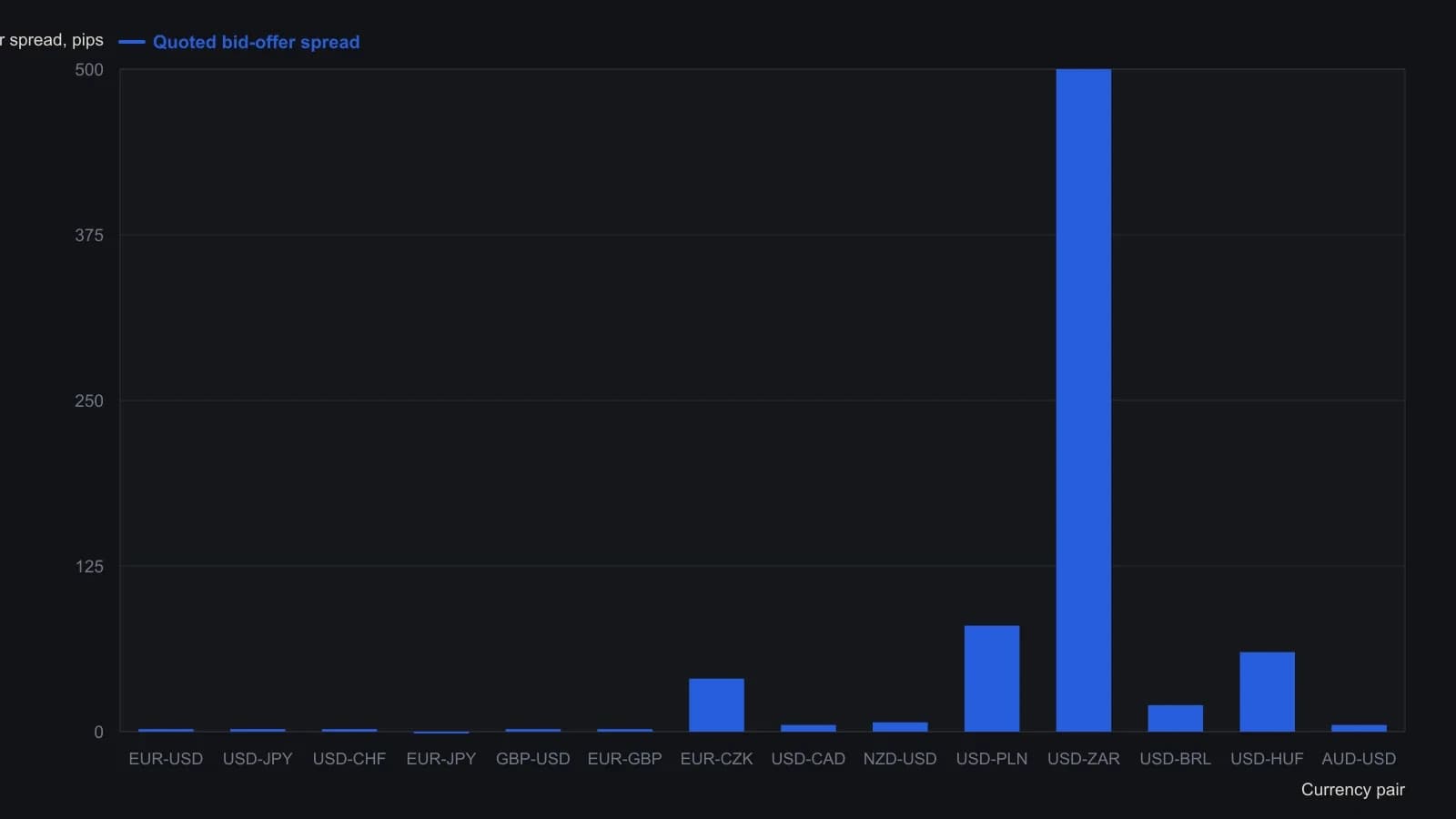
A pip is 0.0001 for pairs quoted to four decimals, 0.01 for yen pairs and USD-HUF, and 0.001 for EUR-CZK as printed on the board. EUR-JPY showed the same bid and offer.
Marks of a usable platform
A usable platform was described as showing live positions, real-time profit and loss, balances, and total equity; holding margin in a segregated, insured deposit; completing withdrawals within two business days; and avoiding order logic that exits a trade at a level the market never traded.
All readings on this track · 30 readings
- 1988Why instant basket routing overwhelms specialist liquidity
- 2004Retail forex tickets as implementation-cost contracts
- 2005A two-gate liquidity filter for futures order routing
- 2006Manual after-hours routing and open-outcry fill risk
- 2010A futures brokerage quote is an execution specification
- 2011Smart order routing, maker-taker, and midpoint execution costs
- 2012Compare equivalent listings before routing
- 2012Rebate-aware routing and execution cost
- 2012Platform routing, fees, and server-side stops
- 2013Compare equivalent listings, then route the order
- 2013Confirm routing, margin, and fill cost before a live forex order
- 2013Brokerage choice as an execution-cost and routing filter
- 2014Order routing, pass-through rebates, and liquidity choice
- 2014Comparing exchange venues before routing the order
- 2014Selecting a futures broker as an execution-architecture problem
- 2014Commission shopping is the wrong first filter for a futures order
- 2015Routing orders when equivalent products trade on multiple venues
- 2015Forex venue checks for speed, margin, and implementation cost
- 2015Backup venues and symbol splits in futures routing
- 2016Route orders across competing exchange venues
- 2016Filter exchange venues before routing orders
- 2017Venue choice as an order-routing filter
- 2017Venue routing for equivalent listed contracts
- 2017Forex broker checks for fill speed, quote honor, and margin
- 2017Brokerage choice as an execution-speed and commission filter
- 2018Routing equivalent contracts across competing venues
- 2018Forex venue selection by fill speed, margin terms, and price honor
- 2019Forex execution filters for routing, cost, and liquidity
- 2020Routing equivalent listings across competing exchanges
- 2020Brokerage filters for routing, commissions, and liquidity