2018issue C0459
Forex venue selection by fill speed, margin terms, and price honor
A forex venue search starts with pair-coverage, then uses margin-terms to bound exposure. A practice-account-test then checks fill speed and whether on-screen prices are the prices at which orders complete.
- Confirm pair-coverage first so the venue will accept the specific currency pair or cross you intend to trade.
- Keep margin-terms on the same checklist as pair coverage so leverage, collateral, and account-size rules bound exposure before an order is sent.
- Use a practice-account-test to observe fill speed and fill-integrity before relying on a live path.
- Treat click-popularity as a traffic count of listing opens, not as an editorial ranking of venues.
A forex venue search should begin by confirming that the venue handles the specific currency pair or cross the trader intends to trade. That pair-coverage check is the first filter on whether an order can be routed at all.
Editorial reading: TradersWeek treats the rest of the search as an implementation-cost problem. After pair-coverage is confirmed, margin-terms bound exposure, and a practice-account-test is used to observe fill speed and fill-integrity before a live path is relied on.
Start with pair coverage
If a venue will not accept orders in the intended pair or cross, later questions about speed and price honor do not arise. Pair-coverage is confirmation that the venue will accept those orders, not a claim about how they will fill.
Bound exposure with margin terms
Margin requirements, available leverage, and whether a reduced-size account is offered belong on the same venue-selection checklist as pair coverage. Those margin-terms are the leverage, collateral, and account-size rules that bound exposure before an order is sent.
Test fill speed and price honor
How quickly an order can be completed is a primary practical question when comparing forex venues. A practice-account-test is a non-live session used to observe that fill speed and to check fill-integrity, meaning whether the price shown on the screen is the price at which the order is actually completed.
Review how orders were handled
A venue’s ability to supply market statistics and hedging-activity reports can matter when reviewing how orders were handled. Those execution-statistics help review the completed path after the fact.
Listings measure traffic, not quality
A list ordered by how often venue listings were opened is a traffic measure, not an editorial quality ranking of those venues. Click-popularity counts how often a listing was opened. It is not a quality score.
Vendor-posted venue listings can change after they are published, and the listing host does not endorse the businesses shown.
Most-clicked forex broker listings at Traders' Resource
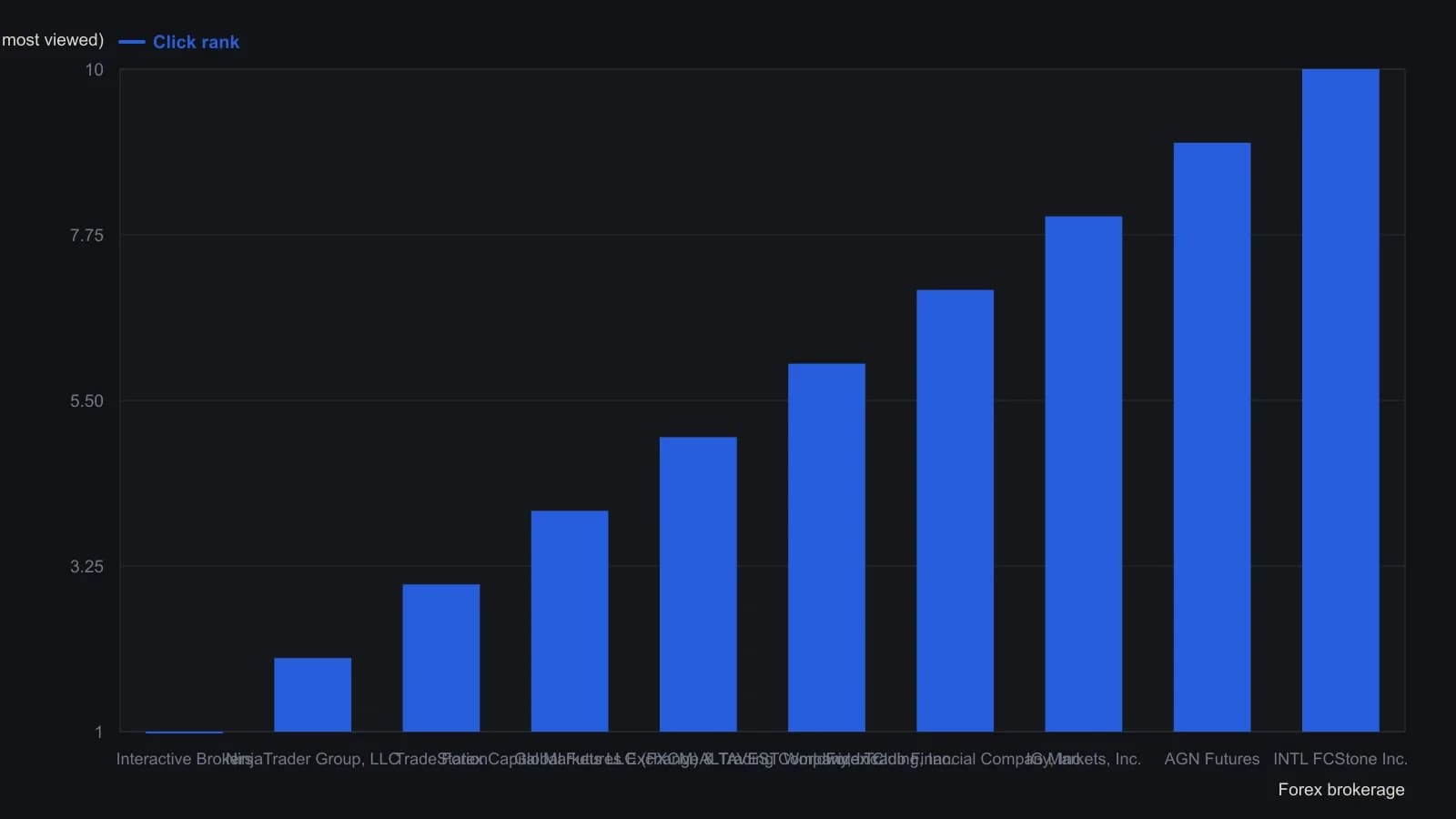
The magazine states each firm is listed by clicks received and that the list is not an editorial rating. Exact click counts are unpublished, so the series uses rank (1 = most clicked) rather than inventing volumes.
All readings on this track · 30 readings
- 1988Why instant basket routing overwhelms specialist liquidity
- 2004Retail forex tickets as implementation-cost contracts
- 2005A two-gate liquidity filter for futures order routing
- 2006Manual after-hours routing and open-outcry fill risk
- 2010A futures brokerage quote is an execution specification
- 2011Smart order routing, maker-taker, and midpoint execution costs
- 2012Compare equivalent listings before routing
- 2012Rebate-aware routing and execution cost
- 2012Platform routing, fees, and server-side stops
- 2013Compare equivalent listings, then route the order
- 2013Confirm routing, margin, and fill cost before a live forex order
- 2013Brokerage choice as an execution-cost and routing filter
- 2014Order routing, pass-through rebates, and liquidity choice
- 2014Comparing exchange venues before routing the order
- 2014Selecting a futures broker as an execution-architecture problem
- 2014Commission shopping is the wrong first filter for a futures order
- 2015Routing orders when equivalent products trade on multiple venues
- 2015Forex venue checks for speed, margin, and implementation cost
- 2015Backup venues and symbol splits in futures routing
- 2016Route orders across competing exchange venues
- 2016Filter exchange venues before routing orders
- 2017Venue choice as an order-routing filter
- 2017Venue routing for equivalent listed contracts
- 2017Forex broker checks for fill speed, quote honor, and margin
- 2017Brokerage choice as an execution-speed and commission filter
- 2018Routing equivalent contracts across competing venues
- 2018Forex venue selection by fill speed, margin terms, and price honor
- 2019Forex execution filters for routing, cost, and liquidity
- 2020Routing equivalent listings across competing exchanges
- 2020Brokerage filters for routing, commissions, and liquidity