2002issue C031-3
Market-order routing, internalization, and displayed size
A market ticket is order flow sent to a destination. Fill quality then depends on who receives it, whether opposing interest can meet inside the quote, and whether a posted commission hides a worse print.
- A market order is filled by the dealer or network that receives the ticket, not by the best bid or offer shown on the screen.
- An internalized match lets a dealer-market-maker complete offsetting order flow and keep the difference between its bid and offer, so tickets that never reach a shared book miss price improvement.
- In a fragmented marketplace a print can occur away from the best displayed quote, and a market sell sent to only one dealer or network need not hit the higher of two bids.
- Displayed size and Level II can understate remaining size or overstate firmness, and a posted commission can be more than offset by implementation cost if the offer moves before the fill.
The ticket is a routing contract
Customer buy and sell tickets are order flow. They can be sent one by one or as offsetting pairs that a dealer can match internally.
Editorial interpretation: treat the market order as a routing contract rather than a price request. Once the ticket leaves the screen, fill quality is set by who receives it, whether opposing order flow can meet inside the quote, and whether the posted commission hides a worse print.
Internalized matches keep the dealer spread
A dealer-market-maker that buys a customer market sell at a 31.00 bid and later sells a customer market buy at a 31.25 offer can complete both tickets internally and keep the difference between those prices. That internalized match finishes the customer buy against the customer sell without sending both tickets to a shared public book.
If more market sells arrive before the dealer can reduce inventory, the dealer may lower its bid or stop showing a bid, which can add local price swings.
Price improvement needs a shared book
A market buy and a market sell arriving together against a 31.00/31.25 quote could meet near 31.12 on a centralized listed book, but customer tickets that never reach a shared specialist often miss that inside print. That inside print is price improvement: a fill inside the displayed quote, possible when opposing interest meets in one visible marketplace.
On a listed venue, a buy limit at 31.25 can print better if an opposing sell limit at 31.10 is present. Tickets sent through a brokerage rather than to that venue often do not receive that improvement.
Fragmented quotes and paid routing
In a fragmented marketplace several dealers and networks quote the same name, so a print can occur away from the best displayed bid or offer. A trade can print at 30.75 while the prevailing best bid is 31.00.
Directing customer tickets to a paid wholesaler is payment for order flow. That routing can leave a displayed offer unchanged after a buy is filled, because the ticket was matched against another firm's seller rather than lifting the quote the buyer saw.
A market sell need not fill at the higher of two displayed bids, such as 31.05 versus 31.00, when the ticket is sent to only one dealer or network. An electronic communications network is one destination, not the entire market.
Displayed size and Level II
A working sell of 5,000 shares may show only 1,000 shares, so the visible book can understate remaining size. Displayed size is the quantity shown on a quote, which may be only a slice of the true working order.
Level II is a montage of participant quotes. It can overstate firmness when size is partial or a quote is not honored.
Posted size by market maker on a Nasdaq Level II book
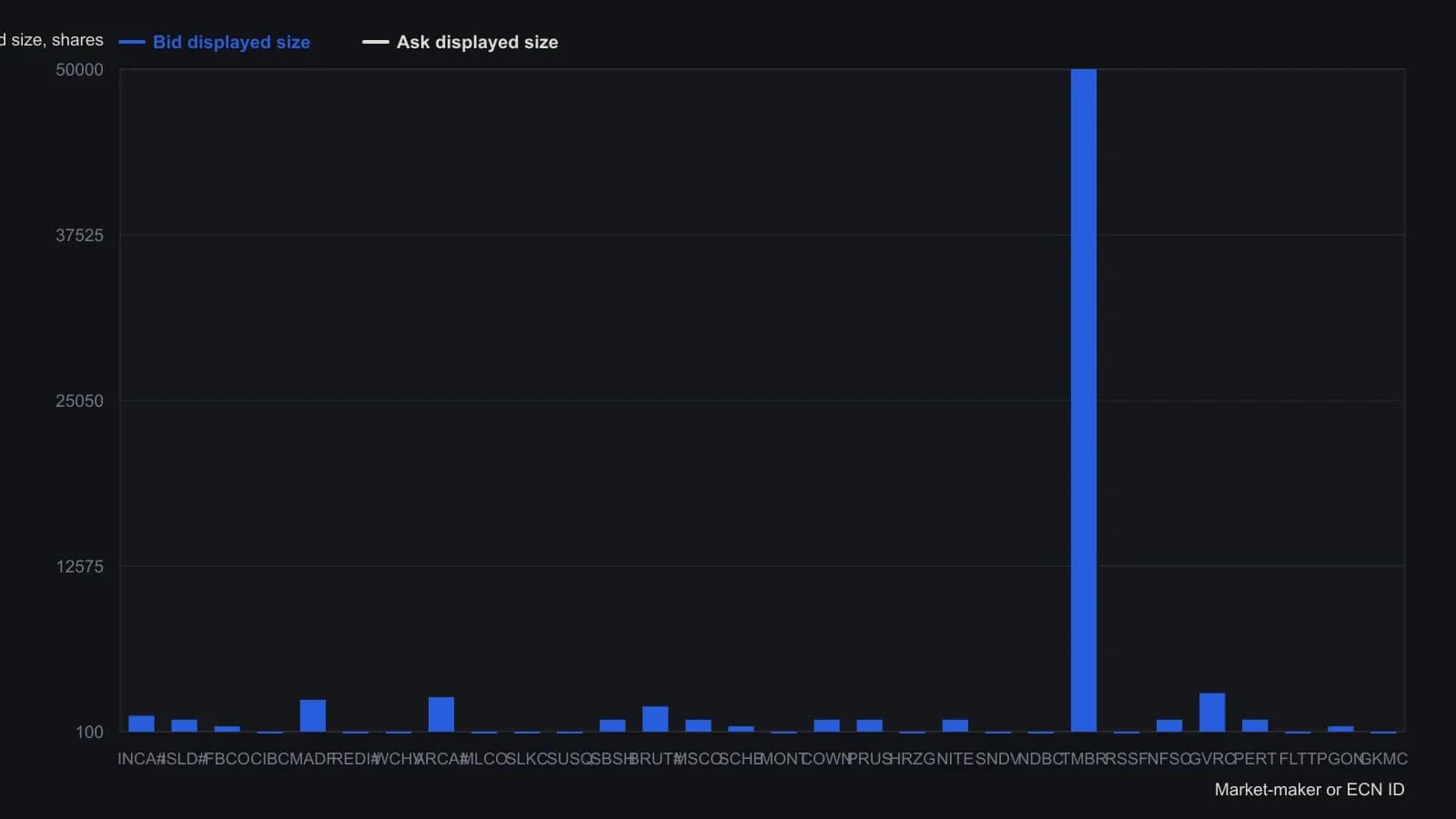
One morning snapshot of posted quotes only. Last-update times run from the 6:35 a.m. leftovers through 9:52 a.m.; the article notes market makers often hide the rest of the order and may not honor the bid or offer.
All readings on this track · 26 readings
- 1995Canceled prints versus executable fills
- 1999How order routing changes market and limit fills
- 2000Direct access, intelligent order routing, and visible book depth
- 2001Retail routing and market versus limit fills
- 2001Stop triggers and opening-only short market orders
- 2002Market-order routing across linked venues
- 2002Market-order routing, internalization, and displayed size
- 2004Direct access order routing after the display rules
- 2004Listed-stock limit envelopes versus market-order routing
- 2005Closing option spreads with limit or market orders
- 2005Contingent routing as a pre-trade futures contract
- 2007Constructing executable futures orders with market, limit, and fill or kill
- 2008Bid-ask spreads, routing paths, and order choice
- 2008Retail market buys hit the ask
- 2008Limit versus market orders for a commodity option-spread
- 2011A pre-trade checklist before market or limit orders
- 2013Retail market orders and the displayed queue they never join
- 2013Option stop orders, wide spreads and forced market exits
- 2014Opening range breakout with weekday ratings, abstention and exits
- 2014Constructing forex orders from session liquidity
- 2015Order-type and routing scripts for faster execution
- 2015Market, limit, and routing choices inside the order life cycle
- 2015Handheld futures tickets as a second execution venue
- 2017Screen execution starts from the live bid and ask
- 2017Electronic stop-loss orders and protected price bands
- 2020Market-order slippage on split-adjusted stock prices