1988issue C121-7
Why instant basket routing overwhelms specialist liquidity
Computerized baskets can exhaust specialist inventory, the resting book, and the crowd in seconds. After that first-level-contra-side size is gone, tactical-allocators often wait, so execution is one liquidity-filter, impact, and routing decision, and a published-book pause is how slower contra-side capital re-enters.
- A liquidity-filter should treat specialist inventory, resting limits, and committed crowd interest as the only immediately executable contra-side size.
- Order-routing that submits an automated multi-name basket, rather than shopping a block upstairs, is what delivers essentially unlimited demand inside seconds.
- Once first-level-contra-side size is absorbed, tactical-allocators often wait, so a market-impact-model has to allow the same burst to become a disorderly melt-down or melt-up.
- An open-book-call-auction that publishes the imbalance is a stronger pause than a simple price limit, because slower contra-side traders can see the schedule and refill it.
Demand that arrives inside seconds
Computerized order submission lets professional desks focus essentially unlimited liquidity demand onto a venue within seconds. That flow includes insurance-style, index-linked, and other fast basket strategies. The senders are dynamic-allocators: participants that demand near-instant liquidity through insurance-style, arbitrage, or other computer-triggered baskets.
Yearly percentiles of 30-minute S&P 500 subset path
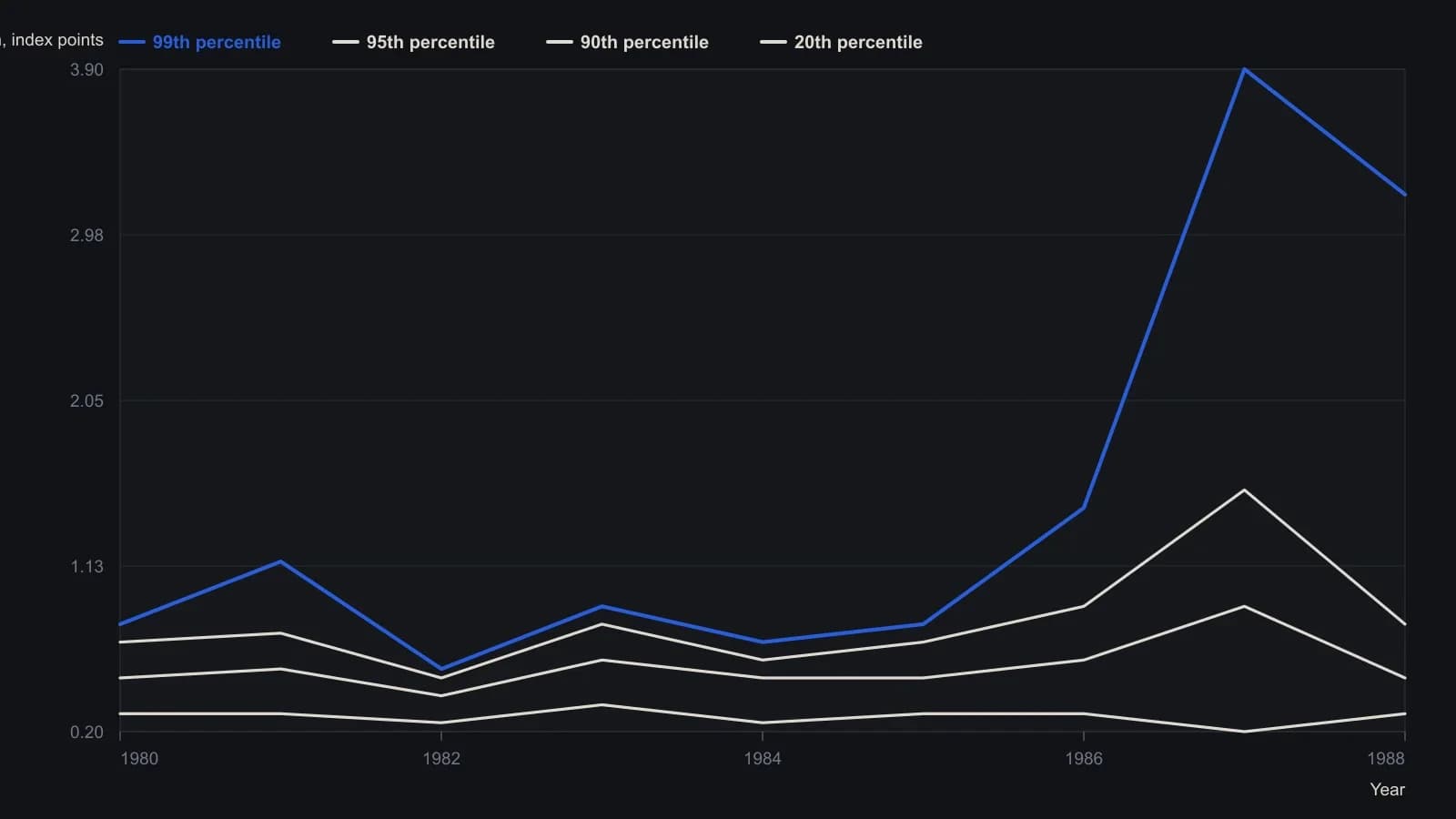
Path is the sum of absolute minute-to-minute index changes inside each 30-minute window that does not span a session break. Sample is 1980–86, seven months of 1987 and five months of 1988; the cash session lengthened on 3 October 1985. Digitized from the figure, so points are approximate to about 0.05 index points.
The filter and the routing choice
A liquidity-filter treats specialist inventory, resting limits, and committed crowd interest as the only immediately executable contra-side size. That screen is the first-level-contra-side: the specialist, the limit book, and the crowd whose committed size can be exhausted in seconds.
Order-routing is the choice between shopping a block upstairs and submitting an automated multi-name basket. The choice sets how fast liquidity demand arrives. Automated multi-name baskets demand instant liquidity, unlike upstairs blocks that can be shopped over time, so the specialist is asked to stand in precisely when inventory cannot meet the size.
When first-level size is gone
After first-level specialist, book, and crowd size is absorbed, slower tactical traders often step aside and wait for impact, so the same burst of demand can produce a disorderly melt-down or melt-up. Those slower participants are tactical-allocators: value or timing traders who can withdraw and wait for price pressure to finish before supplying the other side.
A market-impact-model is a seconds-to-order-life account of how concentrated cash and futures flow moves each market and how those short-horizon responses interact.
A path statistic that sums absolute minute-to-minute moves of a large-cap cash index inside 30-minute windows rose across the distribution from 1980 onward, with the 99th percentile accelerating in 1986-1987 and then declining in 1988. Editorial: TradersWeek reads that path widening as the cash-index footprint of demand that arrives faster than first-level-contra-side size can refill.
On 19 October 1987, one insurance desk sold 1.7 billion of index futures and three other firms sold more than 800 million each, while specialists and futures locals absorbed only about 700 million of net buying.
Forcing larger specialist capital still requires that capital to earn a risk-adjusted return, so the issuer's cost of capital rises without closing the gap between specialist inventory and modern basket size.
A published book versus a price limit
Simple price limits are a weak circuit breaker. A stronger design trips a call auction when order-flow polling detects a severe imbalance and opens the book so slower contra-side traders can see the schedule. That design is an open-book-call-auction: a triggered match that publishes supply and demand schedules so the contra side can see the imbalance and refill it.
Index prices were argued to be discovered first in cheaper, faster futures. Blocking automated routing to arbitrage would shrink the competitive set to a few hand-delivered tickets and could raise volatility and the cost of capital.
Agent impact and principal impact
A hypothesized principal sequence sells cash baskets into anticipated insurance flow so futures fall faster. Whether that covers cheaper than the stock sale depends on short-term cash, futures, and cross-elasticities that were treated as unknown. The sequence is manipulative-legging: a principal sequence that sells cash baskets first, overlays customer flow, and covers futures into the resulting drop, while looking like ordinary arbitrage.
The same firm cannot minimize a client's impact as agent and maximize that impact as principal. A published-book auction that interrupts the imbalance raises the risk of such equilibrium-pushing strategies.
All readings on this track · 30 readings
- 1988Why instant basket routing overwhelms specialist liquidity
- 2004Retail forex tickets as implementation-cost contracts
- 2005A two-gate liquidity filter for futures order routing
- 2006Manual after-hours routing and open-outcry fill risk
- 2010A futures brokerage quote is an execution specification
- 2011Smart order routing, maker-taker, and midpoint execution costs
- 2012Compare equivalent listings before routing
- 2012Rebate-aware routing and execution cost
- 2012Platform routing, fees, and server-side stops
- 2013Compare equivalent listings, then route the order
- 2013Confirm routing, margin, and fill cost before a live forex order
- 2013Brokerage choice as an execution-cost and routing filter
- 2014Order routing, pass-through rebates, and liquidity choice
- 2014Comparing exchange venues before routing the order
- 2014Selecting a futures broker as an execution-architecture problem
- 2014Commission shopping is the wrong first filter for a futures order
- 2015Routing orders when equivalent products trade on multiple venues
- 2015Forex venue checks for speed, margin, and implementation cost
- 2015Backup venues and symbol splits in futures routing
- 2016Route orders across competing exchange venues
- 2016Filter exchange venues before routing orders
- 2017Venue choice as an order-routing filter
- 2017Venue routing for equivalent listed contracts
- 2017Forex broker checks for fill speed, quote honor, and margin
- 2017Brokerage choice as an execution-speed and commission filter
- 2018Routing equivalent contracts across competing venues
- 2018Forex venue selection by fill speed, margin terms, and price honor
- 2019Forex execution filters for routing, cost, and liquidity
- 2020Routing equivalent listings across competing exchanges
- 2020Brokerage filters for routing, commissions, and liquidity