2001issue C071-3
Constructing vertical debit spreads with a preset risk-reward filter
A vertical debit is built as one worksheet. Two same-month strikes lock the net debit, the defined maximum loss, and a pre-placed risk-reward filter before any order is sent.
- A vertical debit spread buys one option and sells another that shares the expiration month but uses a different strike, and the net debit is the defined maximum loss if the position is held to expiration.
- In the mid-November orange-juice illustration, the January 115 and 120 calls produced a 375-dollar net debit and a matching 375-dollar planned gain before commissions.
- A halfway stop at a 125-point spread cut planned cash risk to 187.50 dollars and set a 1-to-2 risk-reward ratio against the 375-dollar remaining gain.
- Time-value erosion on the paired legs can largely offset, and a menu of strikes lets the same construction stay inside a stated budget and risk-tolerance band.
A single construction worksheet
A vertical option spread is constructed by buying one option and selling another that shares the expiration month but uses a different strike. Treated as an option spread, that pair is one entry, exit, and abstention procedure rather than an outright long or short option.
A debit construction incurs a net cash outlay equal to the long-leg premium minus the short-leg premium. That net debit is the defined maximum loss if the position is held to expiration.
The mid-November orange-juice illustration
In the mid-November orange-juice illustration, with the January contract near 118.70, buying the January 115 call for 750 dollars and selling the January 120 call for 375 dollars produced a 375-dollar net debit.
On that same 5-cent strike width and 15,000-pound contract, planned gain before commissions is capped at 375 dollars, matching the debit.
A preset risk-reward filter
A halfway stop at a 125-point spread would cut planned cash risk to 187.50 dollars and set a 1-to-2 risk-reward ratio against the 375-dollar remaining gain.
The risk-reward ratio is a pre-entry comparison of planned cash risk, including any halfway stop, against the remaining defined gain on the spread. Editorial interpretation: that comparison sits on the worksheet before the order, so the planned cash risk and the remaining gain are accepted together.
Paired legs and time-decay offset
The two-legged structure is described as less volatile than the underlying contract or a standalone option, which can lessen the need for constant quote-screen monitoring.
Because the position is always long one option and short another, time-value erosion on the two legs can largely offset, insulating the net spread from decay that would hit a single long option. That time-decay offset belongs to the same-expiration pair, not to either leg alone.
A menu of strikes
A menu of strikes lets the same spread construction be sized to a stated budget and risk-tolerance band so the position remains inside a predefined comfort range.
Mid-November orange-juice call settlements by strike
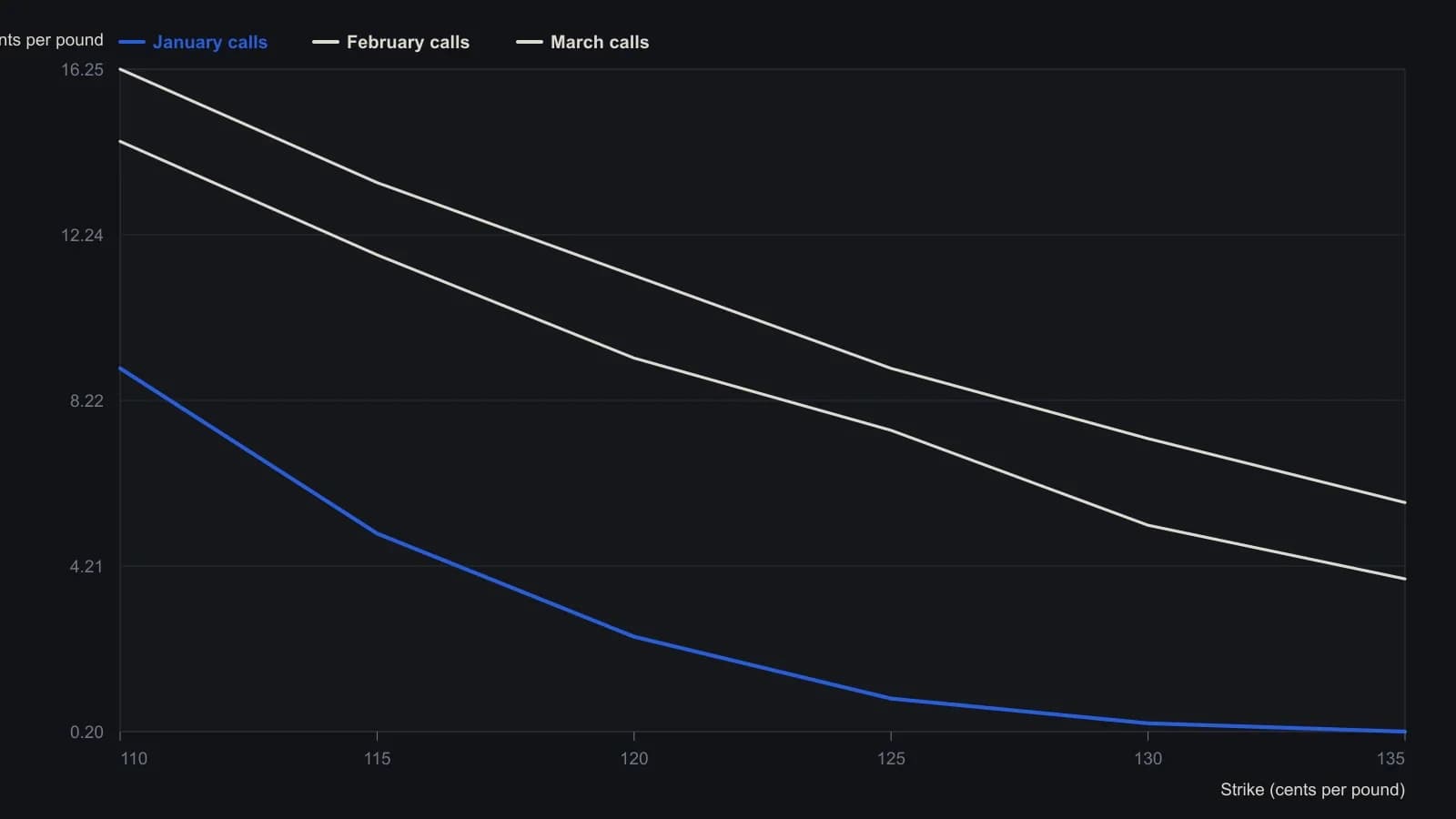
Several put cells in the source table are blank, so only the complete call columns are plotted. This is a single mid-November snapshot, not a path through time.
All readings on this track · 29 readings
- 1986Rank listed calls against a vertical debit inside one forecast band
- 1990Constructing vertical debit spreads around implied volatility
- 1994Even-money call spread after a stop-limit gap
- 1995Payoff anchors for bull and bear vertical spreads
- 1995Matching vertical spreads to forecast confidence
- 1997A defined-risk short vertical as a single testable procedure
- 1998Vertical debit spreads when implied volatility is elevated
- 2001Constructing vertical debit spreads with a preset risk-reward filter
- 2002Regime-first construction of vertical debit spreads
- 2003Sizing a vertical by the constraint you can enforce
- 2006Event premiums, straddle bias, and volatility-hedged spreads
- 2006From a winning long call to a bull vertical debit spread
- 2007Vertical debit spread construction from codes and premiums
- 2010Vertical construction as a bounded-risk procedure
- 2010Zero-cash repair of an underwater long
- 2011Cheap long calls and in-the-money debit vertical marks
- 2011Vertical debit value path, volatility, liquidity, and box exits
- 2013Constructing defined-risk vertical call spreads
- 2014Protective put versus seasonal debit spread
- 2014One bearish energy thesis, three strike geometries
- 2014Coffee versus equity as a two-sided debit-spread drill
- 2015Natural-gas thesis: ETF drag versus a call debit spread
- 2017Funding a call spread with an offsetting put spread
- 2018An expected-value test for vertical option spreads
- 2019Option ladder construction for financed vertical debits
- 2020One-week call versus bull-put premium tradeoffs
- 2020Constructing in-the-money versus out-of-the-money bull call debit spreads
- 2020Combining vertical debit spreads on a volatility product
- 2025Time decay as a decision variable in an NVDA bull call spread