1994issue C051-6
Even-money call spread after a stop-limit gap
When a stop-limit sell is gapped through, the leftover long stays on the book. The historical workflow treated that remainder as a sizing test: refuse added cash, refuse a full-price recovery target, and accept only a covered one-by-two call structure that fills as a single ticket after the new break-even is written down.
- A stop-limit sell on a long stock can remain unfilled when the next open gaps through the limit, so the shares stay on the book as the decline continues.
- Averaging down with a second equal lot lowered the combined break-even but committed more cash, and a further decline would force the same choice again.
- The even-money repair used one at-the-money or in-the-money long call per hundred shares and twice as many short out-of-the-money calls, sent as one spread order that stated the debit or credit.
- A replacement break-even was calculated before entry as the share-price loss offset by the vertical's expiration value plus any dividend, not as a return to the original purchase price.
Leftover stock after a stop-limit gap
A stop-limit gap is a sell stop that also carries a limit and therefore may not fill when the next open jumps through that limit, leaving the long stock still on the book. A stop-limit sell on a long stock can remain unfilled in that case, so the shares stay on the book as the decline continues.
After the illustrated decline, holding the original shares still needed about a 10 percent rebound to recover the purchase price, before commissions or dividends.
The cash bound on any repair
Averaging down with a second equal lot lowered the combined break-even but committed more cash, and a further decline would force the same choice again.
The protective put, as used here, is a risk method that bounds loss or exposure before entry and while the position is open. The same bound is the test applied to any repair: no extra cash, and remaining downside limited to the original share loss.
Editorial: averaging down fails that test because it adds cash and leaves the same choice open if the stock falls again.
The even-money one-by-two structure
The repair required a margin account, one at-the-money or in-the-money long call per hundred shares, and twice as many short out-of-the-money calls, with the net debit near zero or a small credit. An even-money repair is a one-by-two call structure sized to the long share count so premium paid and premium received net to about zero.
The vertical debit spread is the long lower-strike call paired with the short higher-strike call. In the worked tape, splitting the quoted markets produced a zero net difference between the long lower-strike calls and the short higher-strike calls. The strike width was treated as the spread's expiration value if the stock finished above the short strike.
One ticket and a precomputed break-even
The long and short calls were to be sent as one spread order that stated the debit or credit, so a single leg could not fill alone. An option spread is a long option and a short option entered together so the fill, the coverage, and the exit are one procedure rather than two independent tickets.
Short calls were covered by the long stock plus the long calls. The planned expiration path was assignment of the shares at the short strike and closing the vertical for the strike width.
A replacement break-even was calculated before entry as the share-price loss offset by the vertical's expiration value plus any dividend, not as a return to the original purchase price. That precomputed break-even is the share price at which the remaining stock loss equals the vertical's expiration value plus any collected dividend, calculated before the spread is entered.
Even-money Kodak repair P&L if called away at 45
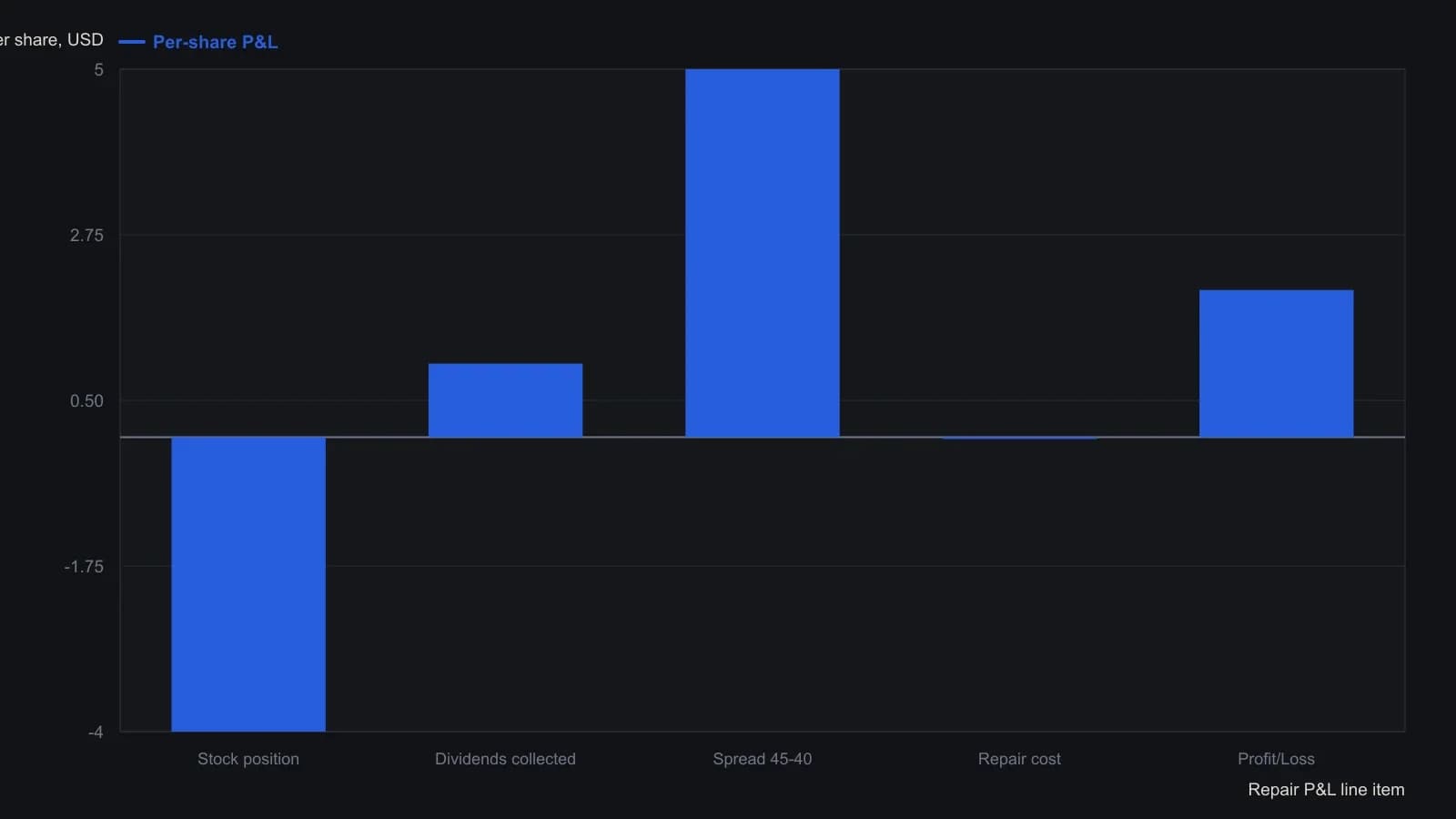
The source omitted commissions and margin interest. The July 40 calls were assumed bought at 5.75 and the July 45s written at 2.875 so the ticket fills at even money.
Further decline and when the repair is unavailable
On a further decline, extra loss stayed on the original stock. The even-money spread added no cash on the downside, so the loss at the lower strike matched the unrepaired stock loss.
If the prior drop was already large or remaining time premium was thin, a near-even option-spread repair was described as unavailable.
All readings on this track · 29 readings
- 1986Rank listed calls against a vertical debit inside one forecast band
- 1990Constructing vertical debit spreads around implied volatility
- 1994Even-money call spread after a stop-limit gap
- 1995Payoff anchors for bull and bear vertical spreads
- 1995Matching vertical spreads to forecast confidence
- 1997A defined-risk short vertical as a single testable procedure
- 1998Vertical debit spreads when implied volatility is elevated
- 2001Constructing vertical debit spreads with a preset risk-reward filter
- 2002Regime-first construction of vertical debit spreads
- 2003Sizing a vertical by the constraint you can enforce
- 2006Event premiums, straddle bias, and volatility-hedged spreads
- 2006From a winning long call to a bull vertical debit spread
- 2007Vertical debit spread construction from codes and premiums
- 2010Vertical construction as a bounded-risk procedure
- 2010Zero-cash repair of an underwater long
- 2011Cheap long calls and in-the-money debit vertical marks
- 2011Vertical debit value path, volatility, liquidity, and box exits
- 2013Constructing defined-risk vertical call spreads
- 2014Protective put versus seasonal debit spread
- 2014One bearish energy thesis, three strike geometries
- 2014Coffee versus equity as a two-sided debit-spread drill
- 2015Natural-gas thesis: ETF drag versus a call debit spread
- 2017Funding a call spread with an offsetting put spread
- 2018An expected-value test for vertical option spreads
- 2019Option ladder construction for financed vertical debits
- 2020One-week call versus bull-put premium tradeoffs
- 2020Constructing in-the-money versus out-of-the-money bull call debit spreads
- 2020Combining vertical debit spreads on a volatility product
- 2025Time decay as a decision variable in an NVDA bull call spread