2020issue C1144-47
Combining vertical debit spreads on a volatility product
The same bullish thesis on an implied-volatility product can be written as an in-the-money bull call spread or an out-of-the-money bull call spread, with different expiration payoffs at the same underlying price. Adjacent 24/30 and 30/50 verticals cancelled at the 30 strike and left a 24/50 merged vertical.
- An in-the-money bull call spread and an out-of-the-money bull call spread can share one bullish thesis while producing different expiration payoffs at identical underlying prices.
- The out-of-the-money spread needed a larger underlying advance to reach its expiration breakeven than the in-the-money spread, which capped once the underlying reached the short strike of 30.
- Combining the 24/30 and 30/50 bull call spreads cancelled the overlapping 30-strike legs and left a 24/50 merged vertical described as costing 363 for a one-lot, with an expiration breakeven of 27.63.
- The compared structures were framed as a tradeoff among objectives, and the verticals sat on a listed implied-volatility product rather than on a single cash equity.
Two spreads, one thesis
An in-the-money bull call spread and an out-of-the-money bull call spread on the same implied-volatility product can share a bullish thesis while producing different expiration payoffs at identical underlying prices. A vertical debit spread is a same-expiry long option and short option of the same type, entered for a net debit, with the short strike farther from the money.
The in-the-money bull call spread has its long strike already below the underlying price at entry, which lowers the expiration hurdle and caps payoff at the short strike. The out-of-the-money bull call spread has its long strike above the underlying price at entry, which raises the expiration hurdle in exchange for a larger distant payoff.
Different expiration hurdles
In the illustrated comparison, the out-of-the-money bull call spread required a larger underlying advance to break even at expiration than the in-the-money spread. The in-the-money bull call spread reached a stated maximum once the underlying arrived at the short strike of 30 and collected no further payoff above that level.
How the merged vertical is formed
Combining a 24/30 bull call spread with a 30/50 bull call spread cancels the overlapping 30-strike legs and leaves a single 24/50 debit spread. That merged vertical is a wider debit spread formed by combining two adjacent verticals so the overlapping intermediate strike cancels.
The combined 24/50 debit spread was described as costing 363 for a one-lot, with an expiration breakeven of 27.63. The expiration breakeven is the underlying price at which a vertical held to expiry recovers its net debit.
Pre-expiration risk curves
The illustrated pre-expiration risk curves for the combined spread moved into profitable territory before expiration if the underlying began to rally. A pre-expiration risk curve is the marked-to-market profit-and-loss path of an option structure as the underlying moves before expiry.
A tradeoff among objectives
The compared structures were framed as a tradeoff among objectives rather than as a single best trade, with the merged vertical presented as a way to hold more than one objective at once. The verticals were built on a listed implied-volatility product rather than on a single cash equity, so the spread geometry sits inside an implied-volatility market regime.
Expiration P/L for ITM versus OTM VXX bull-call spreads
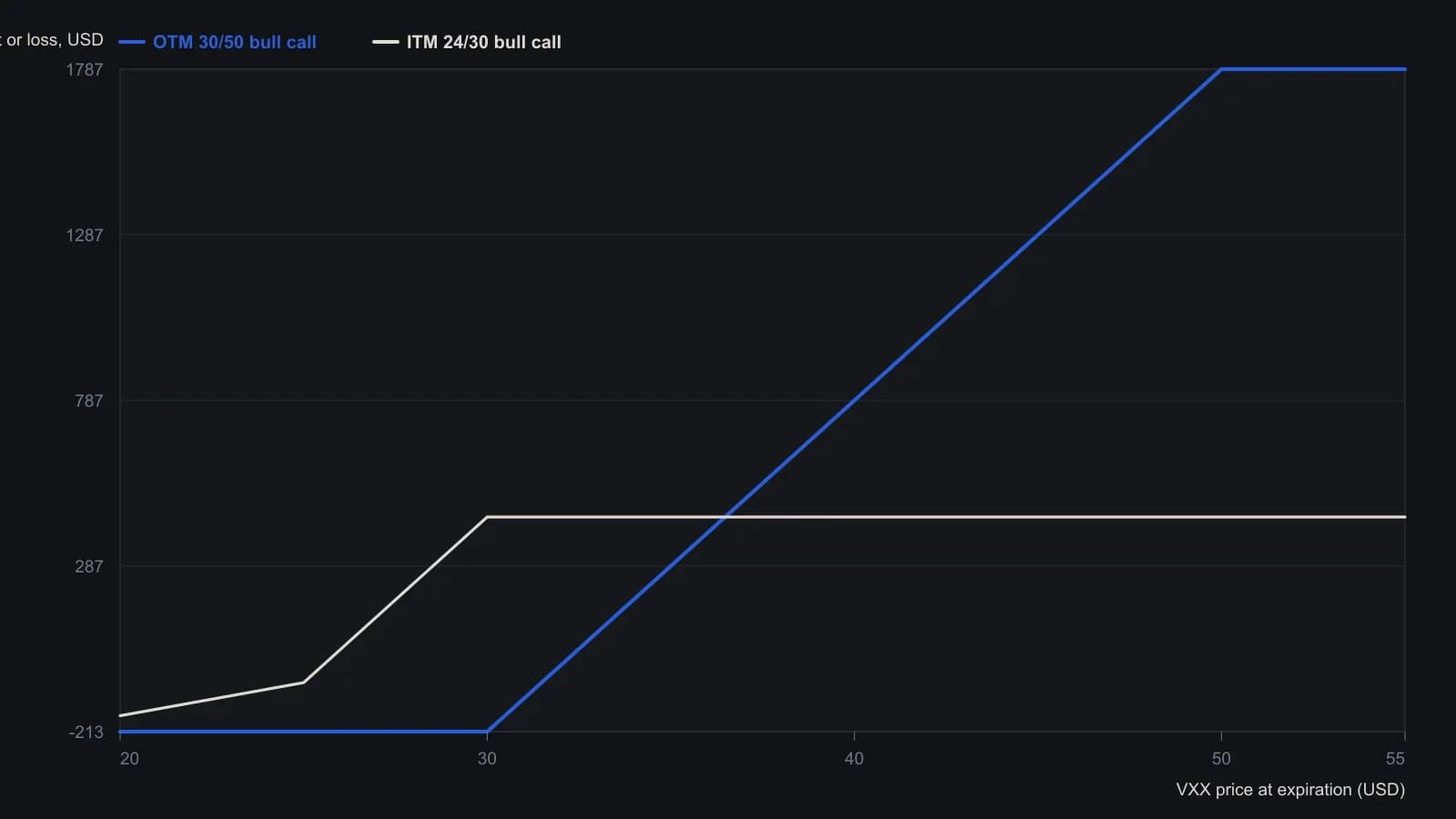
One-lot payoffs at expiration. VXX was 24.33 dollars at the stated entry; the 24/30 debit is 165 dollars and the 30/50 debit is 213 dollars.
All readings on this track · 29 readings
- 1986Rank listed calls against a vertical debit inside one forecast band
- 1990Constructing vertical debit spreads around implied volatility
- 1994Even-money call spread after a stop-limit gap
- 1995Payoff anchors for bull and bear vertical spreads
- 1995Matching vertical spreads to forecast confidence
- 1997A defined-risk short vertical as a single testable procedure
- 1998Vertical debit spreads when implied volatility is elevated
- 2001Constructing vertical debit spreads with a preset risk-reward filter
- 2002Regime-first construction of vertical debit spreads
- 2003Sizing a vertical by the constraint you can enforce
- 2006Event premiums, straddle bias, and volatility-hedged spreads
- 2006From a winning long call to a bull vertical debit spread
- 2007Vertical debit spread construction from codes and premiums
- 2010Vertical construction as a bounded-risk procedure
- 2010Zero-cash repair of an underwater long
- 2011Cheap long calls and in-the-money debit vertical marks
- 2011Vertical debit value path, volatility, liquidity, and box exits
- 2013Constructing defined-risk vertical call spreads
- 2014Protective put versus seasonal debit spread
- 2014One bearish energy thesis, three strike geometries
- 2014Coffee versus equity as a two-sided debit-spread drill
- 2015Natural-gas thesis: ETF drag versus a call debit spread
- 2017Funding a call spread with an offsetting put spread
- 2018An expected-value test for vertical option spreads
- 2019Option ladder construction for financed vertical debits
- 2020One-week call versus bull-put premium tradeoffs
- 2020Constructing in-the-money versus out-of-the-money bull call debit spreads
- 2020Combining vertical debit spreads on a volatility product
- 2025Time decay as a decision variable in an NVDA bull call spread