2014issue C0528-32
Protective put versus seasonal debit spread
The archive uses one long-put and short-put construction in two ways. Against a long holding it is described as cover only between the prevailing price and the short put strike. Without that holding it is a vertical debit spread, and a late-spring seasonal idea is the hypothesis that must be specific enough to justify buying the puts.
- A put or put spread against a long holding is described as covering underlying losses only between the prevailing price and the short put strike.
- Once the underlying moves through the short strike, the spread no longer fully offsets further decline; more cover is described as requiring extra spreads or wider strikes.
- Without a long holding, the same long-put and short-put construction is a vertical debit spread whose loss is limited to the debit paid.
- Protective and speculative uses share that construction. The distinction given is whether a long portfolio is being covered, and a bare opinion that the market will fall is treated as insufficient reason to buy puts.
Shared construction, two uses
The archive treats a long put, or a long put paired with a short put, as one construction that can be used in two ways. Protective use and speculative use share that put or put-spread construction. The distinction given is whether a long portfolio is being covered.
A protective put is a long put held against a long holding so that a defined decline remains a bounded loss before entry and during the position.
Cover only to the short strike
A put or put spread against a long holding is described as covering underlying losses only between the prevailing price and the short put strike.
Once the underlying moves through the short strike, the spread no longer fully offsets further decline in the long holding. More cover is described as requiring extra spreads or wider strikes.
The same strikes without the long holding
The same long-put and short-put construction without a long holding is framed as a vertical debit spread whose loss is limited to the debit paid.
A vertical debit spread is a long option and a short option of the same type and expiration at a nearer strike, so the debit paid is the maximum loss and the width minus that debit is the maximum gain.
Expiration payoff of the SPY 180/170 put debit spread
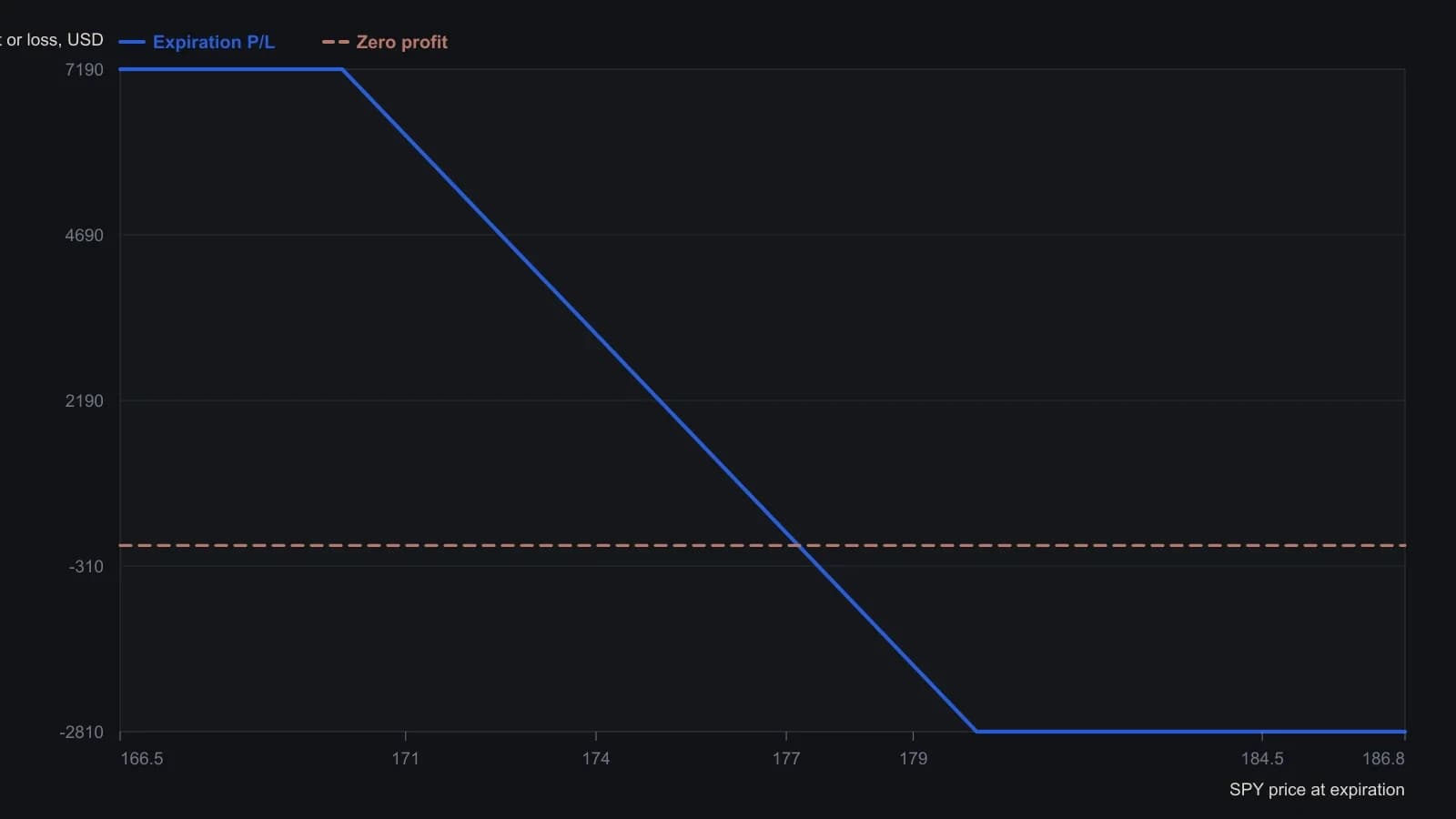
Payoff is expiration value from those blotter fills. It is not the live mark of -146.48 in the quote bar, and it ignores the 233 days of remaining theta.
A seasonal thesis, not a bare fall view
A late-spring seasonal timing idea is used as the hypothesis for the debit-spread case. A bare opinion that the market will fall is treated as insufficient reason to buy puts.
Seasonal trading, in the sense used here, is a calendar-timed entry, hold, and exit procedure that can be tested as one rule set rather than a loose story about typical months.
In the worked example, a long 180 put and short 170 put on the same underlying is said to profit only if that underlying is below 177.19 by the stated October expiration.
The four-step procedure
The write-up lists a four-step procedure: a specific reason to buy puts, a risk-acceptable structure, a plan to adjust or exit if the underlying diverges, and study of the structure before live use.
All readings on this track · 29 readings
- 1986Rank listed calls against a vertical debit inside one forecast band
- 1990Constructing vertical debit spreads around implied volatility
- 1994Even-money call spread after a stop-limit gap
- 1995Payoff anchors for bull and bear vertical spreads
- 1995Matching vertical spreads to forecast confidence
- 1997A defined-risk short vertical as a single testable procedure
- 1998Vertical debit spreads when implied volatility is elevated
- 2001Constructing vertical debit spreads with a preset risk-reward filter
- 2002Regime-first construction of vertical debit spreads
- 2003Sizing a vertical by the constraint you can enforce
- 2006Event premiums, straddle bias, and volatility-hedged spreads
- 2006From a winning long call to a bull vertical debit spread
- 2007Vertical debit spread construction from codes and premiums
- 2010Vertical construction as a bounded-risk procedure
- 2010Zero-cash repair of an underwater long
- 2011Cheap long calls and in-the-money debit vertical marks
- 2011Vertical debit value path, volatility, liquidity, and box exits
- 2013Constructing defined-risk vertical call spreads
- 2014Protective put versus seasonal debit spread
- 2014One bearish energy thesis, three strike geometries
- 2014Coffee versus equity as a two-sided debit-spread drill
- 2015Natural-gas thesis: ETF drag versus a call debit spread
- 2017Funding a call spread with an offsetting put spread
- 2018An expected-value test for vertical option spreads
- 2019Option ladder construction for financed vertical debits
- 2020One-week call versus bull-put premium tradeoffs
- 2020Constructing in-the-money versus out-of-the-money bull call debit spreads
- 2020Combining vertical debit spreads on a volatility product
- 2025Time decay as a decision variable in an NVDA bull call spread