2017issue C0438-39
Funding a call spread with an offsetting put spread
A directional options idea can be compared as three builds: a stock-equivalent long-call and short-put pairing, a standalone vertical debit call spread, and the same call spread funded by an offsetting put spread. Cash outlay, remaining tail risk, and the expiration no-loss band are read together before entry, abstention, or refusal of the unhedged reversal.
- A long call financed by a short put leaves directional exposure no different from owning the shares.
- Buying a call spread and selling a put spread at the same time can cut the net cash needed versus the call spread alone and can sometimes open as a small credit.
- The paired-spread expiration profile resembles a call spread except for a central band with no loss at expiration, so the construction is aimed at a large move rather than a modest drift.
- A long stock position that has already advanced can be paired with puts sized to the share holding as a defined-cost hedge instead of selling the shares.
Three comparable builds
An option spread pairs long and short contracts so net premium, defined risk, and the expiration payoff can be judged as one procedure. A directional idea can be set out as three comparable builds: a stock-equivalent long-call and short-put pairing, a standalone vertical debit call spread, and the same call spread funded by an offsetting put spread.
A vertical debit spread pays a net debit to buy the nearer strike and sell the farther strike at the same expiration, capping both cost and payoff. An offsetting put spread is a short put vertical used to reduce or reverse that debit.
The stock-equivalent pairing
A risk reversal finances a long call with a short put and leaves directional exposure similar to owning the shares. The archive workflow treats that pairing as no different from a long stock position.
On a share priced at 1646, one 1645-strike call at 53.60 required 5360 of premium versus 164600 to buy 100 shares, while still leaving large remaining risk.
A standalone vertical debit spread
With the oil-services ETF at 33, 100 shares implied 3300 of capital at risk. A 30-strike call cost 440, and a bull call debit spread cost 187 per contract.
Funding the call spread
Buying a call spread and selling a put spread at the same time can cut the net cash needed versus the call spread alone and can sometimes open as a small credit.
In the worked pairing, a call spread opened at a 187 debit and a put spread sold for 193 left a net credit of 6 per contract.
The paired-spread expiration profile resembles a call spread except for a central band with no loss at expiration, so the construction is aimed at a large move rather than a modest drift.
A defined-cost hedge instead of a sale
A long stock position that has already advanced can be paired with puts sized to the share holding as a defined-cost hedge instead of selling the shares.
OIH July 2017 call-put spread: profit and return by quote scenario
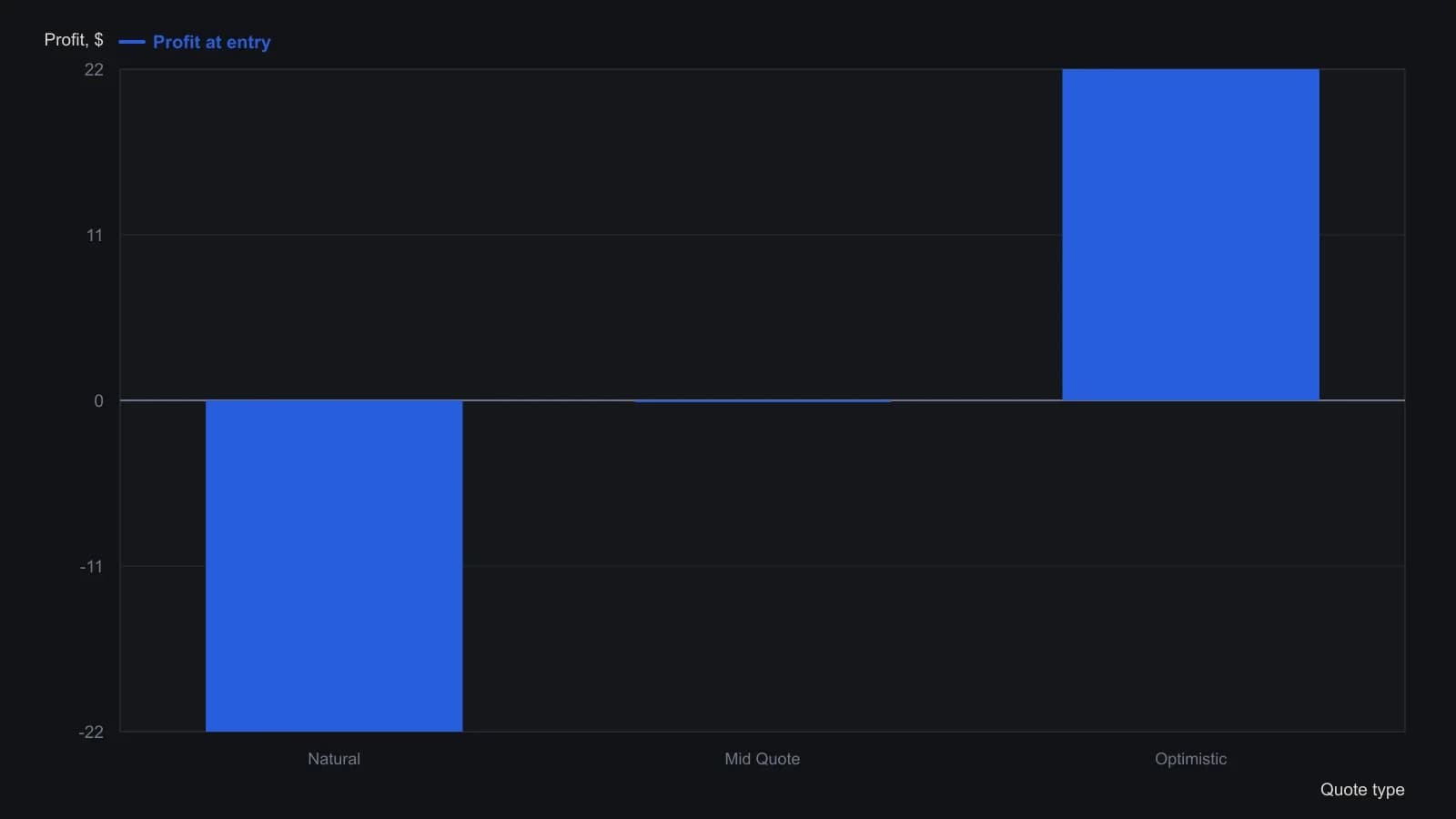
Max profit and max risk are identical across quote types; only entry credit, P/L, and rate of return change with the fill.
All readings on this track · 29 readings
- 1986Rank listed calls against a vertical debit inside one forecast band
- 1990Constructing vertical debit spreads around implied volatility
- 1994Even-money call spread after a stop-limit gap
- 1995Payoff anchors for bull and bear vertical spreads
- 1995Matching vertical spreads to forecast confidence
- 1997A defined-risk short vertical as a single testable procedure
- 1998Vertical debit spreads when implied volatility is elevated
- 2001Constructing vertical debit spreads with a preset risk-reward filter
- 2002Regime-first construction of vertical debit spreads
- 2003Sizing a vertical by the constraint you can enforce
- 2006Event premiums, straddle bias, and volatility-hedged spreads
- 2006From a winning long call to a bull vertical debit spread
- 2007Vertical debit spread construction from codes and premiums
- 2010Vertical construction as a bounded-risk procedure
- 2010Zero-cash repair of an underwater long
- 2011Cheap long calls and in-the-money debit vertical marks
- 2011Vertical debit value path, volatility, liquidity, and box exits
- 2013Constructing defined-risk vertical call spreads
- 2014Protective put versus seasonal debit spread
- 2014One bearish energy thesis, three strike geometries
- 2014Coffee versus equity as a two-sided debit-spread drill
- 2015Natural-gas thesis: ETF drag versus a call debit spread
- 2017Funding a call spread with an offsetting put spread
- 2018An expected-value test for vertical option spreads
- 2019Option ladder construction for financed vertical debits
- 2020One-week call versus bull-put premium tradeoffs
- 2020Constructing in-the-money versus out-of-the-money bull call debit spreads
- 2020Combining vertical debit spreads on a volatility product
- 2025Time decay as a decision variable in an NVDA bull call spread