2007issue C101
Vertical debit spread construction from codes and premiums
Construction of an option-spread starts by decoding both listed legs, netting their premiums into a vertical-debit-spread, and reading that net-debit against strike-width and remaining time value. TradersWeek editorial reading treats those steps as one testable procedure rather than two independent tickets.
- Listed option identifiers combine an option-root, an expiration-month-code, and a strike-code into a three-to-five-character symbol, so both legs can be decoded the same way.
- A vertical-debit-spread opens for a net-debit. In the worked put pair that outlay is 1.70, and it is the expiration loss if both contracts expire unused.
- Option-premium-analysis places the opening debit next to strike-width and the time-value-path so the spread is judged as one capital-risk position.
- While time value remains, live marks differ from the expiration payoff, so the construction is inspected over the holding period with a risk graph.
An option-spread is a long option and a short option treated as a single entry, exit, and abstention procedure rather than two independent tickets. The historical workflow first decodes each listed identifier, then nets the two premiums into a vertical-debit-spread.
TradersWeek editorial reading: those steps, followed by option-premium-analysis of the debit against strike-width, remaining time value, and the market regime the spread is meant to express, form one testable construction procedure.
Read the listed codes
Listed option identifiers are assembled from a root, a month-and-right letter, and a strike letter, and occupy three to five characters. The option-root is the abbreviated underlying identifier that begins the code and may be shorter than the equity ticker. Four-letter equity tickers are shortened to a three-character option-root before the month and strike codes are appended.
The expiration-month-code is a letter that encodes both the expiry month and whether the contract is a call or a put. Call expirations use one set of twelve monthly letters and puts use a separate set of twelve letters. The strike-code is a letter mapped to a listed exercise price, including five-point and fractional strikes.
Turn two premiums into one debit
A vertical-debit-spread is a same-expiration, different-strike pair opened for a net cash outlay, with expiration risk equal to that outlay if both contracts expire unused. The net-debit is the premium paid for the long leg minus the premium received for the short leg.
In the worked vertical, a long 80 put at 4.50 and a short 75 put at 2.80 produce a 1.70 net-debit, which is also the expiration loss if both options expire unused. If the underlying stays above the long 80 put, both legs expire unused and the 1.70 debit is lost. Maximum expiration value of that debit spread equals the 5-point strike-width minus the 1.70 debit, or 3.30, and is reached if the underlying is through the lower strike.
Place the debit in a capital-risk context
Option-premium-analysis reads the opening debit, remaining time value, and strike-width together so one spread sits inside a capital-risk and market-regime context. Strike-width is the difference between the two exercise prices, which caps the spread's value at expiration.
Far out-of-the-money debit constructions can be opened for smaller debits and therefore less capital at risk, with lower odds of capturing the full strike-width. At-the-money and in-the-money constructions cost more to open and are assigned a higher chance of reaching full value.
Premiums, net debit, and expiration payoff of the 80/75 bear put
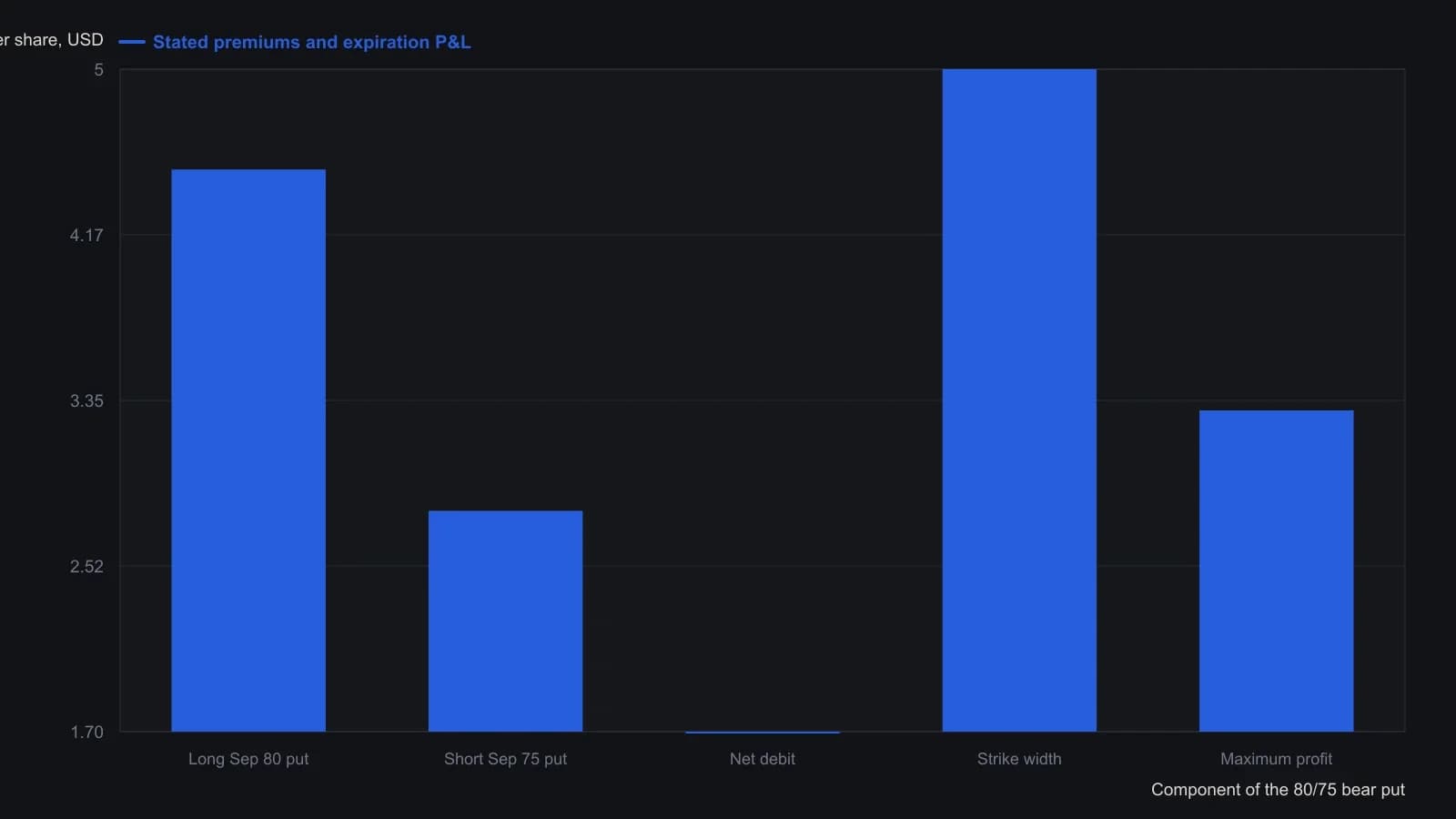
Stated risk and reward apply at expiration. Gentile notes that remaining time value changes the live P&L before expiry.
Follow the time-value-path
The time-value-path is remaining premium that makes live marks differ from the expiration payoff until the holding period ends. Expiration risk and reward differ from live marks while time value remains, so the construction is inspected over the holding period with a risk graph rather than only at expiry.
Editorial note: the archive facts specify how the codes and premiums assemble one vertical. They do not state a present-day market regime or a trading recommendation.
All readings on this track · 29 readings
- 1986Rank listed calls against a vertical debit inside one forecast band
- 1990Constructing vertical debit spreads around implied volatility
- 1994Even-money call spread after a stop-limit gap
- 1995Payoff anchors for bull and bear vertical spreads
- 1995Matching vertical spreads to forecast confidence
- 1997A defined-risk short vertical as a single testable procedure
- 1998Vertical debit spreads when implied volatility is elevated
- 2001Constructing vertical debit spreads with a preset risk-reward filter
- 2002Regime-first construction of vertical debit spreads
- 2003Sizing a vertical by the constraint you can enforce
- 2006Event premiums, straddle bias, and volatility-hedged spreads
- 2006From a winning long call to a bull vertical debit spread
- 2007Vertical debit spread construction from codes and premiums
- 2010Vertical construction as a bounded-risk procedure
- 2010Zero-cash repair of an underwater long
- 2011Cheap long calls and in-the-money debit vertical marks
- 2011Vertical debit value path, volatility, liquidity, and box exits
- 2013Constructing defined-risk vertical call spreads
- 2014Protective put versus seasonal debit spread
- 2014One bearish energy thesis, three strike geometries
- 2014Coffee versus equity as a two-sided debit-spread drill
- 2015Natural-gas thesis: ETF drag versus a call debit spread
- 2017Funding a call spread with an offsetting put spread
- 2018An expected-value test for vertical option spreads
- 2019Option ladder construction for financed vertical debits
- 2020One-week call versus bull-put premium tradeoffs
- 2020Constructing in-the-money versus out-of-the-money bull call debit spreads
- 2020Combining vertical debit spreads on a volatility product
- 2025Time decay as a decision variable in an NVDA bull call spread