2013issue C0240-41
Constructing defined-risk vertical call spreads
An option spread is built as one package rather than as separate one-legged trades. The worked example sells a September 30 call and buys a September 35 call so the strike width and the net credit set a bounded payoff.
- An option spread is one package that can express a bearish, bullish, or neutral view, not a set of separate one-legged trades.
- Selling the September 30 call at 3 and buying the September 35 call at 1 leaves a net credit of 2; the long strike confines share-level risk to the 5-point strike width.
- Stated maximum risk is the strike width minus the net credit already collected. Below 30 the credit can be kept; above 35 the limited net loss is 3.
- When the short option has little remaining time premium, the described management step is to buy it back and sell another option that still carries time premium.
Build the spread as one package
An option spread is built as one package that can express a bearish, bullish, or neutral view rather than as separate one-legged trades.
An option spread is a multi-leg option package treated as one position so a bullish, bearish, or neutral view is expressed with a single set of entry, hold, and exit rules.
The worked September credit
In the worked example a September 30 call is sold at 3 and a September 35 call is bought at 1, leaving a net credit of 2, shown as +200 against -100 on a one-contract basis.
Net credit is the cash left in the account after the short option premium exceeds the premium paid for the long option. Option premium analysis classifies that leftover cash as cash-in.
The purchased strike as a width cap
The long 35 call is added so that if the underlying rises, that purchased strike can offset assignment on the short 30 call and confine the share-level gap to the 5-point width.
That purchased farther-strike leg is the vertical debit spread in this same-expiration vertical. It is paid for as a debit so assignment on the short strike cannot expand share-level risk beyond the strike width.
Strike width is the difference between the two strikes. It is the unhedged gap if both options are exercised or assigned. Stated maximum risk equals the 5-point strike width minus the net credit already collected.
What the expiration sketch marks
If the underlying is below 30 at expiration, the net credit can be kept because buying the shares in the open market is cheaper than calling them at 30.
If the underlying is above 35 at expiration, assignment at 30 plus exercise of the 35 call creates a 5-point differential that, after the 2-point credit, leaves a limited net loss of 3.
The expiration payoff sketch marks a bounded maximum gain, a breakeven, and a bounded maximum loss across underlying prices from the mid-20s through 40.
September 30/35 call credit spread payoff at expiration
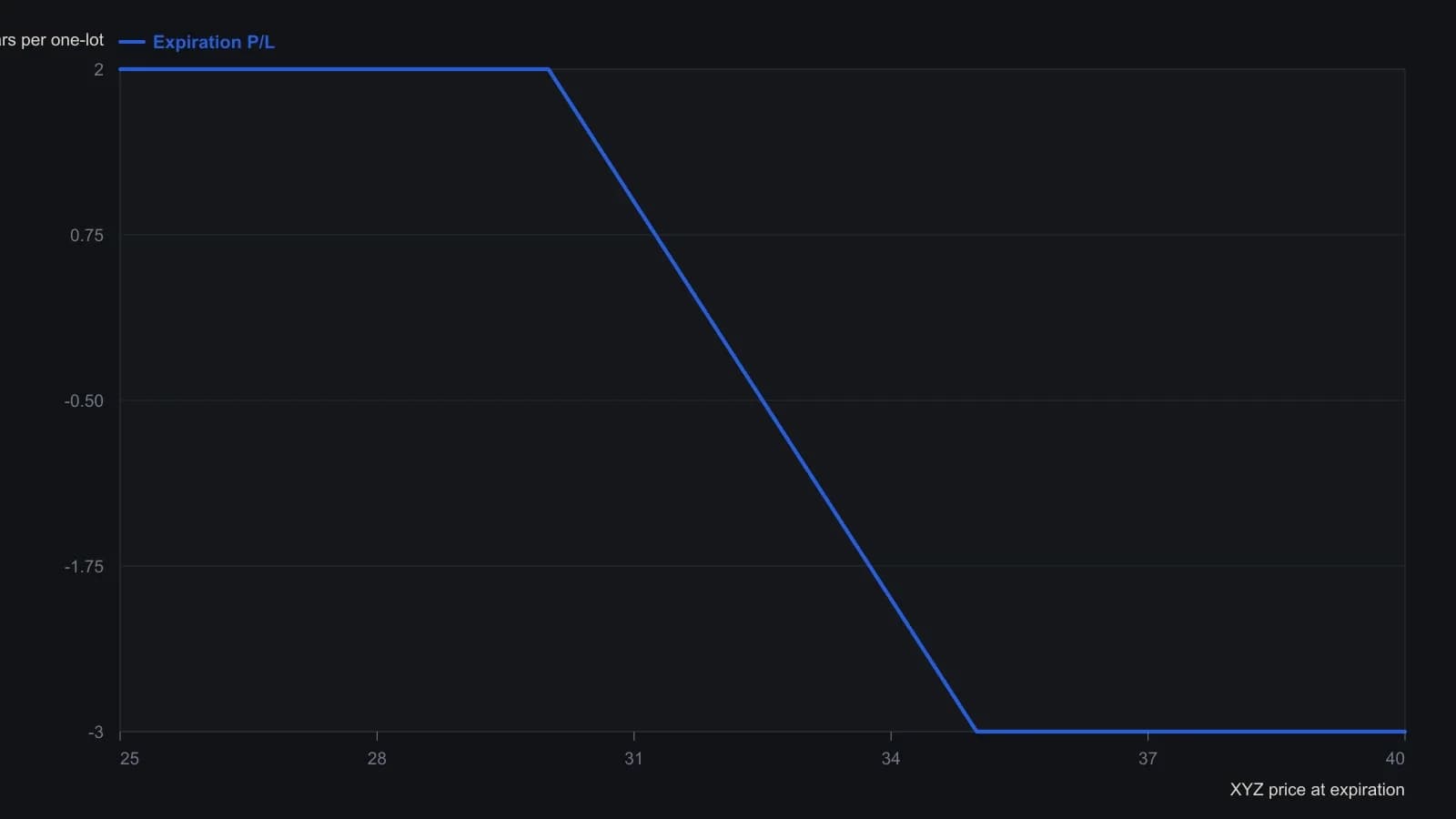
Payoff is the expiration worksheet implied by the stated net credit and $5 strike width, not a mid-life mark-to-market path. Commission and early-exercise costs are omitted, matching the source.
Replace the short strike when time premium is gone
When the short option has little remaining time value, the described management step is to buy it back and sell another option that still carries time premium.
Time premium is the portion of an option price that is not intrinsic value. When it is largely gone on a short option, early exercise risk rises.
Option premium analysis reads net cash flow and remaining time value to classify the package as cash-in or cash-out and to judge when a short option should be bought back and replaced.
All readings on this track · 29 readings
- 1986Rank listed calls against a vertical debit inside one forecast band
- 1990Constructing vertical debit spreads around implied volatility
- 1994Even-money call spread after a stop-limit gap
- 1995Payoff anchors for bull and bear vertical spreads
- 1995Matching vertical spreads to forecast confidence
- 1997A defined-risk short vertical as a single testable procedure
- 1998Vertical debit spreads when implied volatility is elevated
- 2001Constructing vertical debit spreads with a preset risk-reward filter
- 2002Regime-first construction of vertical debit spreads
- 2003Sizing a vertical by the constraint you can enforce
- 2006Event premiums, straddle bias, and volatility-hedged spreads
- 2006From a winning long call to a bull vertical debit spread
- 2007Vertical debit spread construction from codes and premiums
- 2010Vertical construction as a bounded-risk procedure
- 2010Zero-cash repair of an underwater long
- 2011Cheap long calls and in-the-money debit vertical marks
- 2011Vertical debit value path, volatility, liquidity, and box exits
- 2013Constructing defined-risk vertical call spreads
- 2014Protective put versus seasonal debit spread
- 2014One bearish energy thesis, three strike geometries
- 2014Coffee versus equity as a two-sided debit-spread drill
- 2015Natural-gas thesis: ETF drag versus a call debit spread
- 2017Funding a call spread with an offsetting put spread
- 2018An expected-value test for vertical option spreads
- 2019Option ladder construction for financed vertical debits
- 2020One-week call versus bull-put premium tradeoffs
- 2020Constructing in-the-money versus out-of-the-money bull call debit spreads
- 2020Combining vertical debit spreads on a volatility product
- 2025Time decay as a decision variable in an NVDA bull call spread