2020issue C1143
Constructing in-the-money versus out-of-the-money bull call debit spreads
A bullish call debit spread can be built with the long strike in the money or out of the money. The archive frames that moneyness choice as a higher chance of some profit versus a larger potential profit on that trade, under a view that implied volatility could rise sharply over the following months.
- A bull call spread is a same-expiry vertical debit that buys one call and sells another at a farther strike, paying a net debit for a capped payoff if the underlying rises toward or through the short strike.
- The first construction inputs are whether the priority is some profit or maximum profitability on that trade, and how confident the trader is about the expected move.
- High conviction that the expected move will occur, paired with a goal of maximizing profit if that view is right, maps to the out-of-the-money build. Some upside without a firm view on how far the move will run maps to the in-the-money build.
- After those two pure constructions, a hybrid that blends them is offered as a third construction path.
Two ways to build the same bullish debit
A vertical debit spread is a same-expiry option spread that buys one contract and sells another of the same type at a farther strike, paying a net debit for a capped payoff. A bull call spread is the call-side form. Its value improves if the underlying rises toward or through the short strike by expiration.
A bullish call debit spread can be built with the long strike in the money or out of the money. The archive frames that choice as a higher chance of some profit versus a larger potential profit on that trade. That is the probability-versus-payoff construction trade-off: a higher chance of a modest gain against a lower chance of a larger maximum gain on the same directional view.
Decide the priority, then the moneyness
The first construction inputs named are whether the priority is some profit or maximum profitability on that trade, and how confident the trader is about the expected move.
High conviction that the expected move will occur, paired with a goal of maximizing profit if that view is right, is mapped to the out-of-the-money bull call debit spread. In an out-of-the-money construction the long strike sits at or above the underlying, so the debit is smaller relative to width and a larger remaining move is required for a full payoff.
An expectation of some upside without a firm view on how far the move will run is mapped to an in-the-money bull call debit spread as the higher-probability construction. In an in-the-money construction the long strike sits below the underlying, so more of the debit is already intrinsic and a smaller remaining move can produce some profit.
After the two pure constructions, a hybrid construction that blends the in-the-money and out-of-the-money call-debit designs is offered as a third construction path.
A historical volatility-expansion example
The example is dated August 18, 2020. It assumes a view that volatility could rise sharply, including a possible doubling, over the following months. Implied volatility is the volatility priced into listed options. In this dossier it is the market-regime variable the example structures are built around if it rises over coming months.
The in-the-money example is a November 2020 VXX 24/30 call debit: long the 24 call at 5.00 and short the 30 call at 3.35.
The out-of-the-money example is a November 2020 VXX 30/50 call debit: long the 30 call at 3.35 and short the 50 call at 1.37.
A comparison figure shows each spread’s expected profit at expiration against the VXX price at expiration.
Expiration P&L of ITM vs OTM VXX bull call debit spreads
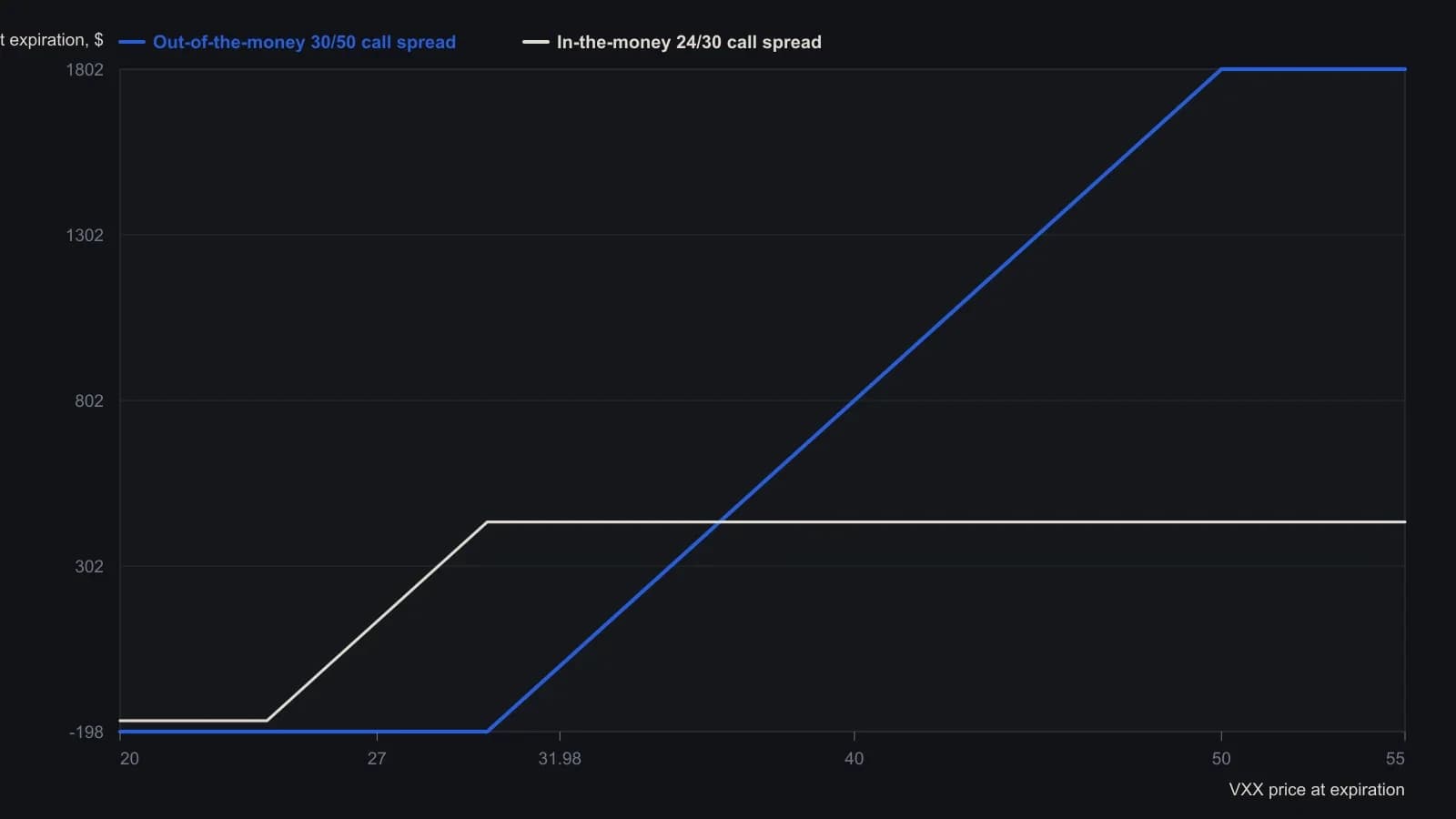
Net debits are $1.65 on the 24/30 spread and $1.98 on the 30/50 spread. Figures are expiration intrinsic value for one 100-share contract and ignore commissions.
All readings on this track · 29 readings
- 1986Rank listed calls against a vertical debit inside one forecast band
- 1990Constructing vertical debit spreads around implied volatility
- 1994Even-money call spread after a stop-limit gap
- 1995Payoff anchors for bull and bear vertical spreads
- 1995Matching vertical spreads to forecast confidence
- 1997A defined-risk short vertical as a single testable procedure
- 1998Vertical debit spreads when implied volatility is elevated
- 2001Constructing vertical debit spreads with a preset risk-reward filter
- 2002Regime-first construction of vertical debit spreads
- 2003Sizing a vertical by the constraint you can enforce
- 2006Event premiums, straddle bias, and volatility-hedged spreads
- 2006From a winning long call to a bull vertical debit spread
- 2007Vertical debit spread construction from codes and premiums
- 2010Vertical construction as a bounded-risk procedure
- 2010Zero-cash repair of an underwater long
- 2011Cheap long calls and in-the-money debit vertical marks
- 2011Vertical debit value path, volatility, liquidity, and box exits
- 2013Constructing defined-risk vertical call spreads
- 2014Protective put versus seasonal debit spread
- 2014One bearish energy thesis, three strike geometries
- 2014Coffee versus equity as a two-sided debit-spread drill
- 2015Natural-gas thesis: ETF drag versus a call debit spread
- 2017Funding a call spread with an offsetting put spread
- 2018An expected-value test for vertical option spreads
- 2019Option ladder construction for financed vertical debits
- 2020One-week call versus bull-put premium tradeoffs
- 2020Constructing in-the-money versus out-of-the-money bull call debit spreads
- 2020Combining vertical debit spreads on a volatility product
- 2025Time decay as a decision variable in an NVDA bull call spread