2014issue C0751-52
One bearish energy thesis, three strike geometries
This archive case held a weaker-oil view fixed and changed only option-spread geometry. A crude bear-put-vertical, an oil-services body-and-wings-butterfly, and a higher-beta call-credit-vertical were graded by required movement, defined risk, and what counted as a win at expiration.
- A bear-put-vertical finances a long higher-strike put by selling a lower-strike put, so the short-leg credit reduces the net debit versus owning the long put alone.
- The same weaker-oil view was written as October 90 and 85 crude puts, an OIH 40/45/50 body-and-wings-butterfly, and an SLB 105/110 call-credit-vertical.
- The call-credit-vertical kept its credit if SLB stayed below 105 through expiration and accepted a larger defined loss than defined gain in exchange for a payoff that did not require the stock to move.
- The three constructions were presented as alternative option-spread procedures, with the choice depending on knowledge of the underlying, knowledge of the spread, and risk tolerance.
A fixed view, rotating geometry
The archive held one bearish energy thesis fixed and rotated only strike geometry. Debit-put, butterfly, and credit-call constructions were presented as alternative option-spread procedures for that view. An option-spread is a paired-leg construction that replaces an outright long or short option with a defined combination of strikes, so entry, exit, and abstention can be tested as one procedure.
OIH was treated as an oil-services fund that tends to move with crude, so a weaker oil view could be expressed with OIH option spreads rather than futures alone. SLB was described as a large OIH constituent with higher beta than the fund, implying a wider expected range for the same energy view.
The crude bear-put-vertical
A vertical-debit-spread is a same-expiration two-strike structure bought for a net debit. In put form it is a bear-put-vertical: a long higher-strike put financed by a short lower-strike put. The credit from the short leg reduces the cash outlay of the long put.
The crude-oil case used October 90 and 85 puts as that vertical debit. At expiration the structure was profitable below 89.07 and reached its defined maximum at or below 85.
The OIH body-and-wings-butterfly
A body-and-wings-butterfly is a three-strike, often near-delta-neutral spread that is long the outer strikes and short the middle strike, targeting a price near the body at expiration.
The OIH example was a 40/45/50 butterfly long the wings and short the body, aiming for a print near 45 at expiration and remaining profitable between 40.68 and 49.32 before costs.
The SLB call-credit-vertical
A call-credit-vertical is a same-month vertical that sells a lower-strike call and buys a higher-strike call for a net credit, keeping that credit if the underlying stays below the short strike through expiration.
The SLB case sold the 105 call and bought the 110 call for a net credit, retaining the credit if the stock stayed below 105 through expiration. That credit call vertical accepted a larger defined loss than defined gain in exchange for a payoff that did not require the stock to move.
OIH October 40/45/50 put butterfly at expiration
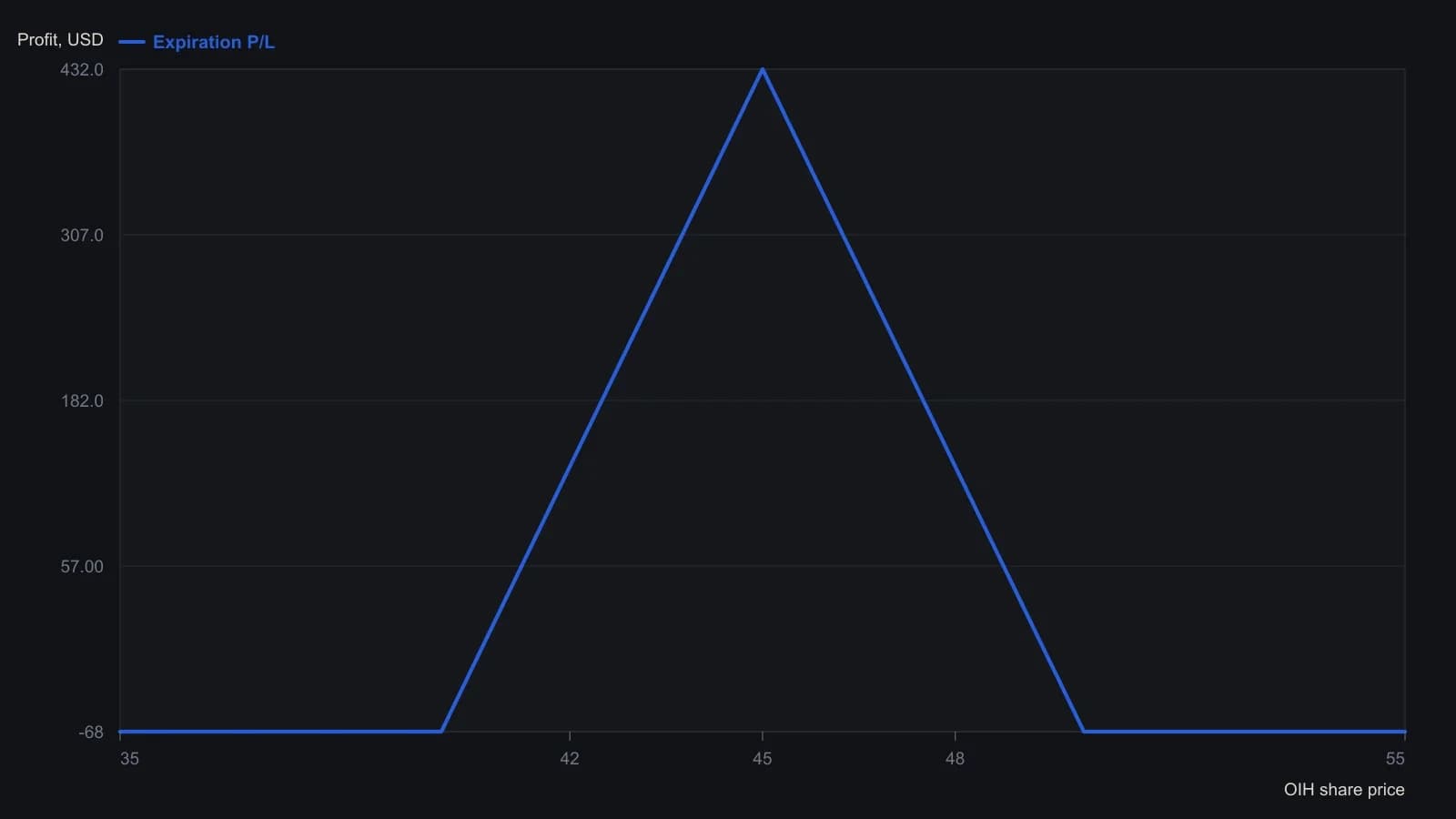
Only the expiration payoff is reconstructed from the ticket. The source also plotted theoretical marks at 163, 109 and 55 days to expiry.
What the choice depended on
The three constructions were presented as alternative option-spread procedures for one bearish energy view. The choice depended on knowledge of the underlying, knowledge of the spread, and risk tolerance.
Editorial: The crude vertical needed the underlying to finish below the stated expiration threshold, the butterfly needed a print near the body and inside a bounded band, and the SLB vertical could keep its credit if the stock simply failed to rally through the short call. Required movement, defined risk, and the expiration win condition changed with strike geometry. The energy thesis did not.
All readings on this track · 29 readings
- 1986Rank listed calls against a vertical debit inside one forecast band
- 1990Constructing vertical debit spreads around implied volatility
- 1994Even-money call spread after a stop-limit gap
- 1995Payoff anchors for bull and bear vertical spreads
- 1995Matching vertical spreads to forecast confidence
- 1997A defined-risk short vertical as a single testable procedure
- 1998Vertical debit spreads when implied volatility is elevated
- 2001Constructing vertical debit spreads with a preset risk-reward filter
- 2002Regime-first construction of vertical debit spreads
- 2003Sizing a vertical by the constraint you can enforce
- 2006Event premiums, straddle bias, and volatility-hedged spreads
- 2006From a winning long call to a bull vertical debit spread
- 2007Vertical debit spread construction from codes and premiums
- 2010Vertical construction as a bounded-risk procedure
- 2010Zero-cash repair of an underwater long
- 2011Cheap long calls and in-the-money debit vertical marks
- 2011Vertical debit value path, volatility, liquidity, and box exits
- 2013Constructing defined-risk vertical call spreads
- 2014Protective put versus seasonal debit spread
- 2014One bearish energy thesis, three strike geometries
- 2014Coffee versus equity as a two-sided debit-spread drill
- 2015Natural-gas thesis: ETF drag versus a call debit spread
- 2017Funding a call spread with an offsetting put spread
- 2018An expected-value test for vertical option spreads
- 2019Option ladder construction for financed vertical debits
- 2020One-week call versus bull-put premium tradeoffs
- 2020Constructing in-the-money versus out-of-the-money bull call debit spreads
- 2020Combining vertical debit spreads on a volatility product
- 2025Time decay as a decision variable in an NVDA bull call spread