1997issue C071-5
A defined-risk short vertical as a single testable procedure
A short vertical credit spread sells an out-of-the-money option and buys a further out-of-the-money option of the same type, replacing naked-write risk with a defined maximum loss. This case study restates the archive workflow that ranks implied volatility, applies entry filters, and pairs the structure with predetermined profit-taking and stop-loss levels.
- A short vertical credit spread sells an out-of-the-money option and buys a further out-of-the-money option of the same type, replacing unlimited naked-write risk with a defined maximum loss.
- Profit is limited to the net credit received, and the maximum loss is typically larger than that credit.
- Writing is reserved for at-the-money implied volatility ranks of 6 or higher on a 1-to-10 scale against the prior two-year high-low range, together with filters on days to expiration, sold-option delta, market state, and a 20% or greater implied-volatility gap.
- Durable use depends on pairing those selection advantages with predetermined profit-taking and stop-loss levels and then following that plan on each trade.
A paired credit structure with a defined loss
A short vertical credit spread is an option spread: a paired long and short option position used as one procedure rather than two separate trades. It is built by selling an out-of-the-money option and buying a further out-of-the-money option of the same type.
That purchase replaces the unlimited risk of a naked write with a defined maximum loss. Profit on the structure is limited to the net credit received, and the maximum loss is typically larger than that credit.
A vertical debit spread is a same-expiration long and short strike pair that pays a net debit and therefore caps both gain and loss. The archive case is separate: it collects a net credit on the short vertical described above, so the cap on profit is that credit while the loss remains defined.
Rank implied volatility first
Relative volatility is formed by ranking current at-the-money implied volatility against the prior two-year high-low range on a 1-to-10 scale. Writing is reserved for ranks of 6 or higher.
Apply the entry checklist
The documented entry checklist also requires fewer than 45 days to expiration, a sold-option delta of 35 or less, and a market state that favors the chosen side of the spread.
A further positive filter is a sold option whose implied volatility is sharply higher than that of the purchased option, described as a 20% or greater gap.
Add a profit rule and a stop-loss
A stop-loss is a precommitted exit that bounds loss or exposure before the trade is placed and while it is open. Durable use of the structure depends on pairing the selection advantages with predetermined profit-taking and stop-loss levels and then following that plan on each trade.
Editorial view: abstention belongs to the same procedure. If the rank, the checklist, or the precommitted exits are missing, the archive workflow does not treat time decay as available.
S&P September 1996 futures implied volatility
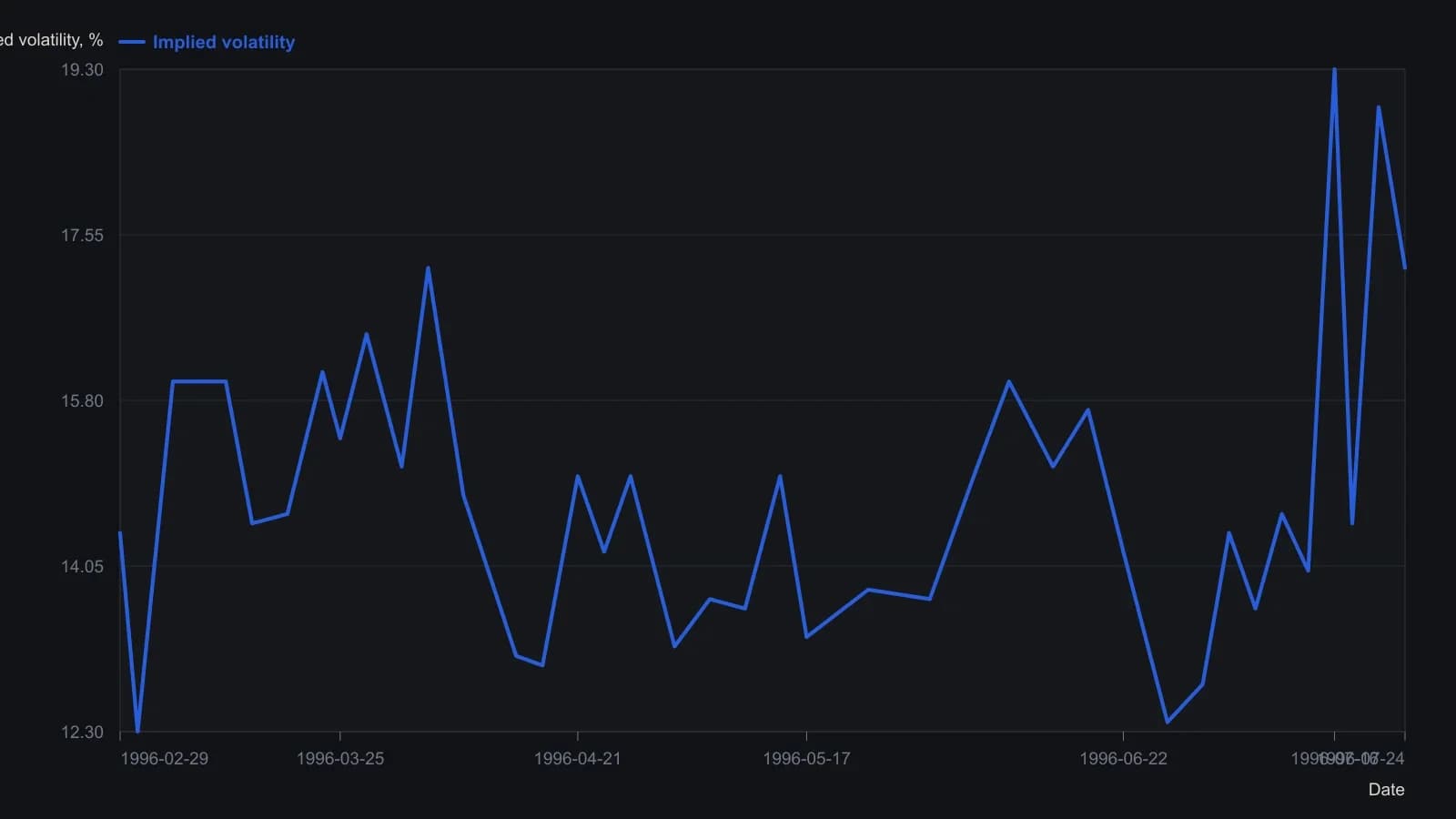
Digitized from the printed Option Pro Online daily window for 29 February–24 July 1996. Grid lines are 1.1 implied-volatility points apart; readings are given to one decimal and are approximate to about two-tenths of a point. The banner states a 24-month relative volatility rank of 9.
All readings on this track · 29 readings
- 1986Rank listed calls against a vertical debit inside one forecast band
- 1990Constructing vertical debit spreads around implied volatility
- 1994Even-money call spread after a stop-limit gap
- 1995Payoff anchors for bull and bear vertical spreads
- 1995Matching vertical spreads to forecast confidence
- 1997A defined-risk short vertical as a single testable procedure
- 1998Vertical debit spreads when implied volatility is elevated
- 2001Constructing vertical debit spreads with a preset risk-reward filter
- 2002Regime-first construction of vertical debit spreads
- 2003Sizing a vertical by the constraint you can enforce
- 2006Event premiums, straddle bias, and volatility-hedged spreads
- 2006From a winning long call to a bull vertical debit spread
- 2007Vertical debit spread construction from codes and premiums
- 2010Vertical construction as a bounded-risk procedure
- 2010Zero-cash repair of an underwater long
- 2011Cheap long calls and in-the-money debit vertical marks
- 2011Vertical debit value path, volatility, liquidity, and box exits
- 2013Constructing defined-risk vertical call spreads
- 2014Protective put versus seasonal debit spread
- 2014One bearish energy thesis, three strike geometries
- 2014Coffee versus equity as a two-sided debit-spread drill
- 2015Natural-gas thesis: ETF drag versus a call debit spread
- 2017Funding a call spread with an offsetting put spread
- 2018An expected-value test for vertical option spreads
- 2019Option ladder construction for financed vertical debits
- 2020One-week call versus bull-put premium tradeoffs
- 2020Constructing in-the-money versus out-of-the-money bull call debit spreads
- 2020Combining vertical debit spreads on a volatility product
- 2025Time decay as a decision variable in an NVDA bull call spread