2019issue C0817
Constructing futures leverage from margin and fixed size
A listed futures trade is a delivery obligation funded by a good-faith deposit smaller than the notional exposure. Realized leverage is set by how many fixed-size contracts sit against account funding, so a percentage swing can exhaust the deposit and leave an account deficit.
- A listed futures trade is a standardized delivery obligation, not an immediate transfer of the commodity, and it can be closed by offset before expiration.
- Futures margin is presented as a good-faith deposit without the interest charge attached to borrowed funds in cash-market margin trades, and it must cover the position from before entry through a later adverse move.
- One crude-oil contract near $55 implied about $55,000 of notional value against an approximate $3,500 deposit; a 10% move is $5,500 and can leave the account at -$2,500 if the position is not closed.
- Realized leverage is set by how many fixed-size contracts are held relative to account funding, not by an exchange-assigned multiplier alone.
A standardized delivery obligation
A listed futures trade creates a standardized delivery obligation. It is a promise to make or take the underlying later, rather than an immediate transfer of the asset. The exchange contract is an indivisible unit. Fixed-contract sizing uses that unit as the block that converts a cash budget into notional exposure.
A short futures position can be opened without first owning or borrowing the underlying asset because both sides exchange offsetable obligations. The same delivery obligation can be closed before expiration by offset, which means buying or selling back the same standardized contract instead of making or taking delivery.
A good-faith deposit, not borrowed cash
Futures margin is presented as a good-faith deposit that supports the position. It is presented as not carrying an interest charge of the kind attached to borrowed funds in cash-market margin trades. Margin management treats that posted deposit as partial funding that must cover the position from before entry through any later adverse move.
When a 10% move exceeds the deposit
In the crude-oil illustration, one contract with the underlying near $55 implied about $55,000 of notional value against an approximate $3,500 deposit. Notional exposure is that full underlying value, and it sets the dollar scale of each percentage price change. A 10% move on that $55,000 notional equals a $5,500 gain or loss. The $3,500 deposit can be exhausted and, if the position is not closed, can leave an account at -$2,500. An account deficit is a mark-to-market loss larger than cash on deposit. It is possible when the notional move exceeds the posted margin.
Contract count sets realized leverage
Realized leverage is set by the trader through how many fixed-size contracts are held relative to account funding, not by an exchange-assigned multiplier alone. Leverage control is the choice of how many standardized contracts to hold against account equity so a given price move stays inside a pre-set loss bound.
Minimum crude-oil margin versus a 10% contract swing
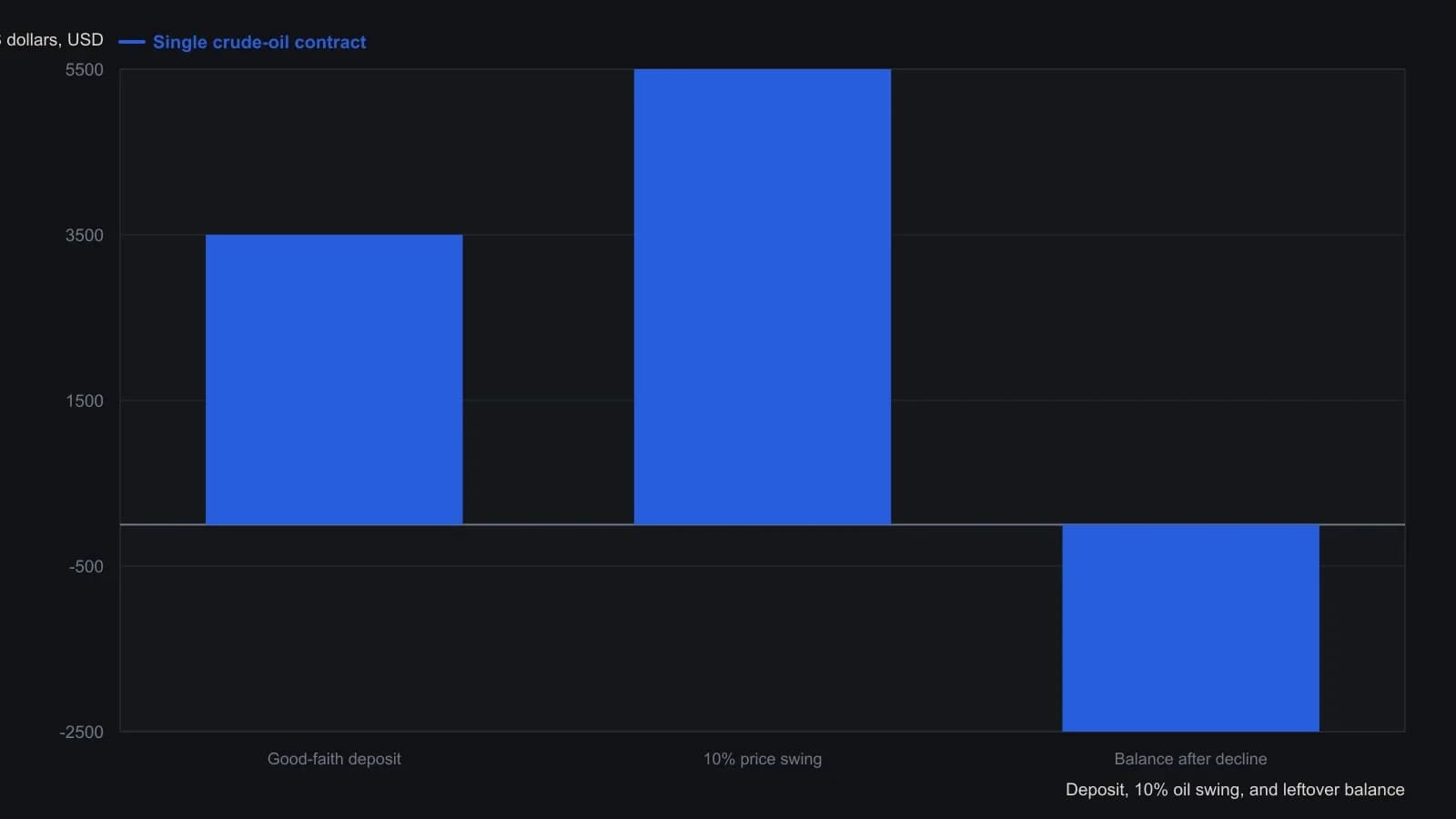
Margin is given as about $3,500; the $55,000 notional assumes crude oil at $55 a barrel on a single standard contract.
All readings on this track · 21 readings
- 1987Volatility-layered mechanical system with fixed contracts
- 1994Starting capital from worst-case portfolio walk-forwards
- 1994Bound small-account risk before adding leverage
- 1996Variable position size after entry
- 1996Equity path filters for contract size and drawdown
- 1997Stop distance, equity caps, and trading halts
- 1999Size-matched buy-and-hold evaluation for stock systems
- 2002Size from stop distance to keep dollar risk even
- 2003Share size from daily profit equilibrium
- 2004Half-size energy futures as a pre-trade leverage filter
- 2007Equalizing contract risk in trend following
- 2007Expected-equity sizing and geometric drag
- 2007Predefine the loss before fixed contract sizing
- 2013Weekday, session, and market expectancy for contract size
- 2014Bounded leverage before you size a trade
- 2015Equal-dollar futures size and open-interest liquidity
- 2015Atomize trading decisions: discipline over complexity
- 2017Tiny bets, ruin risk, and mechanical scale
- 2018Near-strike weekly puts and unfunded assignment risk
- 2019Paper trading is unfinished without fill and size rules
- 2019Constructing futures leverage from margin and fixed size