1987issue C081-5
Volatility-layered mechanical system with fixed contracts
A TradersWeek editorial reading of this archive construction treats it as two sequential locks. A volatility-state first chooses the stop-and-target set so range defines the risk geometry. Size is then frozen at a fixed-contract-size of one unit so that geometry, not added units, bounds the loss before entry.
- The archive specifies one mechanical buy, sell, or hold process that follows the prevailing trend, lets open gains continue, and exits losses promptly.
- A trading-window of daily indicators, shipped with a 20-day default, reads trend from price change. A non-editable volatility-state then selects that day's parameter-bundle.
- The book keeps an always-in-stance until a profit target is reached, and it may reverse when the trend is weak or price reacts sharply against it.
- Exposure is a fixed-contract-size of one contract per market on an independent-market-book, with capital outlines for a full seven-market set and a half-size-path.
An editorial reading of two locks
This article is a TradersWeek editorial reading of an archive mechanical construction. It is not a claim that the archive itself described the work as two locks.
In that editorial reading, construction proceeds in order. A volatility-state first selects the stop-and-target set so range defines the risk geometry. Size is then frozen at one contract so that geometry, not added units, bounds the loss before entry.
One testable buy, sell, or hold process
The archive specifies a mechanical procedure as one testable buy, sell, or hold process. That process encodes three operating rules: follow the prevailing trend, allow open gains to continue, and exit losses promptly.
The trading-window and the trend
Daily indicators are computed over a user-chosen trading-window of trading days. The procedure is shipped with a default of 20 days in every market. Trend state is taken from price change inside that window.
Volatility-state chooses the parameter-bundle
Each market is split into three volatility-state values: low, medium, and high. A different parameter-bundle is applied only after the current state is identified. Volatility-state thresholds are fixed inside the procedure and are not user-editable, even though other parameters remain adjustable.
In the 11-year historical sample used to set the construction, about one-third of days were assigned to each of the three volatility-state values.
After the trading-window, five further parameters remain adjustable: entry and exit rules, a filter, a standard stop, a variable stop, and a profit target. Those values may differ by long versus short side and by market. They are the parameter-bundle assigned once the current volatility-state is known.
Always-in-stance until a target
The procedure keeps an always-in-stance. It stays continuously long or short until a profit target is reached. It may reverse when the trend is weak or price reacts sharply against it.
Fixed-contract-size as the second lock
Exposure is specified as a fixed-contract-size of a single contract in each market. No pyramiding, compounding, or multiple-contract stacking is assumed.
In the TradersWeek editorial reading, that one-contract freeze is the second lock. After the volatility-state has chosen the stop-and-target set, size is not allowed to add units that would enlarge the loss before entry.
An independent-market-book and capital outlines
The construction is an independent-market-book. Each market is signaled and sized on its own, so the full set need not be traded together.
Capital outlines list 13 portfolio constructions from 10,000 to 100,000 account units. They name 40,000 as the minimum to run all seven independently traded markets. They also describe a 5,000-unit path that uses half-size bond or currency contracts. That half-size-path is a reduced-notional contract choice used to lower the stated minimum account needed to run the same rules.
Eurotrader net profit by market, 1976–1987
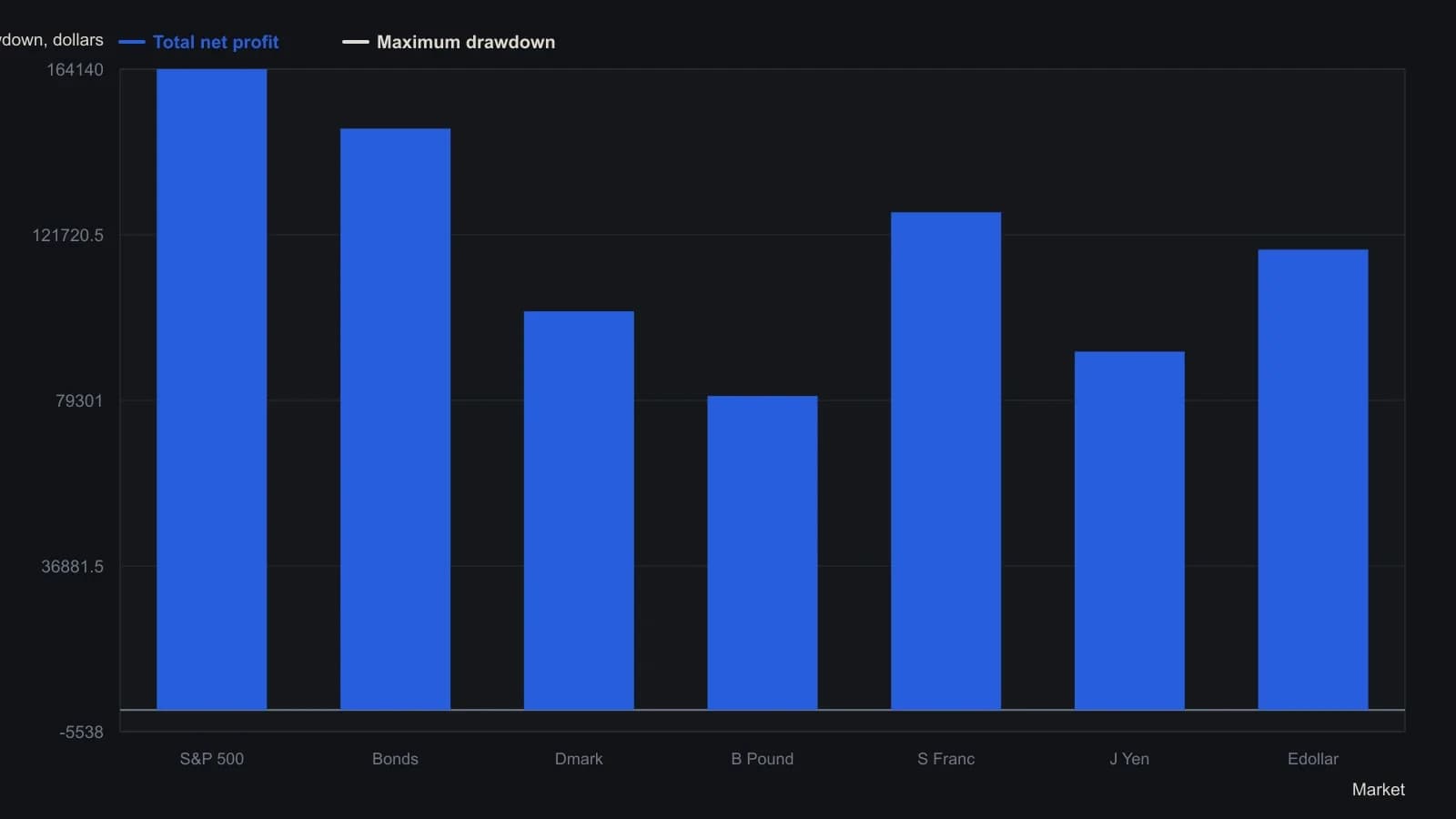
Cash prices were used for the S&P 500 and Eurodollar before those futures listed. One hundred dollars of slippage and commission was deducted from each trade. Size is one contract with no pyramiding. The distributed window length is 20 days.
All readings on this track · 21 readings
- 1987Volatility-layered mechanical system with fixed contracts
- 1994Starting capital from worst-case portfolio walk-forwards
- 1994Bound small-account risk before adding leverage
- 1996Variable position size after entry
- 1996Equity path filters for contract size and drawdown
- 1997Stop distance, equity caps, and trading halts
- 1999Size-matched buy-and-hold evaluation for stock systems
- 2002Size from stop distance to keep dollar risk even
- 2003Share size from daily profit equilibrium
- 2004Half-size energy futures as a pre-trade leverage filter
- 2007Equalizing contract risk in trend following
- 2007Expected-equity sizing and geometric drag
- 2007Predefine the loss before fixed contract sizing
- 2013Weekday, session, and market expectancy for contract size
- 2014Bounded leverage before you size a trade
- 2015Equal-dollar futures size and open-interest liquidity
- 2015Atomize trading decisions: discipline over complexity
- 2017Tiny bets, ruin risk, and mechanical scale
- 2018Near-strike weekly puts and unfunded assignment risk
- 2019Paper trading is unfinished without fill and size rules
- 2019Constructing futures leverage from margin and fixed size