1996issue C051-14
Variable position size after entry
This archive article keeps a channel-breakout-system's entry and exit prices fixed, then compares constant-position-size with a variable-position-size path that may add or reduce units only after a favorable move.
- Entry and exit prices stay the same under constant-position-size and variable-position-size; only the number of contracts held during the trade may differ.
- A unit is a volatility-scaled parcel of contracts, so markets with different multipliers and ranges can be given comparable exposure.
- The vps-profile may change units only when standardized-price makes a new favorable high; size is frozen during retracements.
- Risk is a Monte Carlo estimate of a rare downside loss before a profit goal, so a return-risk-ratio can compare sizing paths without also penalizing upside equity jumps.
A second rule set after entry
This archive article compares two post-entry sizing philosophies. One path reduces size after a favorable move. The other adds size after a favorable move. The question is which path is better on a risk-adjusted basis.
variable-position-size changes how many units are held after entry, while keeping the same entry and exit prices as a constant-position-size version of the system. constant-position-size holds the same number of units from entry to exit. Only the number of contracts held during the trade is allowed to differ.
The channel-breakout-system
The test vehicle is a channel-breakout-system, an always-or-flat breakout procedure that enters on a longer lookback extreme and exits on a shorter opposite extreme. Here that is a two-lookback channel breakout that enters on a 50-day extreme, exits on a 20-day opposite extreme, and stays flat until the next entry.
Units, not raw contracts
Constant-size exposure is defined in units, not raw contracts. A unit is a volatility-scaled parcel of contracts chosen so that markets with different multipliers and ranges receive comparable exposure. Contracts equal a trader-chosen constant divided by the product of the contract multiplier and the 20-day average true range at entry.
The baseline is one unit per market, with the sizing constant set to 1500, across a 25-market US futures book and two five-year windows, 1985-89 and 1990-94.
Standardized-price and the vps-profile
Variable size is applied on a standardized-price scale. standardized-price is price progress from entry, measured in units of the entry-time 20-day average true range, and signed so that favorable movement is positive. That quantity is favorable distance from entry divided by the entry-time 20-day average true range.
The vps-profile maps standardized-price highs to the number of units held. Units may change only when standardized-price makes a new favorable high. Size is frozen during retracements so the size path stays tractable. umax is the largest number of units the variable-size path is allowed to hold on one trade.
A worked size path starts at one unit, adds at standardized-price highs of 1 and 3, and later reduces size at still-higher standardized-price levels.
Risk as a rare downside loss
Risk is defined as a Monte Carlo estimate of a rare downside loss before a profit goal, not as a volatility statistic that also penalizes upside equity jumps. A return-risk-ratio, annual profit divided by a downside-loss amount estimated from the trade stream, is used to compare sizing methods.
A later walk-forward illustration
A later real-world walk-forward illustration compares the same breakout entries under variable and constant sizing. It reports a higher annualized return and a slightly smaller maximum open-equity drawdown for the variable path in 1990-94.
Editorial note: those archive-period figures are not a claim about present-day results.
Units versus standardized price after entry
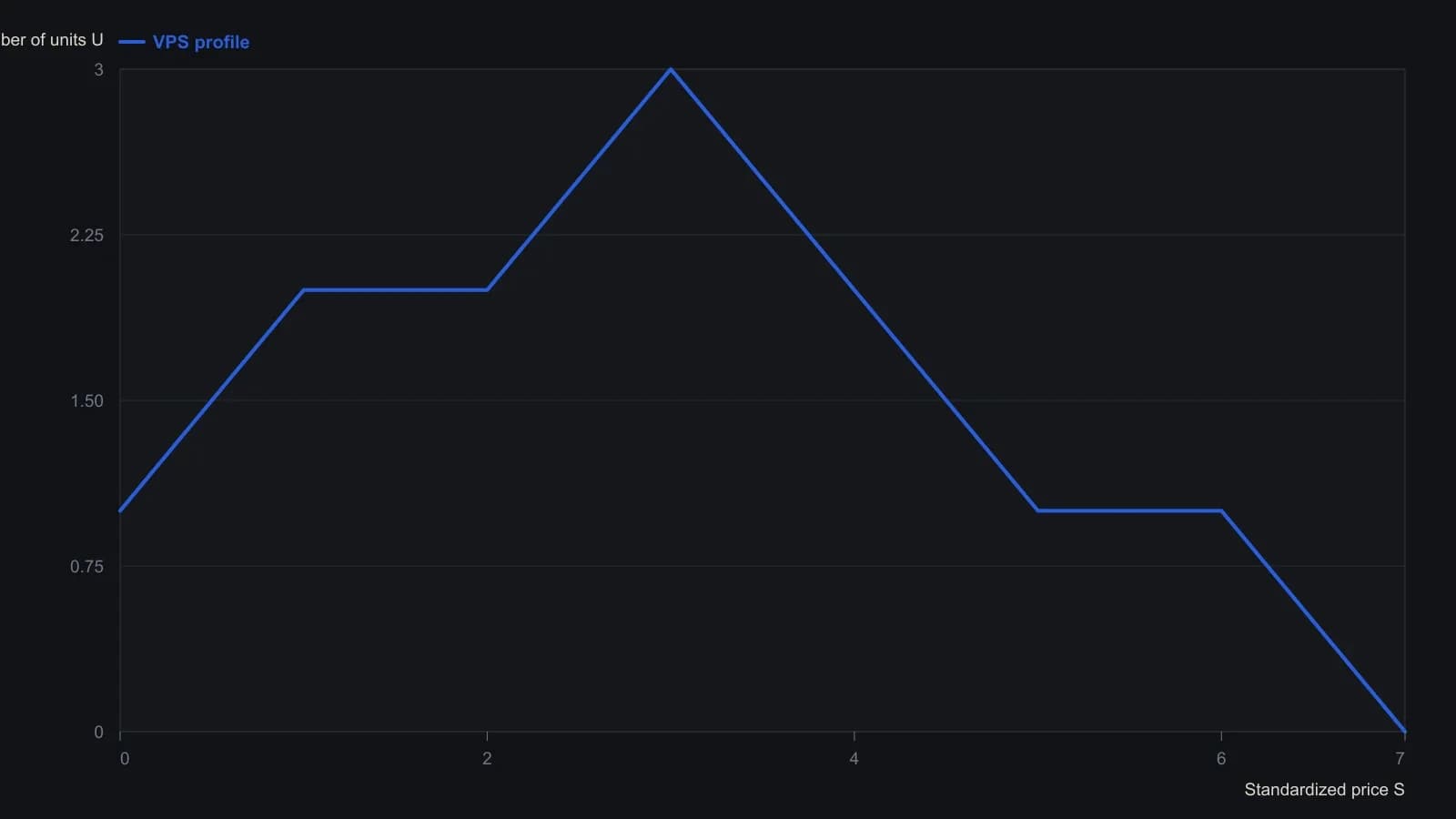
The unit count may change only when S makes a new favorable extreme; retracements leave size unchanged. This teaching profile caps U at 3 and changes size only at integer S.
All readings on this track · 21 readings
- 1987Volatility-layered mechanical system with fixed contracts
- 1994Starting capital from worst-case portfolio walk-forwards
- 1994Bound small-account risk before adding leverage
- 1996Variable position size after entry
- 1996Equity path filters for contract size and drawdown
- 1997Stop distance, equity caps, and trading halts
- 1999Size-matched buy-and-hold evaluation for stock systems
- 2002Size from stop distance to keep dollar risk even
- 2003Share size from daily profit equilibrium
- 2004Half-size energy futures as a pre-trade leverage filter
- 2007Equalizing contract risk in trend following
- 2007Expected-equity sizing and geometric drag
- 2007Predefine the loss before fixed contract sizing
- 2013Weekday, session, and market expectancy for contract size
- 2014Bounded leverage before you size a trade
- 2015Equal-dollar futures size and open-interest liquidity
- 2015Atomize trading decisions: discipline over complexity
- 2017Tiny bets, ruin risk, and mechanical scale
- 2018Near-strike weekly puts and unfunded assignment risk
- 2019Paper trading is unfinished without fill and size rules
- 2019Constructing futures leverage from margin and fixed size