2017issue C0425
The minimum-margin habit is not commodity-market risk
An archive critique of price-speculation in commodities traces extra risk to weak bounds and overused leverage, not to the market itself. One crude contract separates the exchange minimum from notional and treats a fully collateralized deposit as leverage-control.
- For price-speculation, the archive says commodity markets are not inherently riskier than equities. Extra risk is placed on weak bounds and overused leverage.
- One WTI crude contract is shown at about $3,500 of margin against roughly $50,000 of notional, with about $1,000 of profit or loss per $1 move. Posting only about 7% as collateral is presented as a path to losing most or all of the account quickly.
- Backing that same contract with a $50,000 deposit is presented as leverage-control that removes the contract's gearing and keeps the notional more fully collateralized.
- Editorial reading: leverage-control, margin-management, and an exposure-cap are one pre-trade filter. Equity, stop distance, and notional are set before entry so a one-dollar move is not automatically an account event.
Risk sits in behavior, not in the commodity market
For directional price-speculation rather than long-horizon ownership, the archive argues that commodity markets are not inherently riskier than equity markets. Price-speculation here means trading directional price change, as distinct from long-horizon ownership of a company.
The extra-risk reputation is located in participant behavior: weak risk bounds and overuse of available leverage, not in the commodity market itself. Futures accounts receive leverage at any size, while stock leverage is described as generally requiring a six-figure qualifying deposit plus interest on borrowed shares.
One crude contract at the exchange minimum
One WTI crude futures contract is illustrated at about $3,500 of margin against roughly $50,000 of notional, or 1,000 barrels. Notional is the full contract value that generates gains and losses, as distinct from the smaller margin deposit. That contract is shown with about $1,000 of profit or loss per $1 price change.
Posting only about 7% of that contract value as collateral is presented as leaving the account open to losing most or all of its money very quickly. Editorial critique: treating that exchange minimum as the position size is the habit under review, not a property of crude itself.
One WTI crude contract: notional vs. exchange minimum vs. full deposit
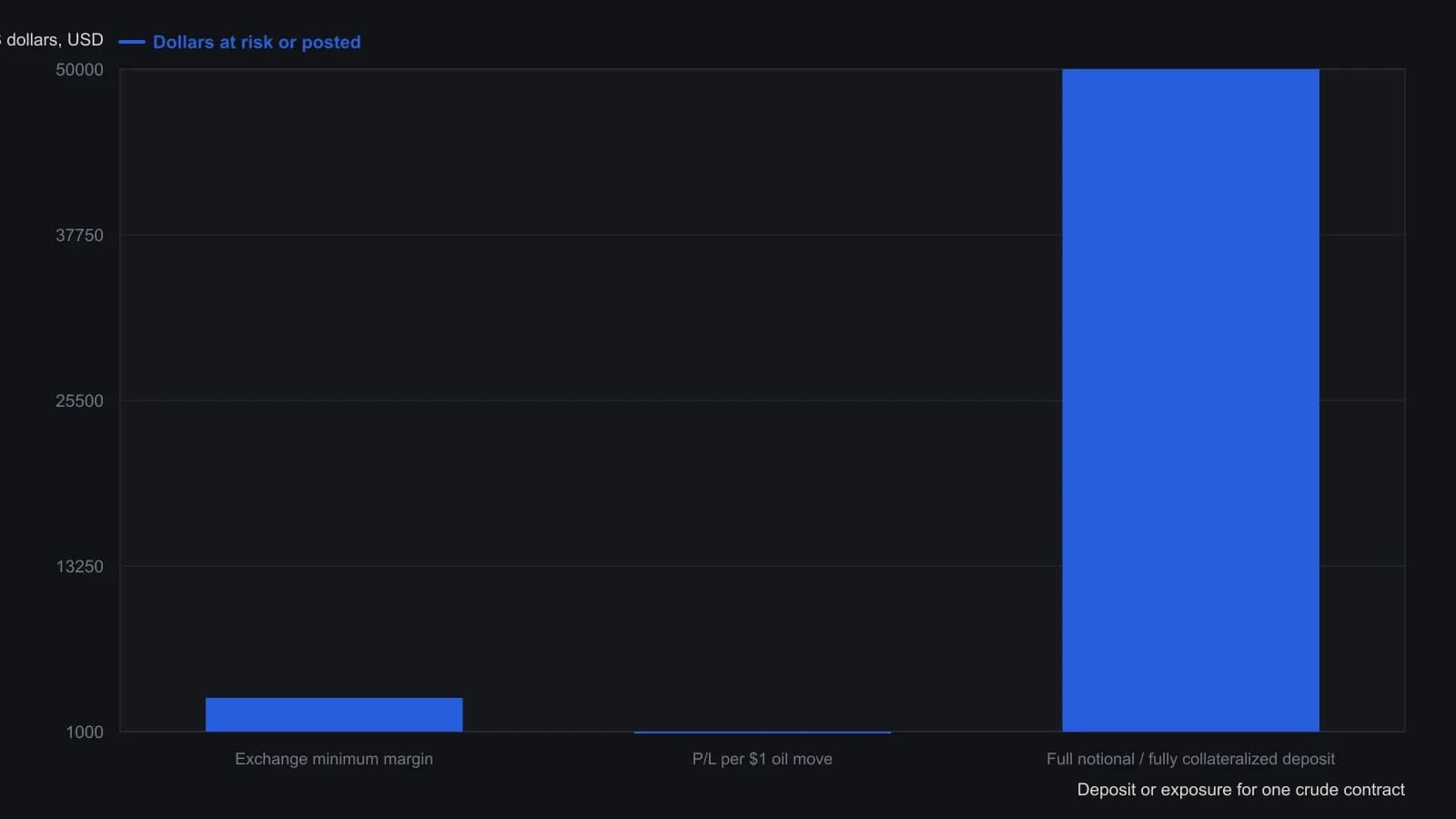
Oil notional is the article’s ‘roughly $50,000’ snapshot (1,000 barrels). The $3,500 exchange minimum and $1,000 P/L per $1 price change are stated as exact working numbers for that example.
The same contract with a full deposit
The same single crude contract backed by a $50,000 deposit is presented as a leverage-control choice. Leverage-control means backing a futures contract with more equity than the minimum so unused buying power is not converted into account-threatening size. In the archive illustration, that deposit essentially removes that contract's gearing and keeps exposure more fully collateralized.
Margin-management is choosing how much deposit sits behind a position so posted collateral reflects a bounded loss plan rather than the lowest allowed gate. An exposure-cap is a pre-trade limit on notional controlled relative to account equity, held through the life of the position.
Equities can fall to zero
The archive contrasts equities, which can fall to zero when firms fail, with commodities, which it says can become extremely cheap but have not been observed to reach zero.
Prices keep moving outside a cash session
Because prices continue to trade outside a single cash session, an uncapped leveraged futures position can change while the holder is not watching. Editorial reading: the exposure-cap is held through the life of the position for that reason, not only at entry.
All readings on this track · 6 readings
- 1988Name the stop, then decide if the account can pay
- 1988Limited-risk labels versus exposure and ruin
- 1992Risk of ruin and exposure caps as a pre-trade filter
- 1994When standing puts fail the drawdown test
- 2017The minimum-margin habit is not commodity-market risk
- 2018Evaluating a normalized risk index for drawdown and exposure limits