2003issue C041-5
Cash-covered split-synthetic after a decline
After a large decline, a long bias is built as a split-synthetic: writes of puts below the new share price, purchases of calls above it, and cash held for every assignment. The historical workflow treats strike placement, a put-heavy mix that can open for a credit, and reserved cash as the construction choices.
- After a large decline the package writes puts below the new share price and buys calls above it, often with more put contracts than call contracts so the opening cash flow can be a net credit.
- Expiration is flat between the two strikes and equals the opening net credit or debit; below the put strike the package is a larger long-share count through assignment, and well above the call strike a smaller long-share count through the calls.
- Strikes are placed with sigma-bars, then mixes of 2-to-1, 3-to-2, and 5-to-2 are scanned for a net credit with acceptable put exposure.
- Cash equal to buying the shares if every written put is assigned is set aside above the broker minimum, so assignment stays inside planned share-equivalent risk.
A share-like package after a decline
A synthetic-option-position is a share-like package built from listed puts and calls instead of buying the underlying today. After a large decline, the historical workflow opens that package as a split-synthetic: a two-strike construction that writes puts below the market and buys calls above it, leaving a flat expiration band between those strikes.
The long-put is the lower-strike put path that, if exercised against the account, delivers a long share position at a reduced net purchase price. Margin-management means holding cash sufficient to fund every written put, not only the broker minimum, so assignment stays inside planned exposure.
Strike split from sigma-bars
Puts struck below the new price are described as temporarily rich, and calls struck above it as relatively cheaper, in the days after a sharp drop when implied volatilities differ across strikes. A wait of two or three days is used before scanning the chain.
Strikes are placed with a volatility forecast. Sigma-bars are forecast-volatility price envelopes used to place the put below minus one standard deviation and the call inside plus one. The put sits below the minus-one-sigma price bar, and the call sits between the current price and the plus-one-sigma bar. One-, two-, and three-sigma bars are treated as about 67, 95, and 99 percent envelopes to expiration.
Contract mix and net-credit-opening
The put-call-ratio is the count of put contracts written versus call contracts bought when screening for a credit with bounded downside share-equivalent. Put-to-call contract mixes of 2-to-1, 3-to-2, and 5-to-2 are the combinations scanned for a net credit with acceptable put exposure.
A net-credit-opening means receiving more for the written puts than is paid for the purchased calls. After a large decline, the package is opened by writing puts struck below the new share price and buying calls struck above it, often with more put contracts than call contracts so the opening cash flow can be a net credit.
Option lifetime after the drop
Near-term puts are the usual lifetime right after a drop because those puts tend to be relatively expensive then. Longer-dated options are presented as a separate lifetime choice for longer share-like exposure.
Expiration payoff
At expiration the payoff is flat between the two strikes and equals the opening net credit or debit. Below the put strike the package is treated as a larger long-share count through assignment, and well above the call strike as a smaller long-share count through the calls.
Expiration P/L of the 3-by-2 split synthetic on ABCD
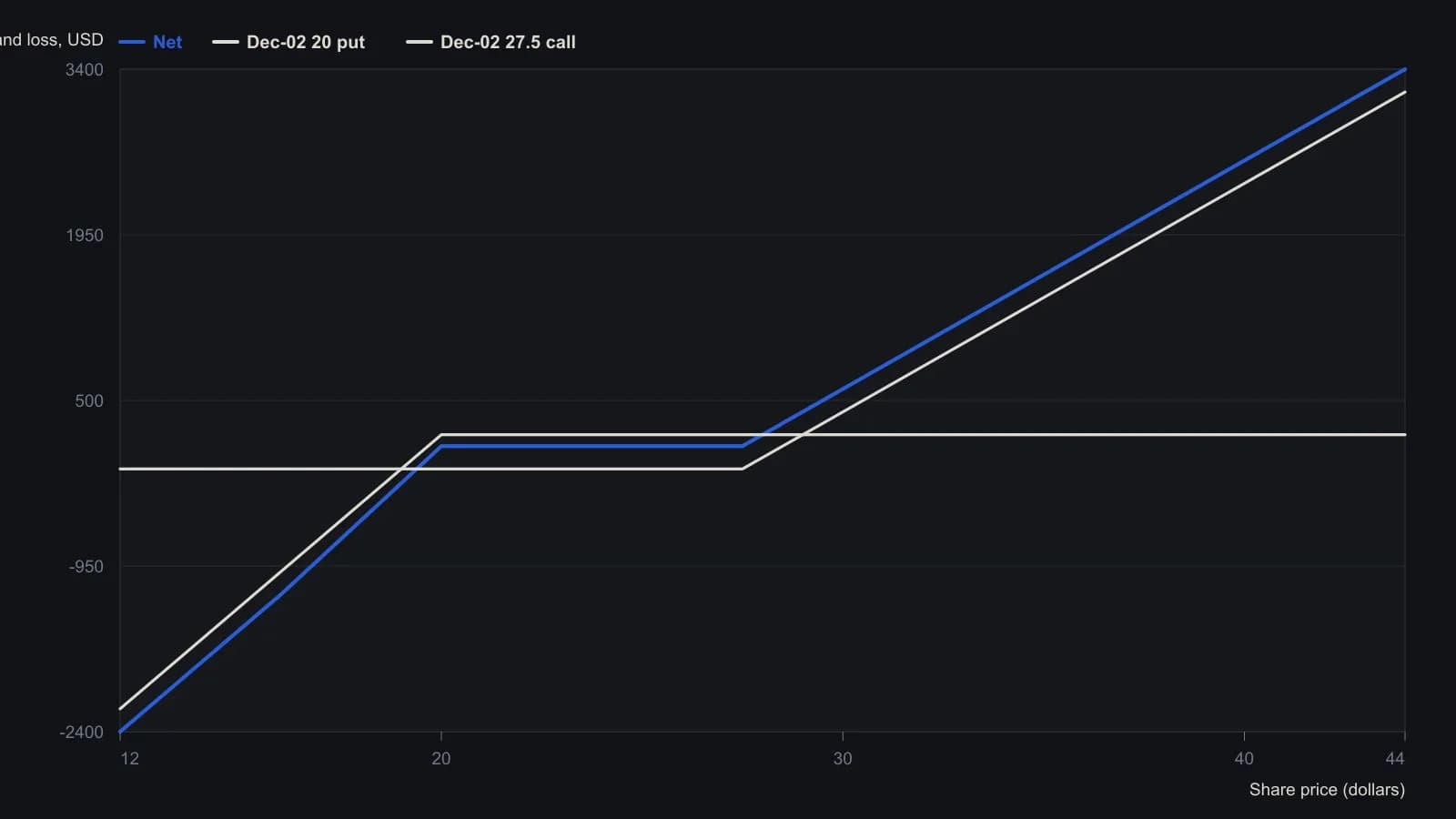
Coordinates are approximate readings off the raster, rounded to the nearest 100 dollars. The snapshot fixes ABCD at 25.15, implied volatility at 0.484, and projects P/L to 21 December 2002. Left-edge share price is inferred from the 20/30/40 labels and plot margins.
Worked numbers at a 25 share price
In the worked numbers, a 25 share price is paired with three 20-strike puts and two 27.50-strike calls. Assignment is shown near 19.50 after a 0.50 put premium, with about 300-share downside equivalence and about 200-share upside equivalence.
Cash for every written put
Cash equal to buying the shares if every written put is assigned is set aside, above the broker minimum, so the synthetic is treated as fully funded share-equivalent risk. That cash rule is the margin-management step: assignment is kept inside planned exposure rather than limited to the broker minimum.
The opening combination order
The opening order is specified as an all-or-none combination with a net credit or maximum debit limit, because with time remaining the package still tracks the stock. The illustration behaves like about 110 shares, or about 11 of combination value per 10 cents of share move.
All readings on this track · 16 readings
- 1990Synthetic option parity in limit-locked futures
- 1991Constructing synthetic option positions with puts and spreads
- 1991Synthetic stock and protective put payoff construction
- 1993Equivalent option strategies as a capital and execution checklist
- 1993Keep a futures loss bounded when stops fail
- 2001Financed call ratio repair for a gapped long
- 2003Synthetic long construction with delta and margin checks
- 2003Cash-covered split-synthetic after a decline
- 2004Constructing synthetic calls and puts with stock
- 2006In-the-money calls as bounded synthetic leverage
- 2006Credit construction of a synthetic long call via futures and a long put
- 2006Convert a support-and-resistance range into one synthetic option procedure
- 2007Long-call adjustment via a synthetic straddle
- 2008Constructing protective puts and synthetic option packages
- 2018An uneven vertical debit spread as a stock proxy
- 2020Out-of-the-money strikes as a delta budget for synthetic futures