2004issue C091-5
Half-size energy futures as a pre-trade leverage filter
Standard energy futures left no step below one full contract. Newly listed half-size crude-oil and natural-gas units lowered the minimum notional step and typical margin so account equity, posted collateral, and stop distance could be kept inside a loss budget before entry.
- Energy futures were historically a single large unit, so unlike stocks the smallest step of risk was one full contract.
- Half-size crude-oil and natural-gas units cut the minimum notional step and typical margin roughly in half for speculation and energy-cost hedges.
- Over 1997-2001, energy futures were characterized as several times more volatile than equity-index, eurodollar, and Treasury-bond futures.
- A smaller listed unit still needs a margin and stop plan that can absorb incomplete fills and keep posted margin inside a pre-set account limit.
The listed unit is the smallest step of risk
Standard futures were historically offered as a single large unit, so unlike share-based stock positions a trader could not scale energy exposure below one full contract. Fixed contract sizing expresses exposure only in whole listed units, which means the smallest step of risk is the contract specification itself.
Initial margin set a cash floor
Full-size equity-index futures were described as requiring more than 16000 dollars of initial margin, while energy contracts still asked for more than 3000 dollars on crude-related products and nearly 6750 dollars on natural gas. Initial margin is the exchange collateral required to open one listed futures unit, and it sets a hard cash floor on whether that contract can be traded at all.
New or undercapitalized traders were described as unable to carry even one full energy contract without pooling capital, with natural-gas margin the steepest hurdle in that complex.
Half-size energy units change size, not the market
Newly listed energy minis were specified at half the size of their full-size counterparts. A half-size energy unit is a listed crude-oil or natural-gas future specified at half the quantity of the standard contract, cutting the minimum notional step and typical margin roughly in half. That change lowered the minimum notional step for both speculative accounts and hedges of energy-related costs.
Mini energy contracts were expected to move with their full-size twins except for brief, arbitrageable dislocations, so the smaller unit functions as a size and leverage choice rather than a different market.
July e-miNY crude-oil daily closes
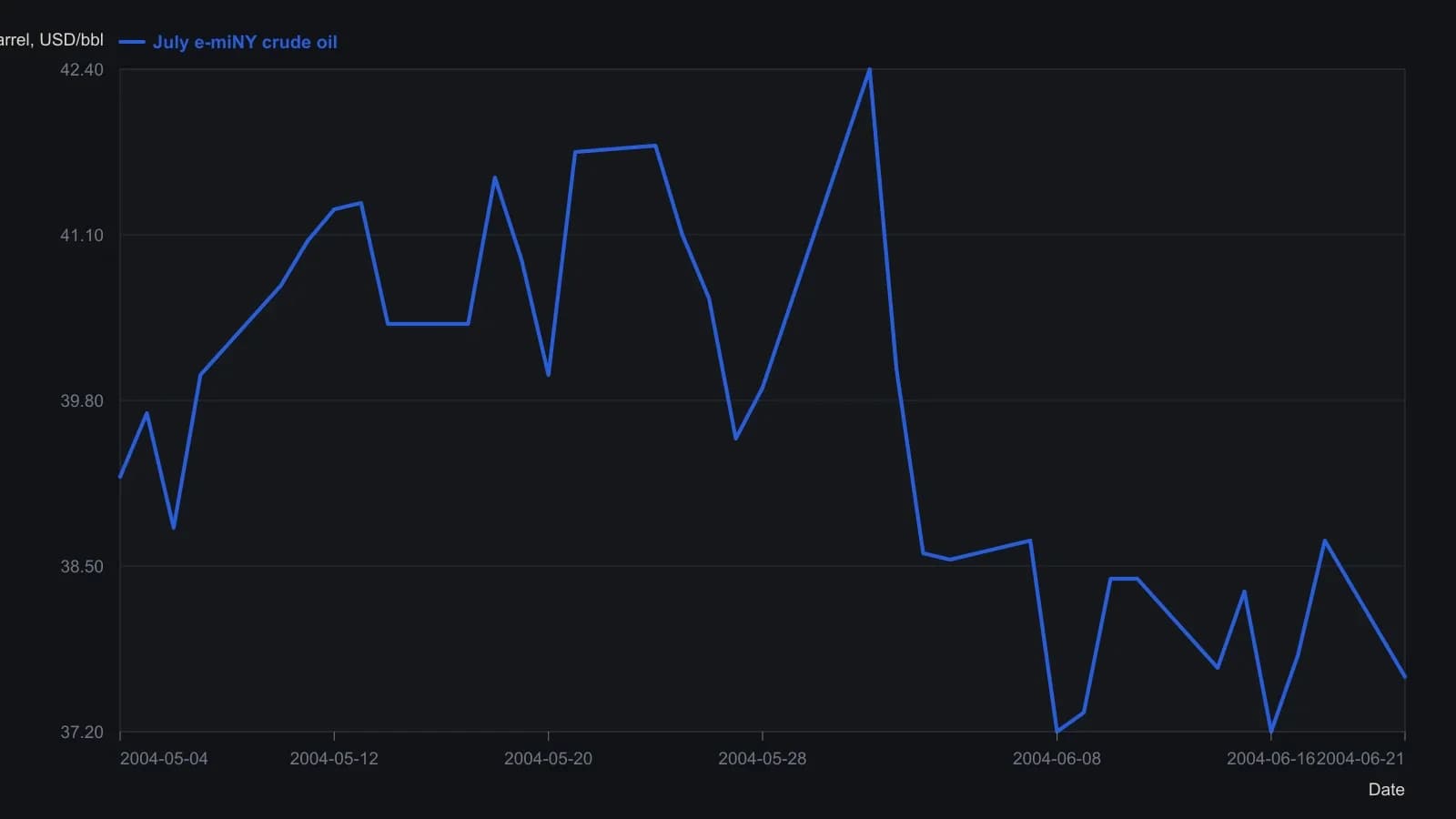
Closes were digitized from the daily candlestick raster and are approximate to about 0.10 dollars. The platform printed 37630 for the last close, taken as 37.63 dollars per barrel. Session dates were inferred from the May–June axis labels and the 2004 futures calendar, omitting Memorial Day.
Energy volatility relative to other futures
For 1997-2001, crude-oil futures were characterized as about twice as volatile as a broad equity-index future and three to four times as volatile as eurodollar and Treasury-bond futures. Over that same 1997-2001 span, natural-gas futures were characterized as about three times as volatile as the equity-index future and more than five times as volatile as eurodollar and Treasury-bond futures.
Editorial view: that volatility relative to benchmarks is a reason to settle leverage control before entry, by keeping notional energy exposure a bounded multiple of account equity through a smaller listed unit, a wider cash buffer, or both.
Keep the bound for the life of the position
A later common view held that commodity accounts needed at least 20000 dollars, against an older rule of thumb built around 5000 dollars. Smaller listed energy units were presented as a way to keep that equity-to-contract ratio from forcing oversized leverage.
If a new mini product is slow to attract volume, short-term charts may show unfilled prices and gaps, so a smaller listed unit still needs a margin and stop plan that can absorb incomplete fills.
Editorial view: margin management is the follow-through step. Size and monitor the position so posted margin and planned stop distance remain inside the same pre-set account limit from entry through exit.
All readings on this track · 21 readings
- 1987Volatility-layered mechanical system with fixed contracts
- 1994Starting capital from worst-case portfolio walk-forwards
- 1994Bound small-account risk before adding leverage
- 1996Variable position size after entry
- 1996Equity path filters for contract size and drawdown
- 1997Stop distance, equity caps, and trading halts
- 1999Size-matched buy-and-hold evaluation for stock systems
- 2002Size from stop distance to keep dollar risk even
- 2003Share size from daily profit equilibrium
- 2004Half-size energy futures as a pre-trade leverage filter
- 2007Equalizing contract risk in trend following
- 2007Expected-equity sizing and geometric drag
- 2007Predefine the loss before fixed contract sizing
- 2013Weekday, session, and market expectancy for contract size
- 2014Bounded leverage before you size a trade
- 2015Equal-dollar futures size and open-interest liquidity
- 2015Atomize trading decisions: discipline over complexity
- 2017Tiny bets, ruin risk, and mechanical scale
- 2018Near-strike weekly puts and unfunded assignment risk
- 2019Paper trading is unfinished without fill and size rules
- 2019Constructing futures leverage from margin and fixed size